Garage Door Opener Showdown: Chain vs. Belt vs. Wall-Mount Jackshaft (Which One Belongs in Your Shop?)

Rattling chain openers shake ceiling joists and wake sleepers upstairs. Compare chain, belt, and wall-mount jackshaft drives for noise, ceiling headroom, and safety.
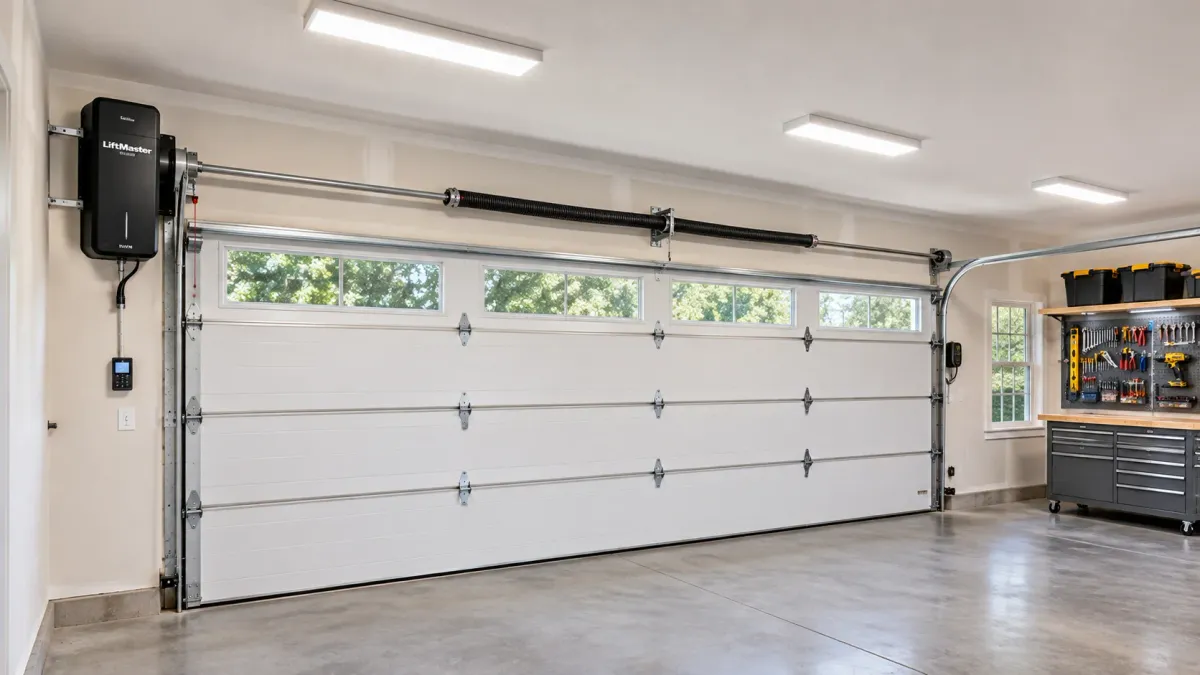
Table of Contents5 Sections
You pull into your driveway after a long shift, press the visor remote button to open the door, and hear a harsh metallic clatter echo through the framing of your house. The heavy steel drive chain whips against its stamped steel rail, the alternating-current motor hums loudly, and you know you just woke everyone sleeping in the master bedroom directly overhead.
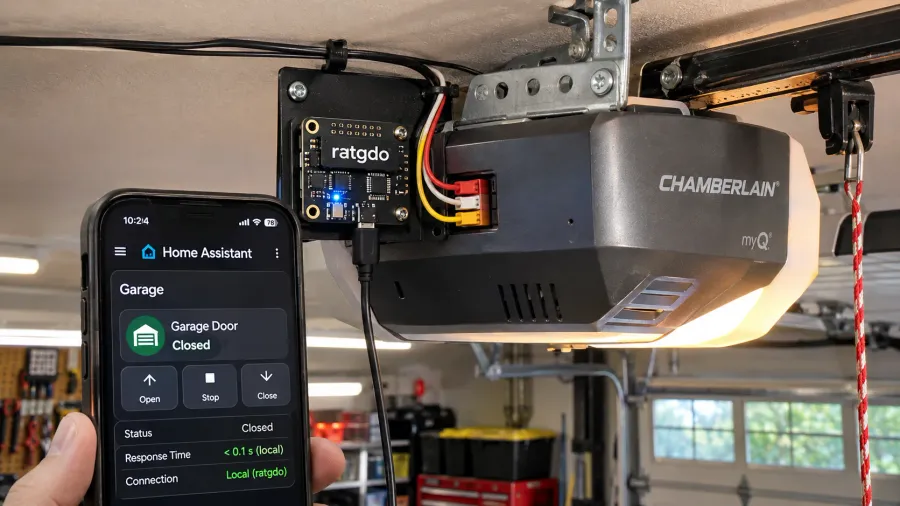
Builder-grade chain-drive garage door openers are noisy relics of 1980s mechanical engineering. Beyond the deafening operational noise, a traditional center-mounted trolley motor hangs directly in the middle of your ceiling space, blocking overhead storage racks, interfering with car lifts, and creating a spiderweb of angled iron brackets.
I spent decades diagnosing mechanical drives, servicing overhead systems, and setting up residential workshops. In this guide, I break down the physical difference between airborne noise and structure-borne vibration, compare modern drive options across real workshop metrics, and explain why wall-mount jackshaft openers have become the preferred choice for serious DIY workspaces.
The Noise Anatomy: Airborne Sound vs. Structure-Borne Vibration
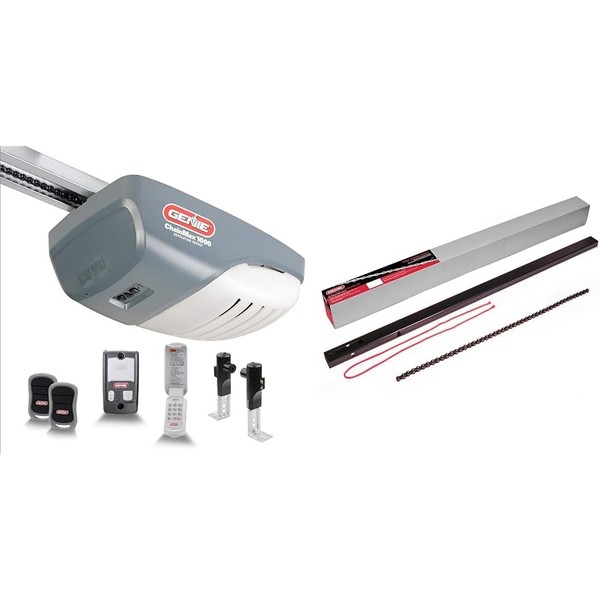
Genie ChainMax 1000 Heavy-Duty Chain Drive Garage Door Opener (Model 3022)
Best For: Heavy solid-wood or uninsulated commercial carriage house doors in detached shops
Est. Price: $219.00
"If your garage is detached from your living quarters and you have a heavy carriage door, this chain-drive unit provides brute lifting power for fifty dollars less than belt drives."
- +140V DC motor combined with rugged steel chain delivers bulletproof lifting reliability
- +C-channel steel rail assembly will not flex under sudden door weight shifts
- +Dual-bulb 100W equivalent lighting system floods the parking bay cleanly
- -Audible metal chain clatter transmits structure-borne vibration into living areas
- -Requires periodic chain slack inspection and lithium spray maintenance
When a garage door opener operates, it creates two completely different types of sound energy that travel through your house framing in different ways.
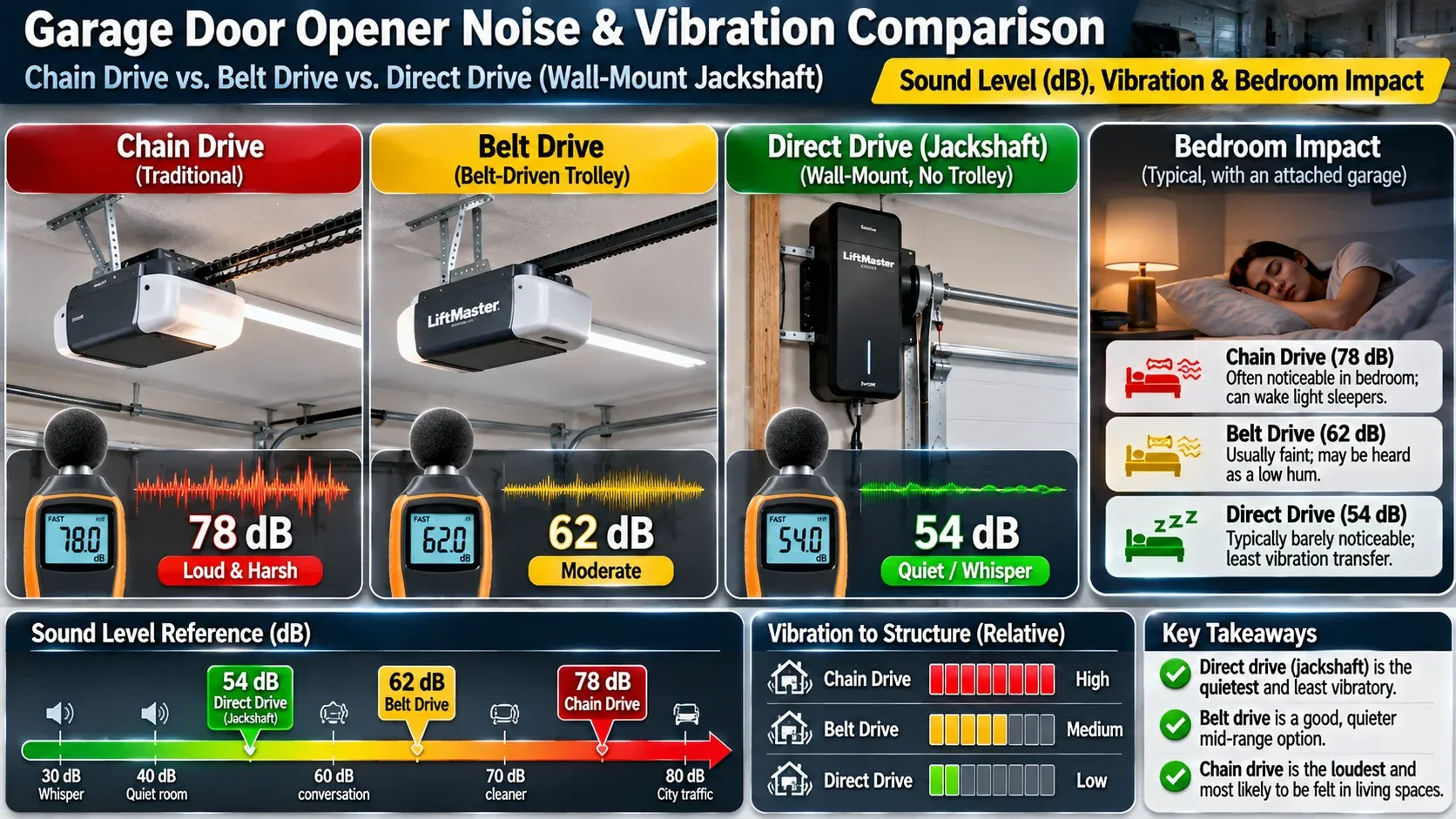
Acoustic comparison infographic chart showing sound levels of garage door openers, decibel sound wave meter comparing chain drive (78 dB harsh red), belt drive (62 dB yellow), and direct drive wall-mount jackshaft (54 dB whisper green), bedroom vibration impact icons.
Airborne noise refers to the clinking of steel bicycle chain links sliding across a hollow steel rail and the whir of unsealed motor bushings. You hear this sound while standing inside the garage, but sound-dampening wall insulation stops most airborne frequencies from penetrating living spaces.
Structure-borne vibration represents the true culprit that shakes upstairs bedrooms. Traditional openers bolt their motor housing directly to wooden ceiling joists using steel angle iron.
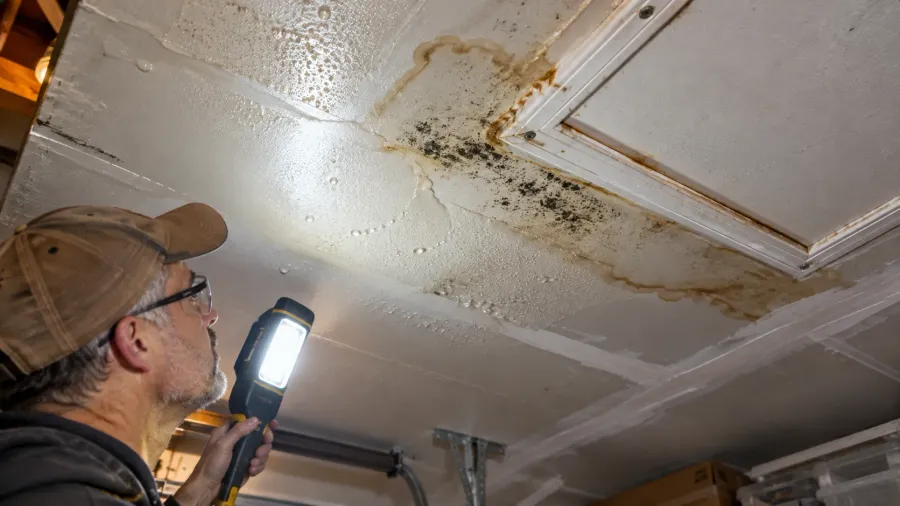
As an older AC motor struggles to lift a cold door, it transfers low-frequency rotational harmonic vibrations directly into the wooden floor joists above. Those wooden joists act like the soundboard of an acoustic guitar, amplifying the hum into a deep bass rumble that travels through flooring, bed frames, and walls.
Modern DC-powered motors solve this problem by incorporating soft-start and soft-stop electronic programming. The motor ramps up speed gradually over two seconds and decelerates smoothly before the door reaches the floor, eliminating the violent jolt that shakes residential ceiling joists.
Garage Door Opener Drive Comparison: Chain vs. Belt vs. Wall-Mount Jackshaft
Comparing operational decibel levels, ceiling clearance impact, price, and security locking features.
Heavy-Duty Chain Drive
Detached outbuildings or garages without living space above
- Maximum pulling power for heavy carriage house wood doors
- Loudest operational sound and severe ceiling structure vibration
Steel-Reinforced Belt Drive
Attached garages with bedrooms situated directly overhead
- Whisper-quiet operation and smooth DC motor deceleration
- Still occupies the center 10 feet of your ceiling overhead space
Wall-Mount Jackshaft Drive
Workshops with car lifts, overhead racks, or high ceilings
- Completely frees your ceiling and includes automatic deadbolt lock
- Requires torsion spring system and strict door balance calibration
Why the Wall-Mount Jackshaft Is the DIYer’s Dream Machine
Besides freeing up center ceiling space for overhead lumber storage, a jackshaft mounts directly to the torsion tube. Because it lacks an overhead trolley and pull-cord release, it inherently eliminates the risk covered in my guide on stopping the 6-second coat hanger garage break-in.
If you treat your garage as a dedicated workshop rather than a simple parking stall, ceiling real estate is precious. A traditional ceiling-mounted opener monopolizes a ten-foot by two-foot strip of overhead space right in the structural center of your bay.
That hanging motor prevents you from installing a portable vehicle lift like a QuickJack, blocks overhead lumber racks, and prevents you from mounting overhead fluorescent or LED fixtures where you need them most.
A wall-mount jackshaft opener, such as the LiftMaster 8500W series, mounts flush against the wall directly beside the garage door opening. The motor slides over the end of the one-inch steel torsion tube, rotating the spring bar directly to wind the lift cables and raise the door without any overhead rail, trolley, or hanging center bracket.
By moving the mechanical drive to the side wall, your entire ceiling opens up for overhead storage, tall project assembly, or car lift clearance. Jackshaft units also include an automatic motorized deadbolt that drives a heavy steel pin through the track whenever the door closes, physically locking the door to prevent intruders from prying the bottom panel open with a crowbar.
The Jackshaft Prerequisite Checklist: Can Your Garage Handle It?
Modern wall-mount operators comply with Underwriters Laboratories UL 325 safety standards for residential garage door openers, which mandate automatic cable tension monitors and secondary auto-reverse safety sensors.
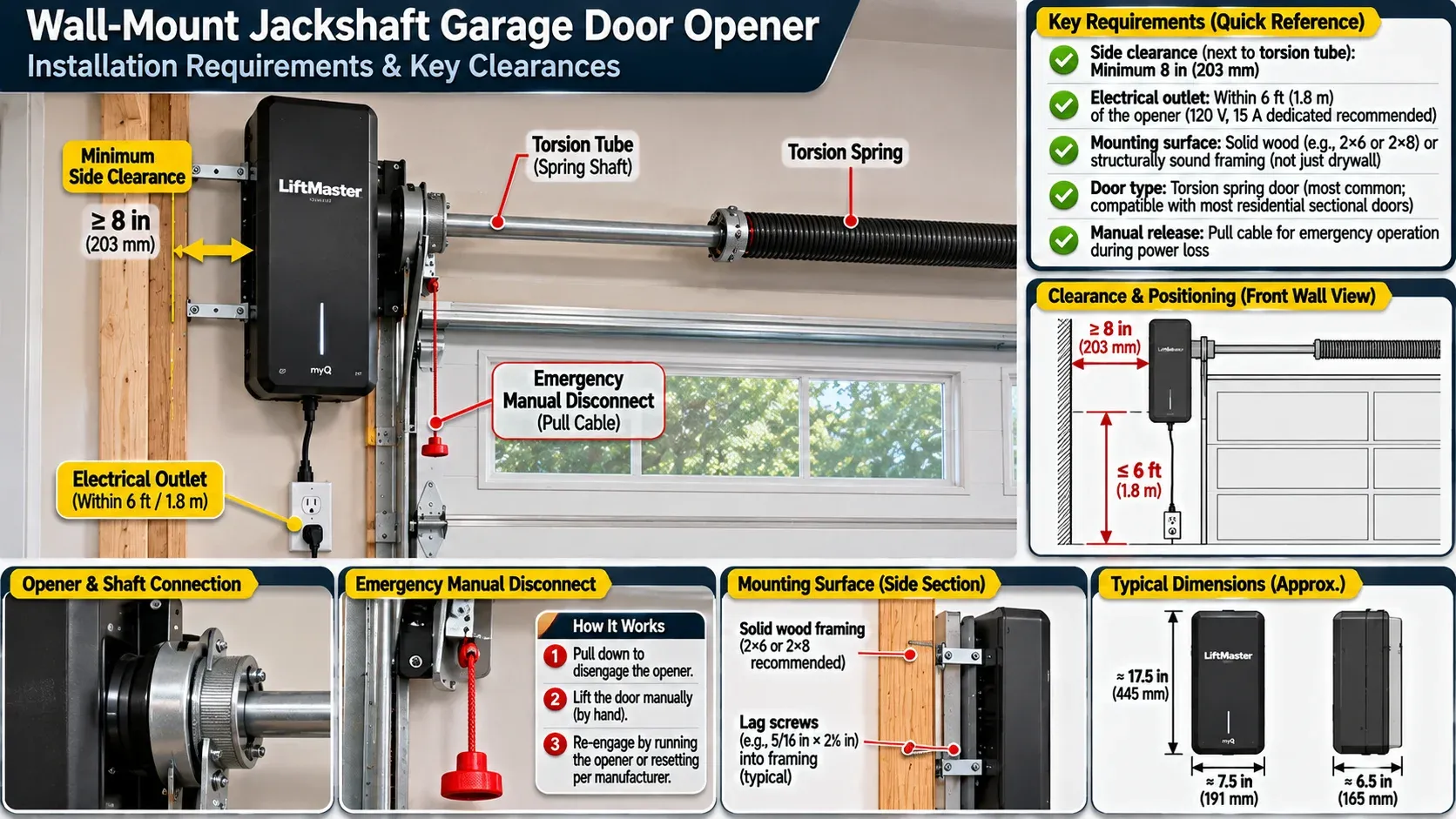
Before ordering a wall-mount opener, you must verify four critical mechanical conditions in your garage to ensure safe and reliable operation.
Condition 1: Torsion Spring Overhead System (MANDATORY)
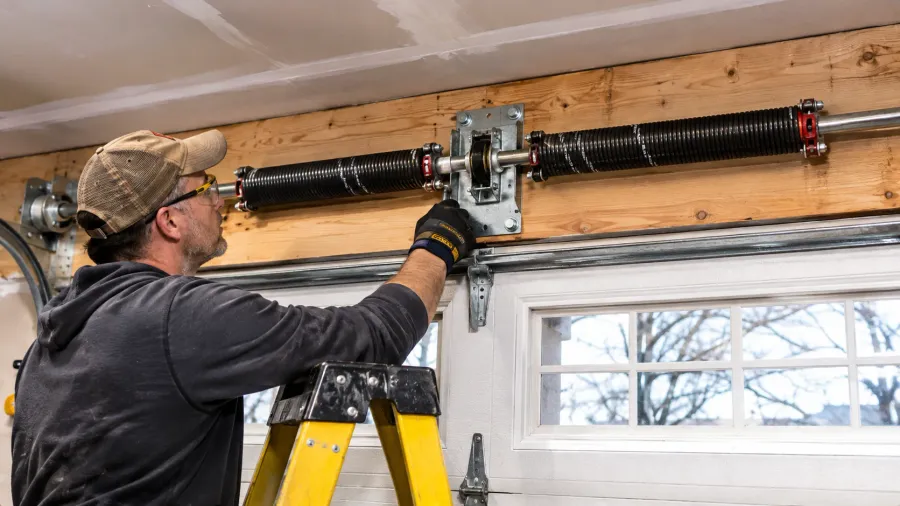
Jackshaft openers turn the overhead torsion bar directly. They cannot operate on doors equipped with side-mounted extension springs that stretch along the horizontal tracks. If your garage features extension springs, you must hire a professional door technician to convert the door to a standard front-mount torsion spring system first.
Technical compatibility guide photo showing overhead garage door spring mechanisms, green check on solid 1-inch torsion spring shaft ready for jackshaft collar, red X over side extension springs with warning callout, clear DIY educational visual.
Condition 2: Wall Clearance Dimensions
The opener motor housing mounts onto the steel torsion tube projecting past the outer bearing plate. You must have at least eight inches of clear wall space between the vertical track and the nearest side wall or obstruction, plus three inches of clear shaft extending from the torsion bracket.
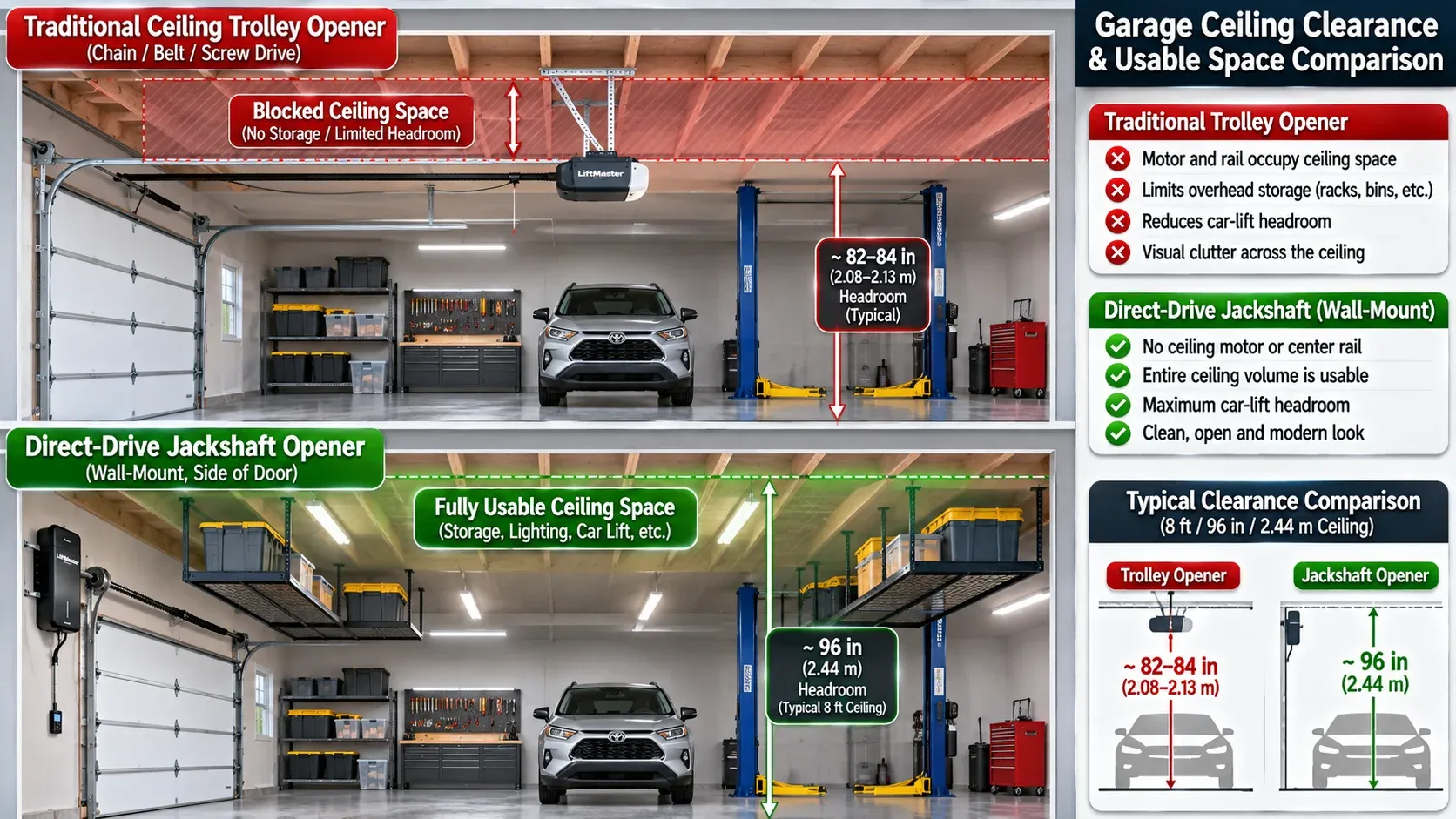
Architectural cross section comparison of garage ceiling clearance, top diagram showing traditional center ceiling trolley motor blocking upper overhead storage and car lift headroom, bottom diagram showing direct-drive jackshaft opener mounted on front wall freeing up entire ceiling volume, CAD styling.
Condition 3: Proximity to an Electrical Outlet
Jackshaft openers plug into a standard 120-volt grounded electrical receptacle. The factory power cord measures six feet in length, meaning you need an electrical outlet mounted within three feet of the upper door corner on the motor side.
Condition 4: Perfect Manual Door Balance
A center-mount trolley can push a poorly balanced, heavy door downward through sheer mechanical force. A jackshaft opener simply turns the torsion bar; if the door balance is off, the lift cables can go slack when the bottom panel contacts the concrete, jumping off the cable drums and wedging the door crooked in the frame.
Test your door balance manually: disconnect the existing opener, lift the door halfway up by hand, and release it. The door should hover suspended at waist height without drifting downward toward the slab or shooting upward toward the ceiling.
The Bottom Line: The Smart Money Move
If your garage has an eight-foot ceiling, you park two family vehicles inside, and bedrooms sit directly over the garage, purchase a steel-reinforced belt-drive opener like the Chamberlain B4613T. You get near-silent operation, integrated battery backup, and smartphone connectivity for under three hundred dollars.
If you plan to turn your garage into a serious automotive or woodworking bay, have ceilings ten feet or higher, or want to install ceiling storage racks, spend the extra money on a wall-mounted jackshaft unit. Freeing the center of your ceiling transforms the usable volume of your workshop immediately.
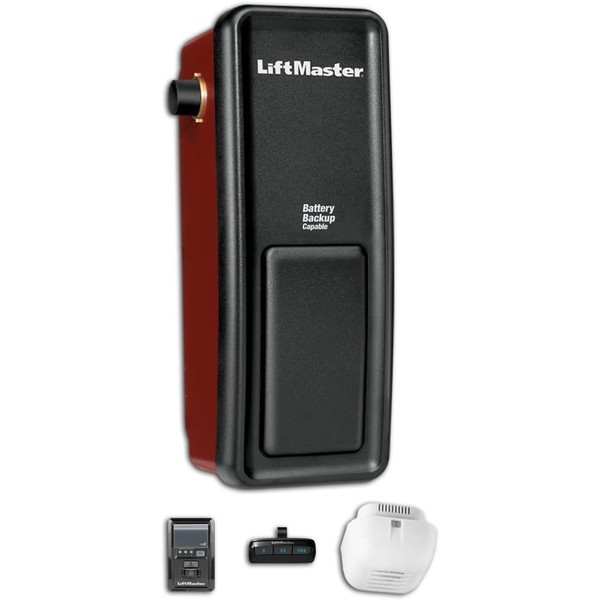
LiftMaster 98022 Next-Gen Wall Mount Wi-Fi Opener (with Battery Backup & LED)
Best For: Garages with car lifts or overhead storage needs
Est. Price: $480 - $550
"The definitive workshop garage opener that unlocks your entire ceiling while operating with whisper-quiet smoothness."
- +Directly turns torsion bar, freeing 100 percent of central ceiling space
- +Ultra-quiet DC motor eliminates structure-borne floor vibration
- +Includes automatic power deadbolt lock for maximum break-in security
- -Only compatible with torsion spring systems (not extension springs)
- -Demands precise door balancing to avoid cable slack issues
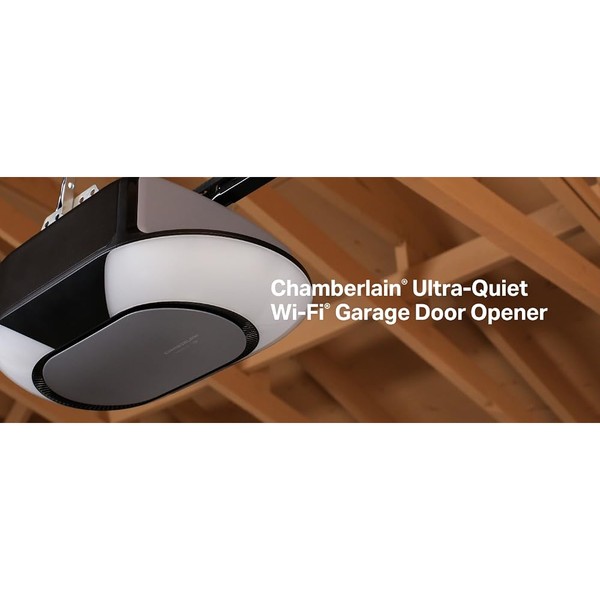
Chamberlain B4613T Smart Quiet Belt Drive Opener
Best For: Standard ceiling garages with living space above
Est. Price: $240 - $280
"The gold standard residential replacement opener for eliminating rattling chain noise without spending commercial money."
- +Steel-reinforced polyurethane belt operates almost silently
- +Built-in battery backup keeps door functioning during power outages
- +Integrated wide-angle security camera and bright LED lighting
- -Traditional center-mount trolley rail occupies overhead ceiling space
- -Rail assembly requires careful tensioning to prevent belt slap
Completing Your Garage Sound and Ceiling Upgrades
Upgrading to a quiet opener is only half the battle when silencing an older overhead system.
Pair your new drive with our lubrication and maintenance protocol in stop spraying WD-40 on your garage door to swap out rattling steel rollers for quiet nylon bearings.
Once your new jackshaft opener clears out the center of your ceiling, take full advantage of that open overhead space by reviewing our structural installation guide for mounting overhead garage storage racks safely.

Hank Miller
Hank is a master craftsman and DIY mechanic based in Ohio. He tests workshop equipment, garage floor coatings, and power tools under brutal, real-world workshop conditions, with zero paid brand sponsorships.