How to Remove a Rounded or Broken Bolt Without Buying a $300 Tool Truck Set

Heard that sickening snap or felt your wrench round off a frozen caliper bolt? Put the tools down, step back, and follow this 4-stage mechanical rescue ladder.
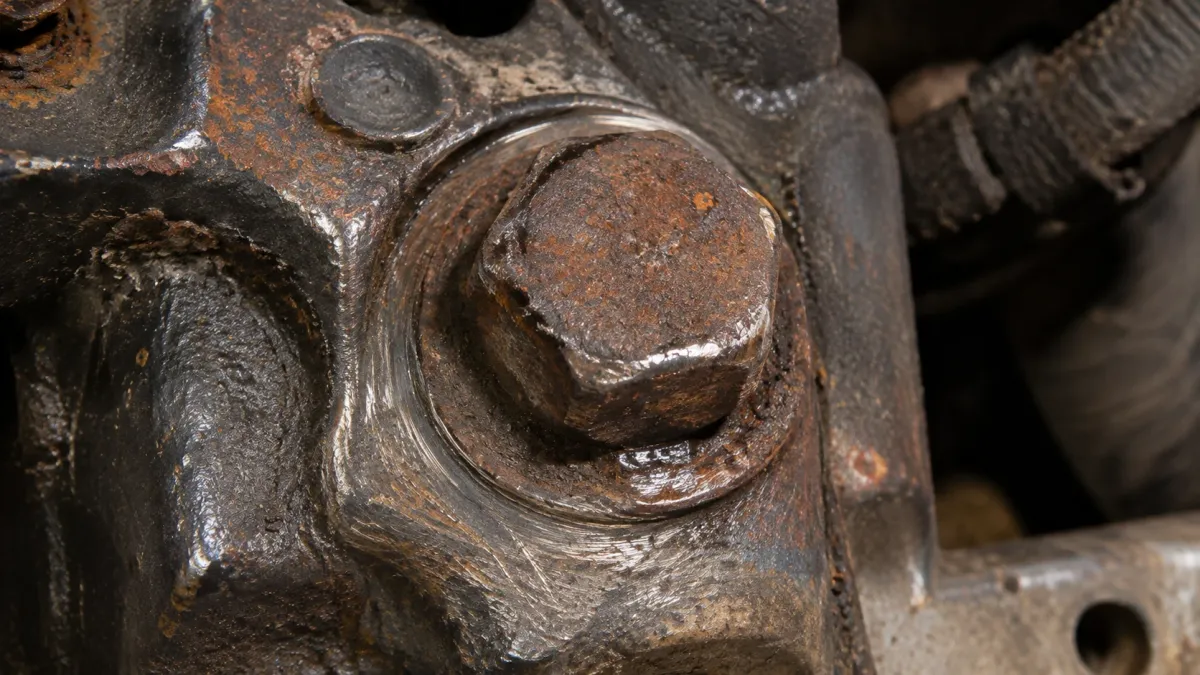
Table of Contents8 Sections
- 01.The 4 Stages of Fastener Hell: Stop Before You Make It Worse
- 02.Stage 1: The Chemistry of Unfreezing Rust (Kroil vs. The 50:50 Brew)
- 03.Stage 2: Reverse-Spiral Twist Sockets (The Right Way to Bite)
- 04.Stage 3: Why Left-Hand Drill Bits Beat Traditional Spiral EZ-Outs
- 05.Stage 4: When Fasteners Snap Deep (Straight-Flute Extraction)
- 06.3 Costly Mistakes That Turn a $2 Bolt into a $500 Machine Shop Bill
- 07.The Bottom Line on Broken Fasteners
- 08.Clamping and Supporting Your Extraction Work
You pull hard on a combination wrench to break a brake caliper bolt free, feel a sudden mushy slip, and look down to find the hex corners shaved into a smooth, shining metal dome. That sickening feeling hits every DIY mechanic eventually, and panic usually drives folks to grab locking pliers and make the damage twice as bad.
Stop right there and take your hands off the tool. A rounded or seized fastener is a standard mechanical puzzle with a methodical solution, provided you do not mangle the metal past the point of recovery.
You do not need a $300 specialty set off a professional tool truck to pull rounded fasteners out of engine blocks and chassis brackets. Follow this 4-stage rescue ladder to break that frozen hardware loose cleanly.
The 4 Stages of Fastener Extraction
Identify your current fastener condition and jump to the correct mechanical tool.
Creep Oil & Thermal Shocking
Rusty chassis bolts that have not rounded off yet
- Penetrates microscopic thread clearance
- Dissolves surface rust without cutting metal
- Demands 15 to 30 minutes of soak time
- Useless once corners are completely rounded off
Reverse-Spiral Twist Sockets
Severely rounded hex bolts with accessible exterior heads
- Internal tapered flutes bite deeper as you turn counterclockwise
- Grabs 85% rounded heads
- Extracting the chewed bolt head out of the socket afterwards requires a punch pin and bench vise
Cobalt Left-Hand Drill Bits
Fasteners broken off flush inside threaded housings
- Counterclockwise cutting torque frequently spins the broken stub out while drilling the pilot hole
- Demands dead-center punch alignment
- Dulls rapidly if you spin drill at high RPM
Straight-Flute Multi-Spline Extractors
Deeply recessed broken bolts in cast iron engine blocks
- Drives into pre-drilled holes without expanding bolt walls outward like tapered spiral EZ-outs
- Requires precise pilot drill diameter
- Brittle under sudden impact gun shocks
The 4 Stages of Fastener Hell: Stop Before You Make It Worse
Every catastrophic bolt extraction disaster began as a simple stuck fastener that someone tried to force. Mechanics recognize four escalating stages:
- Stage 1 (Seized): The hex corners remain crisp, but thread corrosion bonds the steel bolt into cast iron or aluminum threads.
- Stage 2 (Rounded): The wrench slipped, chewing the six hexagonal points into a cone.
- Stage 3 (Snapped Flush): Over-torquing sheared the bolt shank clean off at the housing face.
- Stage 4 (Terminal): A cheap, brittle extractor bit snapped off inside the broken shank, leaving glass-hard high-speed tool steel trapped inside the hole.
Your single goal is resolving the bolt at its current stage without kicking it into the next level of misery. Once you break a tap or cheap spiral extractor inside a bolt hole, standard drill bits will skate off the hardened tool steel, turning a 20-minute job into a trip to an automotive machine shop.
Stage 1: The Chemistry of Unfreezing Rust (Kroil vs. The 50:50 Brew)
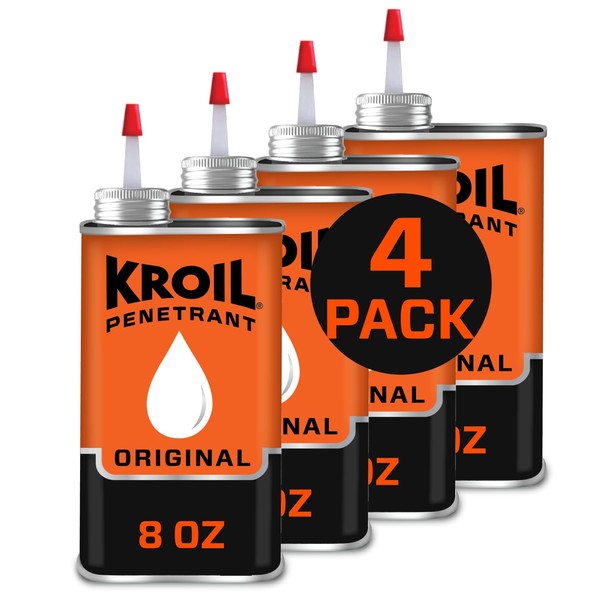
Kano Kroil Original Penetrating Oil (8 oz Liquid Can)
Best For: Creeping into sub-micron thread gaps and dissolving seized rust
Est. Price: $19.95
"The undisputed king of penetrating oils in commercial maintenance shops; soaking a frozen fastener in Kroil cuts break-away torque in half."
- +Ultra-low surface tension wicks uphill into frozen fastener threads
- +Breaks chemical rust bonds that ordinary aerosol oils cannot penetrate
- +Safe on aluminum heads and structural iron casings
- -Distinct chemical aroma lingers in enclosed garages for several hours
- -Costs more per ounce than generic hardware store aerosol sprays
Standard multi-purpose lubricants like blue-can WD-40 do not dissolve rust. They act as light water displacers, lacking the capillary action required to travel through microscopic pitch clearances on seized threads.
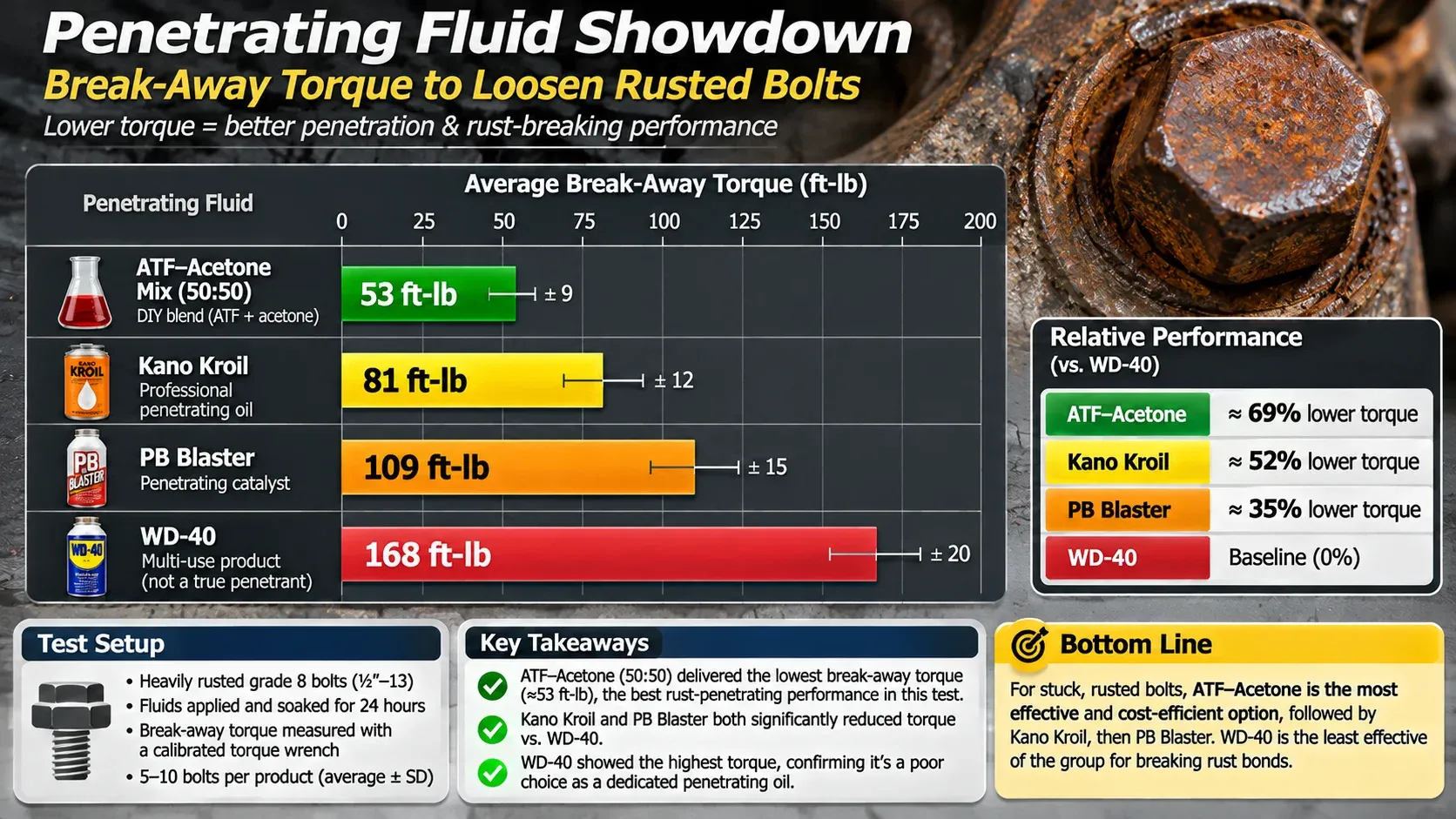
Clean infographic chart showing break-away torque required to loosen rusted bolts across different penetrating fluids, horizontal bar graph comparing WD-40 vs Liquid Wrench vs PB Blaster vs 50/50 ATF Acetone mix, modern clean dark mode technical styling, clear legible numbers in ft-lbs.
Independent dynamometer breakaway tests measure the real mechanical force required to break rusted Grade-8 bolts:
| Penetrant Formula | Average Breakaway Torque Required | Mechanical Advantage |
|---|---|---|
| Dry / No Lubricant | 516 ft-lbs | Baseline seizure |
| Standard Multi-Purpose Spray (WD-40) | 460 ft-lbs | Minor 10% reduction |
| PB Blaster Penetrating Catalyst | 355 ft-lbs | Good 31% reduction |
| Kano Kroil Micro-Creep Oil | 325 ft-lbs | Excellent 37% reduction |
| 50:50 Acetone and Automatic Transmission Fluid (ATF) | 214 ft-lbs | Outstanding 58% reduction |
You can brew the most effective penetrant in your garage for less than $10. Mix equal parts standard Acetone and Dexron III Automatic Transmission Fluid in a dedicated chemical-resistant pump oiler.
Acetone features an extremely low viscosity and surface tension, allowing it to wick deep into microscopic rust pores while dragging the high-film-strength petroleum lubricants of ATF behind it. Shake the mixture vigorously right before spraying, soak the fastener threads, and wait a full 15 minutes before applying your breaker bar.
Pair penetrant with heat to double your success rate. Aim a small propane torch directly at the surrounding aluminum or cast iron housing for 45 seconds to expand the threaded bore outward before turning the fastener.
Stage 2: Reverse-Spiral Twist Sockets (The Right Way to Bite)
Conforming to ASME B18 specifications for standard threaded fasteners and sockets, hardened chrome molybdenum extractor flutes cut counterclockwise into rounded hex heads, generating maximum bite as removal torque increases.
When the hex corners round off, throw your open-end wrenches and locking pliers back in the drawer. Locking pliers lack parallel jaw contact, crushing the bolt head into an irregular egg shape that ruins your chances with precision extractors.
Reach for a reverse-spiral twist socket. These sockets feature left-handed spiral internal flutes machined from hardened chrome-molybdenum steel. As you turn counterclockwise, the spiral flutes cut into the circular perimeter of the bolt head, wedging tighter the harder you push.
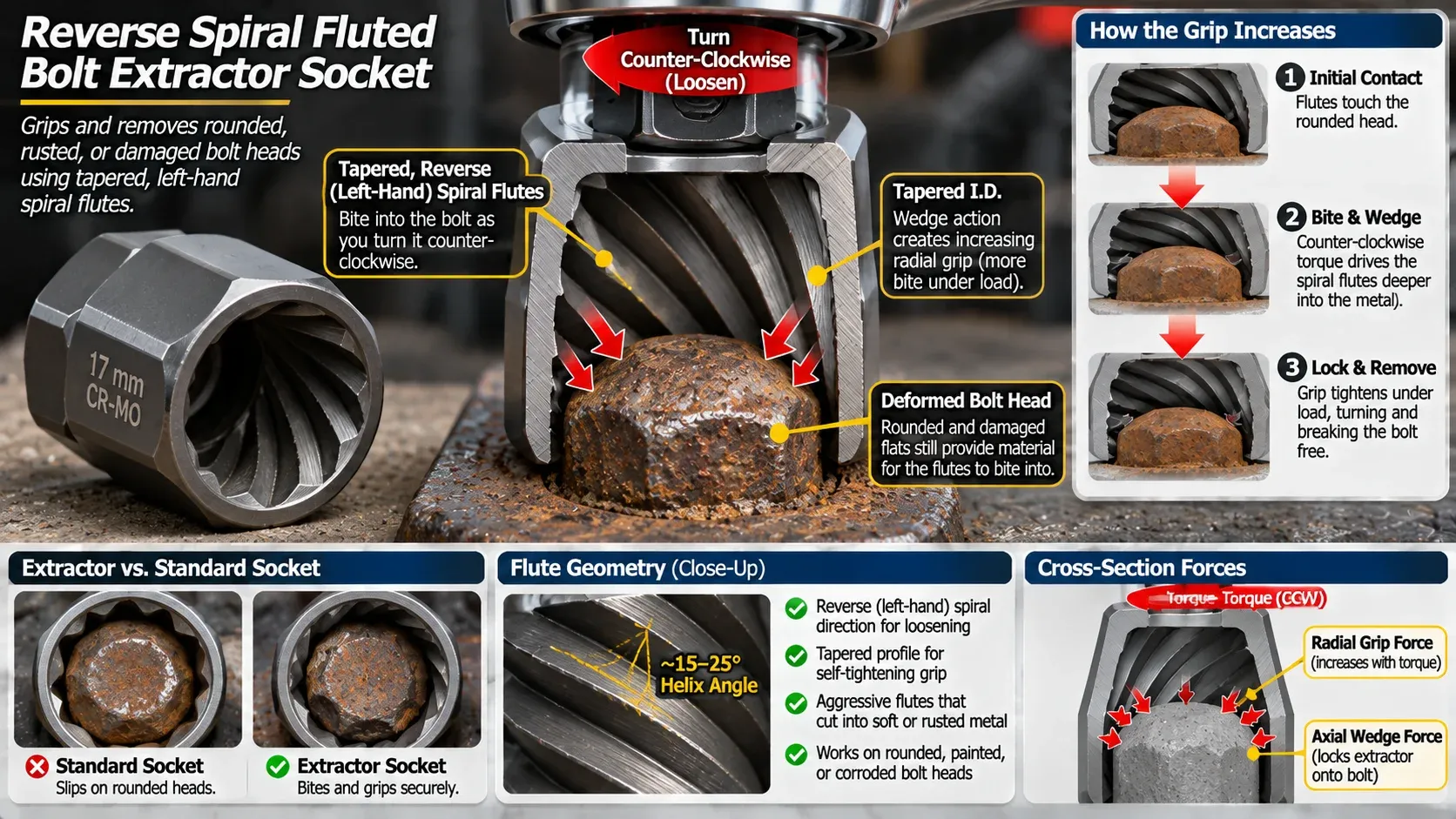
Engineering close-up diagram and cutaway of a reverse spiral fluted bolt extractor socket, showing hardened chrome-moly teeth gripping deeper into a rounded hex head fastener as counter-clockwise rotational torque increases, red directional bite force vectors, sharp industrial render.
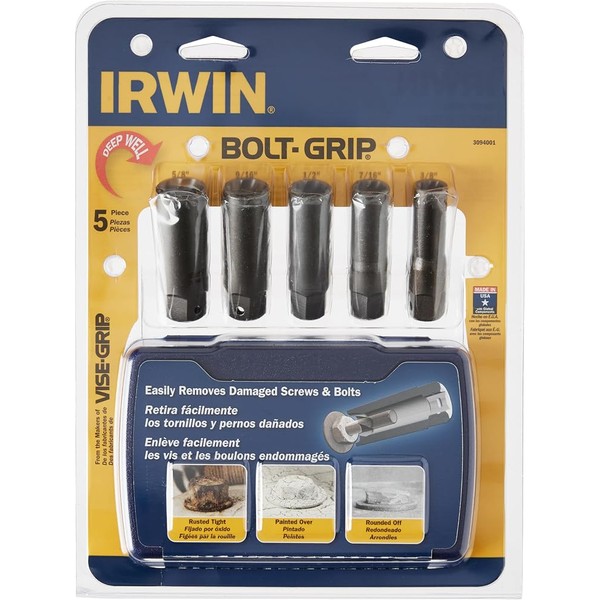
IRWIN Bolt-Grip 5-Piece Base Extractor Set
Best For: Removing rounded, painted over, and heavily corroded hex bolt heads
Est. Price: $39.99
"This five-piece set pulls 80% of rounded hex bolts in home workshops without drilling or welding nuts on heads."
- +Reverse spiral flutes bite aggressively into 85% rounded-off bolt heads
- +High-carbon steel construction withstands heavy hand breaker bar torque
- +Standard 3/8-inch square drive fits your existing ratchets and extension bars
- -Extracted bolt head locks tightly inside the socket cavity after removal
- -Demands a steel knock-out pin and bench hammer to dislodge the extracted bolt
Here is the vital technique that amateur mechanics skip: You must seat the socket with a two-pound hammer before applying turning torque.
Select the socket size that barely fits over the rounded head. Place the socket squarely over the bolt, take a steel ball-peen hammer, and strike the rear anvil of the socket firmly three times.
That hammer strike forces the sharp spiral teeth deep into the core metal of the fastener. Once seated, snap your 3/8-inch breaker bar into the drive end, apply firm downward pressure to prevent cam-out, and pull steadily until the threads break free.
Stage 3: Why Left-Hand Drill Bits Beat Traditional Spiral EZ-Outs
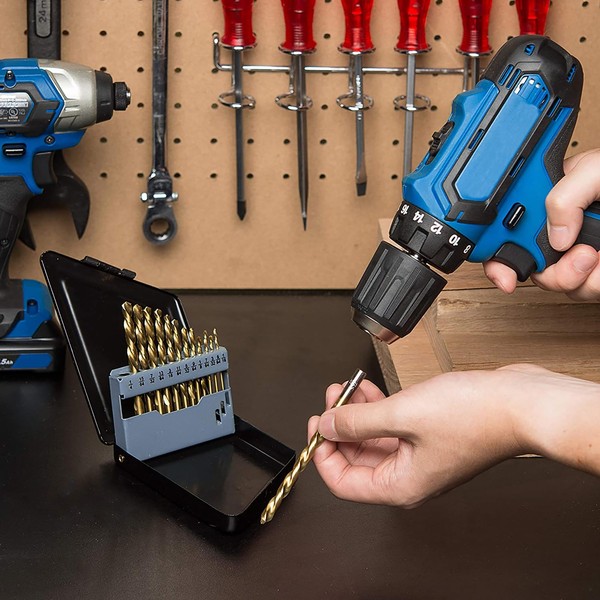
Neiko 10037A Left-Hand Cobalt Drill Bit Set (15-Piece)
Best For: Backing out broken bolt stubs during drilling without expanding threads
Est. Price: $34.99
"Avoid tapered spiral extractors that swell broken bolts; left-hand bits spin broken fasteners straight out of the hole 60% of the time."
- +M2 high-speed steel with left-hand reverse spiral cuts counterclockwise
- +Drill friction and reverse rotational torque back stubs out automatically
- +Includes 15 incremental sizes from 1/16-inch to 1/2-inch with metal index case
- -Demands a variable-speed drill running strictly in reverse mode
- -High-hardness alloy bits can snap if angled sideways during drilling
If the bolt head snaps off flush with the surface, hardware stores will try to sell you a tapered spiral screw extractor, commonly known as an EZ-Out.
Avoid tapered spiral extractors on stuck bolts. As you twist a tapered spiral extractor into a pilot hole, its cone geometry acts as an internal wedge, expanding the hollow bolt shank outward against the threaded housing. You literally press the threads tighter into the bore right when you want them to release.
Instead, invest in a dedicated set of Cobalt Left-Hand Drill Bits.
Left-hand drill bits cut while spinning counterclockwise in reverse gear. As you drill down into the broken fastener, the cutting edges deliver constant reverse torque into the bolt body while friction heat softens thread rust. In roughly 60% of cases, the cutting flute catches an edge and spins the broken stub straight out of the hole without needing an extraction pin at all.
Follow these strict drilling rules:
- Grind the broken stub flat: If the bolt snapped jaggedly, touch the high spots with a small rotary burr so your drill bit does not skate sideways.
- Mark dead center with an automatic center punch: Indent the exact center of the bolt shank. If your pilot hole drifts off-center into the aluminum engine threads, you will ruin the housing.
- Run your drill on low RPM with firm pressure: High drill speeds generate excessive heat that glazes the metal, dulling cobalt cutting edges in seconds. Keep your drill speed down around 300 to 500 RPM and lubricate the tip continuously with cutting oil.
Stage 4: When Fasteners Snap Deep (Straight-Flute Extraction)
If a left-hand drill bit bores through the bolt without spinning it out, do not hammer a tapered spiral bit into the hole. Switch to a straight-flute multi-spline extractor.
Straight-flute extractors feature vertical splines machined parallel along a solid hex shaft. You tap the spline straight into your drilled pilot hole with a hammer, sliding the vertical teeth into the sidewalls without creating outward wedge expansion.
Slide an open-end wrench over the hex shoulder of the extractor, lean your body weight into the shaft to keep it seated, and turn slowly. Never use an electric impact driver on extractor pins; hardened tool steel handles extreme shear loads but shatters instantly under violent harmonic impacts.
3 Costly Mistakes That Turn a $2 Bolt into a $500 Machine Shop Bill
Avoid these three mechanical errors when extracting stuck fasteners:
- Attacking rounded bolts with locking pliers first: Clamping teeth round off remaining hex shoulders into polished cones, removing the flat edges that reverse-twist sockets need to bite.
- Drilling pilot holes off-center without a punch indent: Drifting into the host aluminum housing destroys factory threads, requiring expensive Heli-Coil or Time-Sert thread inserts to fix.
- Applying breaker bar cheater pipes to small extractor pins: Quarter-inch extractors snap clean off when twisted with long cheater bars. If a bolt resists moderate breaker bar pressure, stop and reheat the housing with a propane torch.
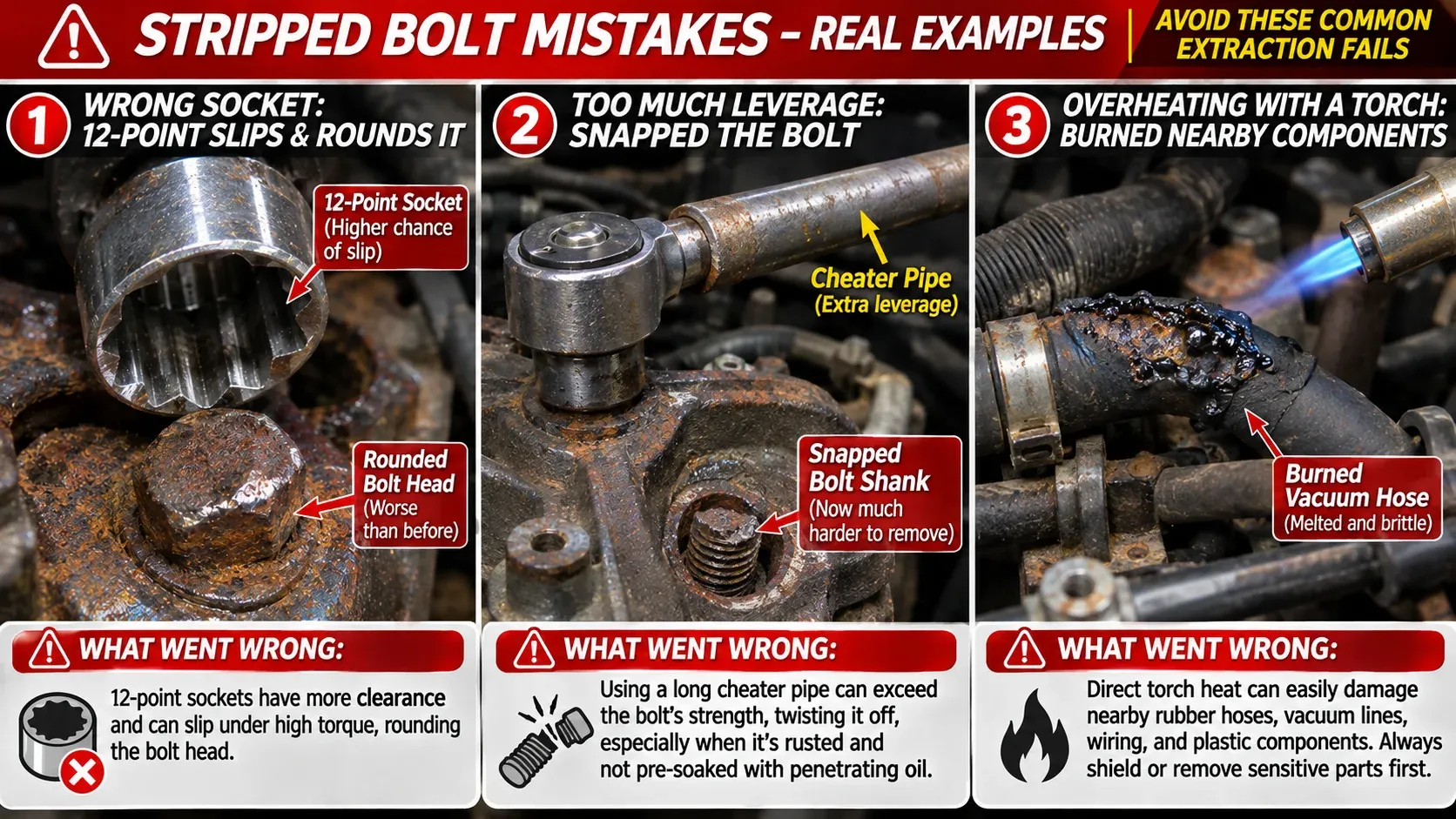
Three-panel technical warning photo montage showing stripped bolt mistakes: panel 1 showing 12-point wrench slipping on rounded bolt head, panel 2 showing impact wrench stripping head with smoke, panel 3 showing off-center drill bit ruining internal threads, red warning overlays, clear DIY educational layout.
The Bottom Line on Broken Fasteners
The moment your wrench slips on a seized bolt, put the tool down and step back. The easiest way to ruin an afternoon is trying one more desperate yank with the wrong socket.
Spray the joint with a 50:50 mix of acetone and ATF, tap a reverse-spiral socket onto the head with a hammer, and pull with a smooth breaker bar. Keep calm, use the right geometry, and you will save your projects without paying a mechanic to drill out your mistakes.
Clamping and Supporting Your Extraction Work
Extracting stubborn fasteners requires solid mechanical bracing and adequate leverage.
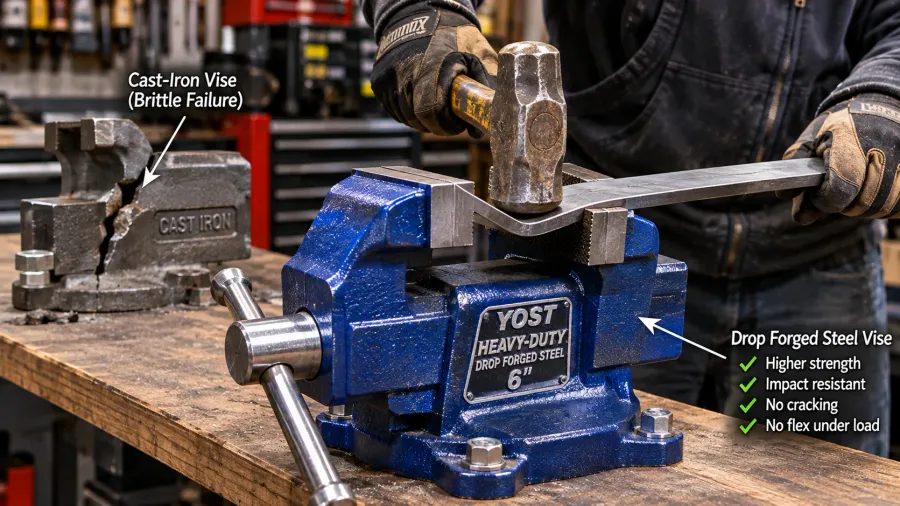
Clamp seized brackets, calipers, or rusted linkages firmly to your bench using a heavy-duty vise from our guide on bench vises: forged steel vs. cast iron.
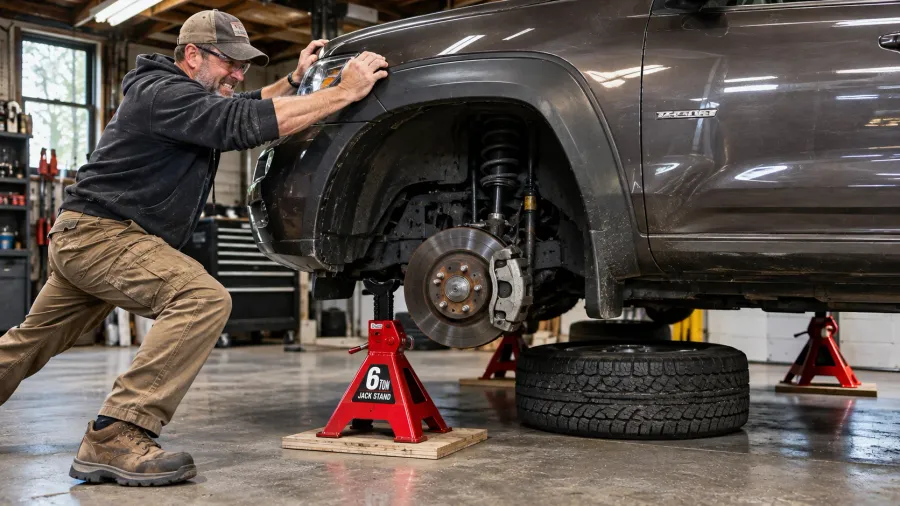
If you are breaking free rusted suspension hardware beneath a vehicle, always support the chassis with certified equipment from our guide on the safest double-locking jack stands.
And if you need heavy pneumatic breakaway torque for frozen bolts, verify your compressor supply using our sizing guide on what size air compressor you need for a 1/2 impact wrench.
Hank Miller
Hank is a master craftsman and DIY mechanic based in Ohio. He tests workshop equipment, garage floor coatings, and power tools under brutal, real-world workshop conditions, with zero paid brand sponsorships.