Never Get Under a Car Without This: The Safest Double-Locking Jack Stands (And How to Protect Your Floor)

Lying on your back with 4,000 pounds of steel balanced inches above your chest? Here is why cheap ratchet stands fail and what professional safety gear actually looks like.
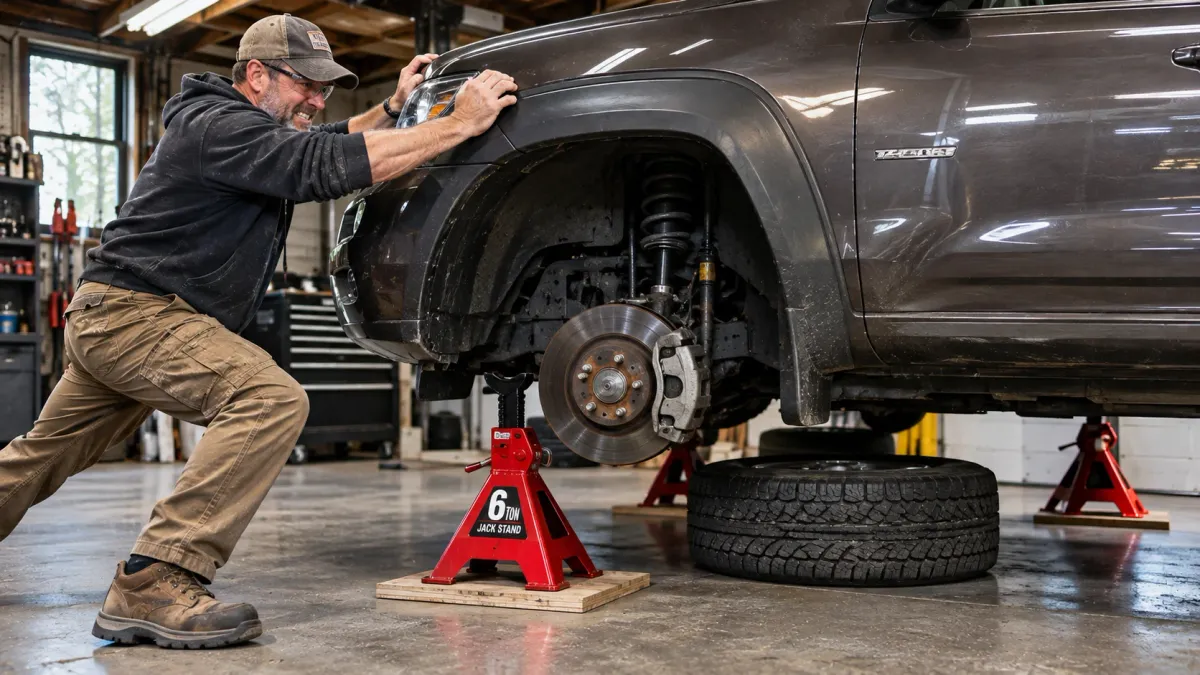
Table of Contents6 Sections
- 01.The Recall Wake-Up Call: Why Cheap Ratcheting Pawls Fail
- 02.The Gold Standard: Pin-Type and Double-Locking Stands
- 03.Flat Top vs. Curved Saddles: Protecting Unibody Pinch Welds
- 04.How to Stop Jack Stand Feet from Gouging Your Floor
- 05.The 60-Second Non-Negotiable Safety Routine
- 06.The Bottom Line on Vehicle Safety
When you slide beneath a raised vehicle on a shop creeper, barely eight inches of air separates your ribcage from two tons of unyielding steel. If you entrust your life to a $29 pair of bargain-bin ratcheting jack stands with questionable casting molds, you make the most foolish gamble in DIY mechanics.
Major retail recalls over recent years proved that single-pawl cast-iron ratcheting teeth can slip under lateral vibration, dropping heavy vehicles in an instant.
I spent twenty years wrenching on cars, and I maintain zero tolerance for flimsy lifting equipment. Here is the mechanical failure analysis behind cheap ratchet teeth, why pin-type flat-top stands represent the gold standard of home safety, and how to protect your garage concrete from gouging.
Hank's Bottom Line on Vehicle Support Safety
- Single-pawl cast-iron ratcheting jack stands can disengage under lateral vibration when wrenching on stubborn suspension bolts.
- Pin-type through-hole stands or double-locking pawls provide physical metal redundancy that cannot slip.
- Never leave vehicle load resting on a hydraulic floor jack; internal O-rings and check valves can fail without a sound.
- Always perform the Violent Bump Test before sliding your body beneath the vehicle.
Jack Stand Safety Mechanisms Compared
Compare locking reliability, base stability, and pinch-weld protection.
Standard Single-Pawl Ratchet Stands
Holding light yard trailers while removing wheels only
- Quick height adjustments
- Ubiquitous availability at discount retail stores
- Vulnerable to side-load tooth disengagement
- Casting voids caused millions of recalls
Double-Locking Ratchet Jack Stands
Sedans and compact crossovers on bare unfinished concrete
- Secondary steel safety pin slides behind ratchet pawl to prevent slip
- Narrow stamped steel feet dig into hot asphalt and scratch painted garage floors
Heavy-Duty Pin-Type Flat-Top Stands
Anyone crawling completely under a vehicle for major drivetrain or exhaust work
- Solid through-pin shear strength
- Circular tripod base
- Flat rubber pad cradles pinch welds
- Heavier to carry across shop
- Pin insertion takes ten seconds longer than ratcheting
The Recall Wake-Up Call: Why Cheap Ratcheting Pawls Fail
The ASME PASE (Portable Automotive Service Equipment) safety standard for jack stands requires rigorous off-center proof-load testing to prevent sudden catastrophic release under angled vehicle loads.
The catastrophic failure mode of traditional ratcheting jack stands comes down to side-load disengagement.
A standard ratcheting stand relies on a cast-iron pawl pivoting into teeth cast along a central post. When you yank a four-foot cheater pipe on a frozen suspension bolt or shake a driveshaft loose, the vehicle shifts horizontally.
That lateral force creates a side load that rocks the central post inside its stamped-steel collar. If the cast teeth feature slight mold imperfections or rounded edges, the pawl slips out of the groove, collapsing the stand instantly.
Millions of stands were recalled because worn factory tooling produced shallow casting teeth that failed under minor vehicle shifts. Never risk your life on a single cast tooth when secondary mechanical locks exist.
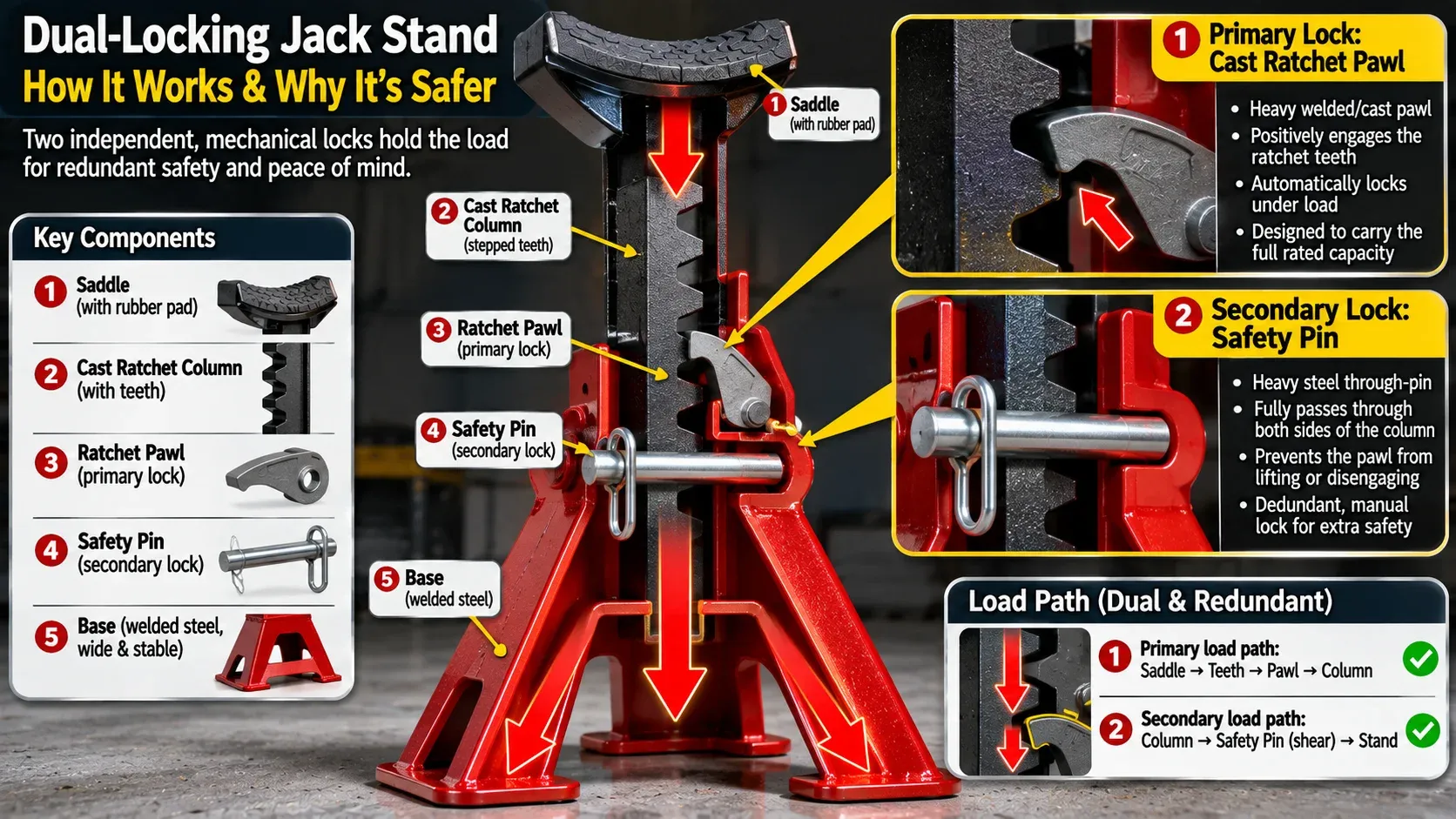
Technical cutaway diagram of a double-locking jack stand mechanism, callout showing primary cast ratchet pawl engaged in teeth, second callout showing heavy steel safety pin inserted completely through column preventing accidental release, red arrows highlighting dual redundant load paths.
The Gold Standard: Pin-Type and Double-Locking Stands
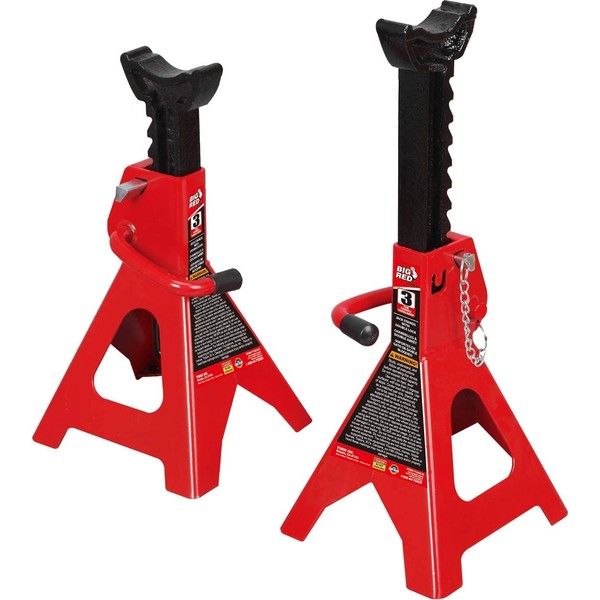
BIG RED Torin 3-Ton Double-Locking Steel Jack Stands (Pair)
Best For: Budget-conscious DIYers who demand mechanical pin redundancy
Est. Price: $46.99
"If you cannot afford $140 for flat-top stands, this $47 pair provides the mechanical pin security you need so ratchet slippage cannot crush you."
- +Integrated removable steel locking pin physically blocks the ratchet pawl from releasing
- +Large pyramid base footprint provides stable ground contact on concrete slabs
- +Forged steel ratchet bar and ductile iron support collar resist heavy vehicle loads
- -Deep curved saddle will bend thin unibody pinch welds without rubber adapters
- -Ratchet teeth must be visually inspected for casting burrs before initial use
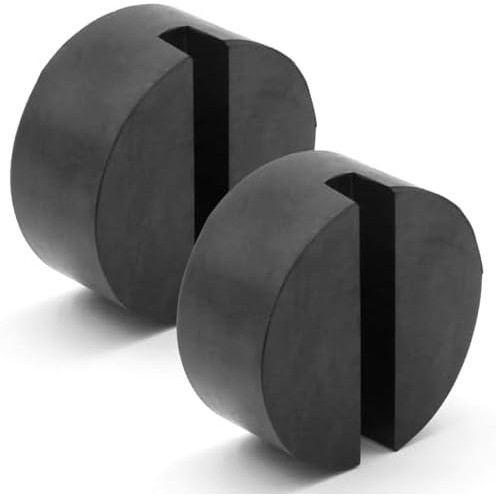
Universal Slotted Rubber Pinch Weld Frame Rail Protectors (2-Pack)
Best For: Preventing curved jack stand saddles from crushing rocker panels
Est. Price: $11.99
"Never put curved steel saddles directly against modern unibody seams; these inexpensive rubber pads prevent hundreds of dollars in rocker panel body damage."
- +Durable vulcanized rubber compound cushions vehicle weight without collapsing
- +Center V-groove fits over factory vehicle lift points and unibody seams
- +Compatible with most 2-ton, 3-ton, and 6-ton ratchet-type jack stands
- -Rubber will develop surface cuts after dozens of uses on razor-sharp pinch welds
- -Can get stuck to undercoating in hot summer weather if left under load overnight
If you service vehicles frequently and want a rock-solid lifting setup with push-button convenience, read my hands-on review of the QuickJack portable car lift for low-ceiling garages.
If you buy ratcheting stands, verify they feature a secondary locking pin. A heavy steel wedge pin slides completely through the outer housing directly beneath the ratchet pawl, mechanically blocking the pawl from releasing even if the handle gets kicked by your boot.
For ultimate peace of mind, upgrade to a pin-type flat-top stand.
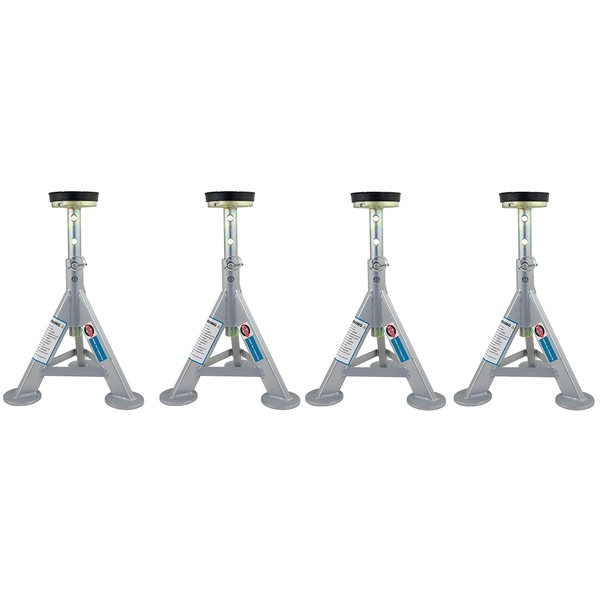
ESCO 10498 3-Ton Heavy-Duty Flat Top Jack Stand
Best For: Safely supporting unibody vehicles without crushing pinch welds or slipping
Est. Price: $139.99 (Pair)
"The safest jack stand designed for home mechanics. It locks rock-solid, protects your car frame, and keeps you safe underneath."
- +Solid steel cross-pin delivers verified 6,000-lb shear strength with zero teeth to slip
- +Removable textured rubber flat top cradles unibody pinch welds without bending metal
- +Broad circular tripod foot pads distribute vehicle weight evenly across concrete
- -Costs roughly double the price of generic stamped-steel discount store ratchet stands
- -Large base footprint requires extra clearance when positioning stands near tight suspension arms
Pin-type stands eliminate cast ratchets entirely. A thick tubular steel post slides inside a heavy welded collar, secured by a solid heat-treated steel pin that passes through both walls.
The pin operates under pure shear load, making mechanical failure physically impossible without shearing solid high-strength steel.
Flat Top vs. Curved Saddles: Protecting Unibody Pinch Welds
Once you set your car securely on rated stands, doing routine hydraulic service is easy and safe. Check my field testing of the best one-man brake bleeder for home garages to bleed your lines without needing a helper pumping the pedal.
Traditional jack stands feature a deep curved “U-shaped” saddle designed seventy years ago for solid round truck axles.
When you position a curved saddle beneath a modern unibody car, the two high horns of the saddle dig into the rocker panel, while the flat base crushes the delicate vertical pinch weld seam flat. Crushed pinch welds crack paint, bend unibody structural rails, and trigger premature rust along rocker panels.
Flat-top stands feature a thick, textured rubber cushion that supports unibody lift points across their flat perimeter rather than concentrating pressure on thin sheet metal edges.
If you already own curved-saddle stands, invest $12 in slotted rubber pinch-weld adapters. These rubber pucks sit inside the saddle horns, offering a deep center slot that cradles the vertical seam while supporting vehicle weight on surrounding chassis metal.
How to Stop Jack Stand Feet from Gouging Your Floor
Narrow stamped-steel feet on discount jack stands concentrate 1,500 pounds of point pressure onto sharp metal corners.
That focused point load gouges bare concrete and fractures expensive resin floor coatings. In our guide on why cheap garage epoxy coatings peel under tire heat, we explain how concrete surface fracturing ruins floor adhesion.
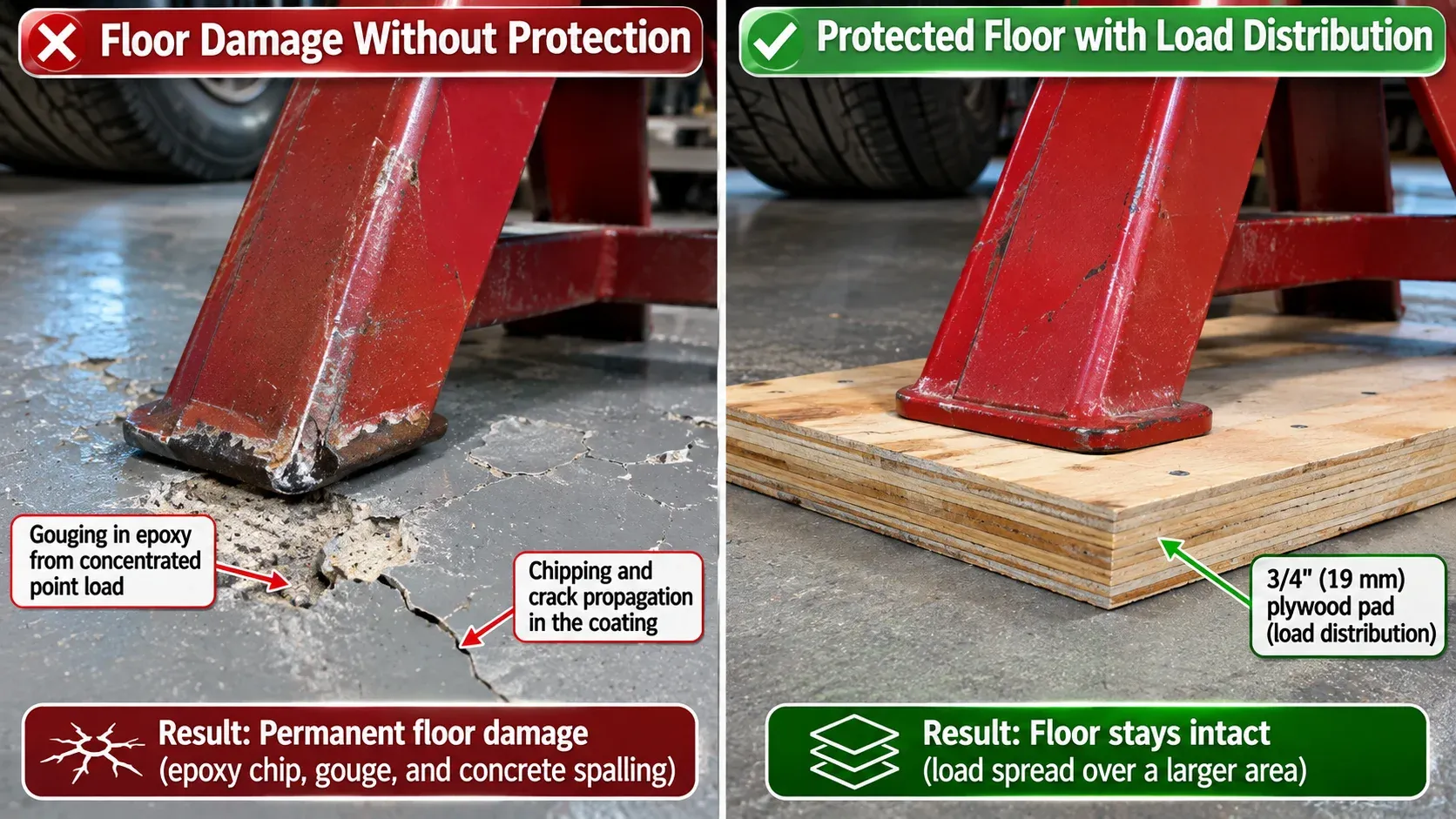
Side-by-side macro photo of garage floor damage: left side showing severe gouging and chip cracks in concrete epoxy caused by bare metal jack stand pyramid feet under heavy car weight, right side showing protected floor with stand resting on 3/4-inch plywood distribution pad, sharp focus.
Protect your floor with plywood distribution pads:
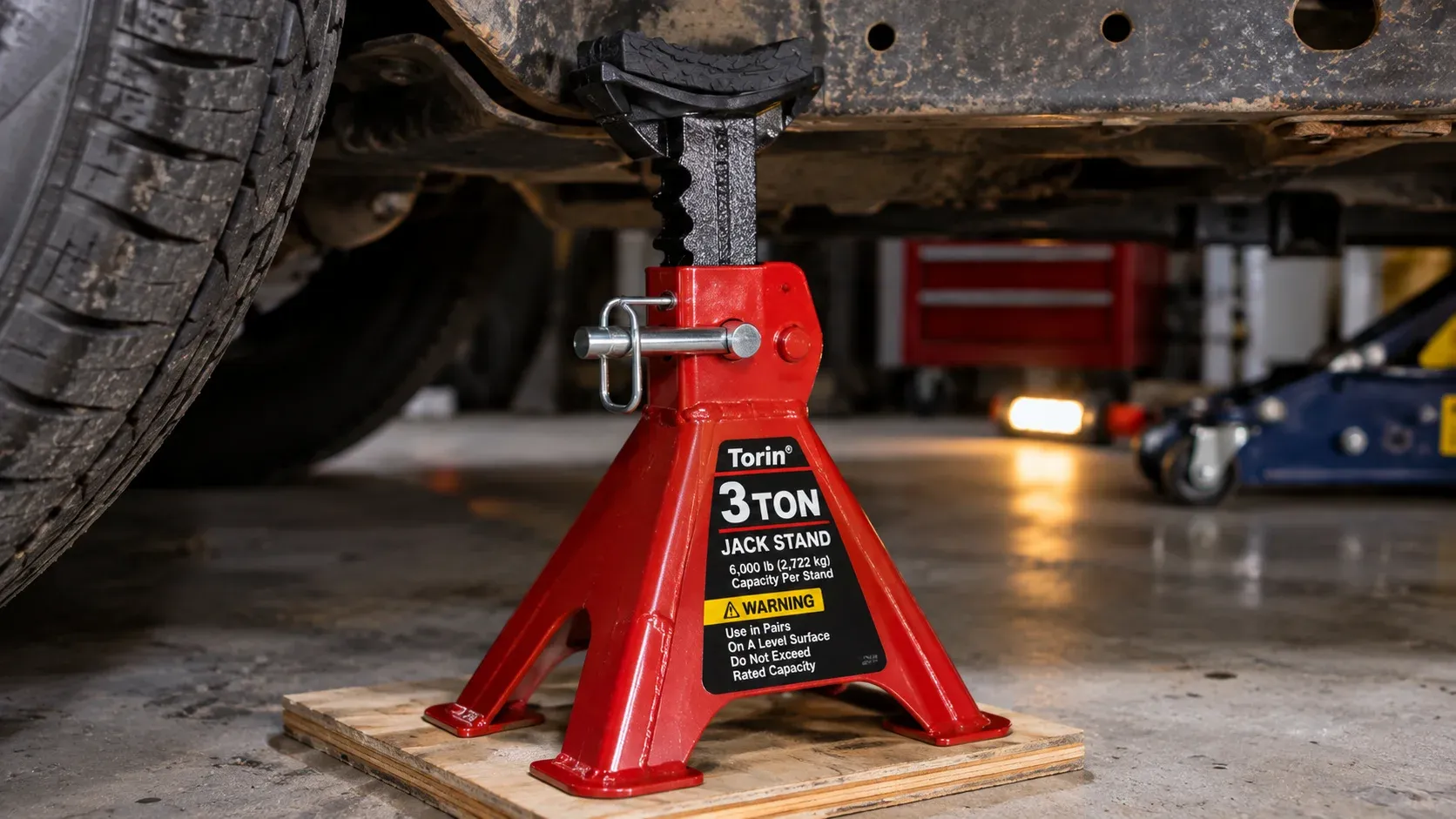
Cut four squares of 3/4-inch exterior plywood measuring 12x12 inches. Center your jack stand on the plywood pad before lowering vehicle weight.
The dense plywood grain spreads downward mechanical force across 144 square inches, preventing point chipping and keeping your floor pristine.
The 60-Second Non-Negotiable Safety Routine
The 60-Second Pre-Work Safety Protocol
Non-negotiable 4-step sequence before sliding any part of your body beneath raised steel.
Chock Opposing Wheels
15 secEngage parking brake and wedge solid rubber wheel chocks snugly against both front and rear of tires remaining on concrete.
Lower 100% onto Mechanical Stands
15 secSlowly lower hydraulic floor jack until vehicle load settles completely onto jack stand saddles. Relieve hydraulic pressure.
Position Redundant Wheel Stops
15 secSlide removed alloy wheels and tires directly beneath vehicle center frame rails or rocker panels.
Execute the Violent Bump Test
15 secStep back, grasp vehicle fender or bumper firmly with both hands, and shake car aggressively with full body weight.
Chassis locked mechanically on solid framing with fail-safe tire stops in place, tested against full bodyweight lateral shock.
Mechanic performing the mandatory pre-work safety shake test on an elevated vehicle resting on jack stands, hands firmly gripping the front fender pushing vigorously to verify stability, removed wheel tire placed under rocker panel as redundant safety fail-safe, dramatic workshop shot.
The Bottom Line on Vehicle Safety
Never compromise on the hardware standing between your chest and four thousand pounds of vehicle weight.
Retire cheap single-pawl ratchet stands to the recycling bin. Buy heavy-duty double-locking or pin-type flat-top stands, use wheel chocks on every lift, and shake the vehicle hard before crawling under. You will work with confidence and return home safely to your family after every project.
Hank Miller
Hank is a master craftsman and DIY mechanic based in Ohio. He tests workshop equipment, garage floor coatings, and power tools under brutal, real-world workshop conditions, with zero paid brand sponsorships.