Why Cheap Garage Epoxy Peels Under Hot Tires (And How to Fix It Without Re-grinding)

Rolled out a budget DIY garage floor kit only to watch radial tires tear off two bare grey strips? Here is why hot tires wreck cheap epoxy and how to fix it.
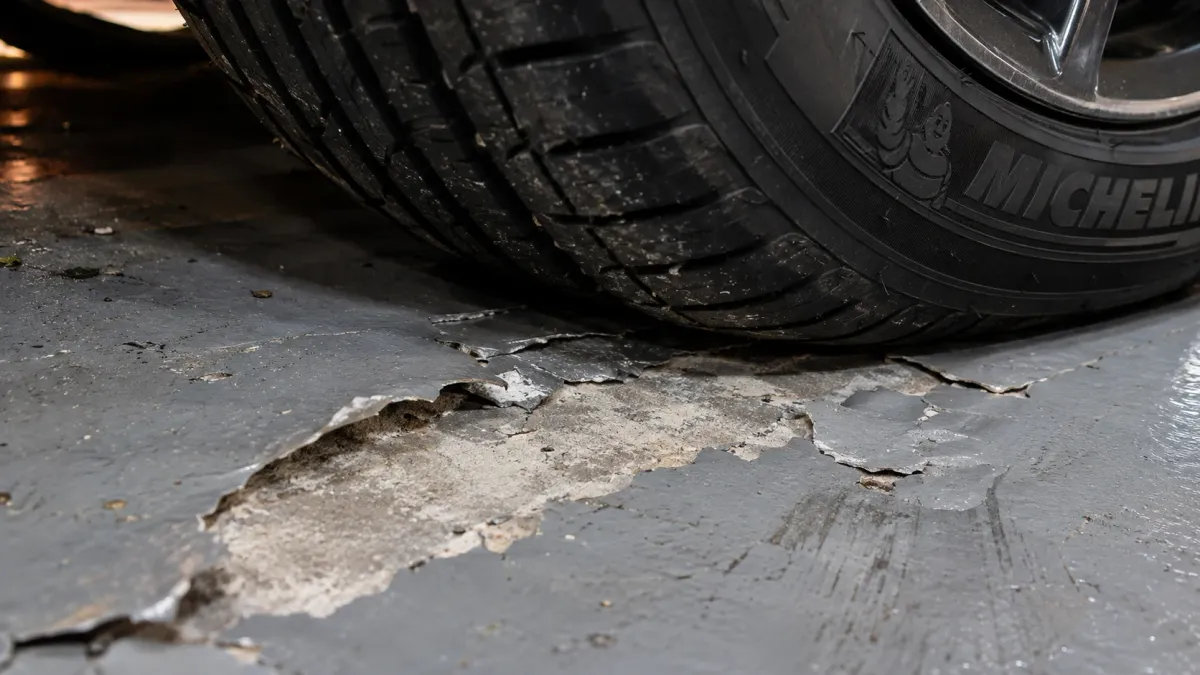
Table of Contents7 Sections
- 01.The Science of Hot Tire Pickup: What Big-Box Stores Don’t Tell You
- 02.What to Do If Your Epoxy Floor Is Already Peeling
- 03.The Budget Workaround: Heavy-Duty Parking Pads
- 04.The Lifetime Fix: Floating Modular Ribbed Tiles
- 05.Polyaspartic vs. 100% Solids Epoxy: What Actually Holds Up
- 06.3 Costly Mistakes That Guarantee Your Epoxy Will Fail
- 07.The Bottom Line on Peeling Garage Floors
You spend an entire weekend degreasing, scrubbing, and rolling a fresh epoxy coating across your garage floor, only to back your truck out two weeks later and spot two bald grey patches where your front tires rested. The paint did not wear down gradually; it stuck directly to the tire tread and peeled off in clean sheets down to raw concrete.
Mechanics and commercial floor coaters call this hot tire pickup. It represents the single most common failure mode for retail floor kits, and touching up the bare spots with leftover paint only sets you up for another round of peeling next month.
Your tires are rolling heat sinks packed with petroleum solvents. Before you spend $3,000 to hire an industrial grinding crew or buy another gallon of touch-up paint, understand why your floor failed and choose a targeted fix.
Quick-Decision Matrix: Matching the Fix to Your Floor Condition
Compare repair avenues, mechanical trade-offs, and estimated costs at a glance.
Heavy-Duty Vinyl Parking Mats
Owners who want an instant fix without scraping or re-coating
- Isolates tire heat immediately
- Covers bare concrete without stripping old paint
- Visible mat edges on floor
- Aggressive dry-steering on top can wrinkle material
Interlocking Ribbed Modular Tiles
Floors with recurring peeling, moisture problems, or uneven surfaces
- Zero chemical adhesion required
- 70,000-lb load capacity with free drainage
- Higher upfront material cost
- Fine wood dust falls through open grid
Professional Polyaspartic Re-coat
Permanent seamless showroom look on heavily trafficked shop bays
- Withstands 300°F tire contact
- Bonds permanently to CSP-2 diamond-ground profile
- Demands heavy commercial floor grinders and full personal protective gear
The Science of Hot Tire Pickup: What Big-Box Stores Don’t Tell You
Standard pull-off adhesion tests conducted under ASTM D4541 standard test method for pull-off strength of coatings reveal that water-based epoxy kits fail at under 150 PSI of tensile stress, while vulcanized hot radial tires exert up to 400 PSI during cool-down.
When you drive 65 mph down the interstate on an August afternoon, highway friction heats your radial tires to between 130°F and 160°F. When you pull into your garage and park, those hot tires transfer concentrated thermal energy directly into the top few millimeters of your concrete floor.
That thermal transfer triggers three destructive mechanisms:
- Thermal softening of thin films: Budget water-based epoxy kits dry to a dry film thickness (DFT) of just 2 to 3 mils. High heat quickly softens this thin resin layer, turning it gummy underneath your tread.
- Plasticizer migration: Tire manufacturers blend plasticizers and polymer oils into tire rubber to keep tread flexible in freezing weather. Heat forces those plasticizers out of the tire and into the softened paint film, chemically de-linking polymer bonds.
- Vacuum cooling suction: As the parked tires cool down, the rubber contracts slightly while pressing into the softened resin. When you back out the next morning, tire grip overcomes the paint bond and yanks the coating off the concrete.
Cheap acid-etching prep causes this failure before you even open the paint can. Pouring mild muriatic acid over power-troweled garage concrete only opens the pores slightly to an aggregate profile of CSP-1.
Industrial coatings demand an aggressive CSP-2 or CSP-3 profile, which feels like 60-grit sandpaper under your fingers. Without mechanical diamond grinding to expose raw aggregate pores, your epoxy merely sits on top of loose surface laitance, waiting for hot rubber to peel it loose.
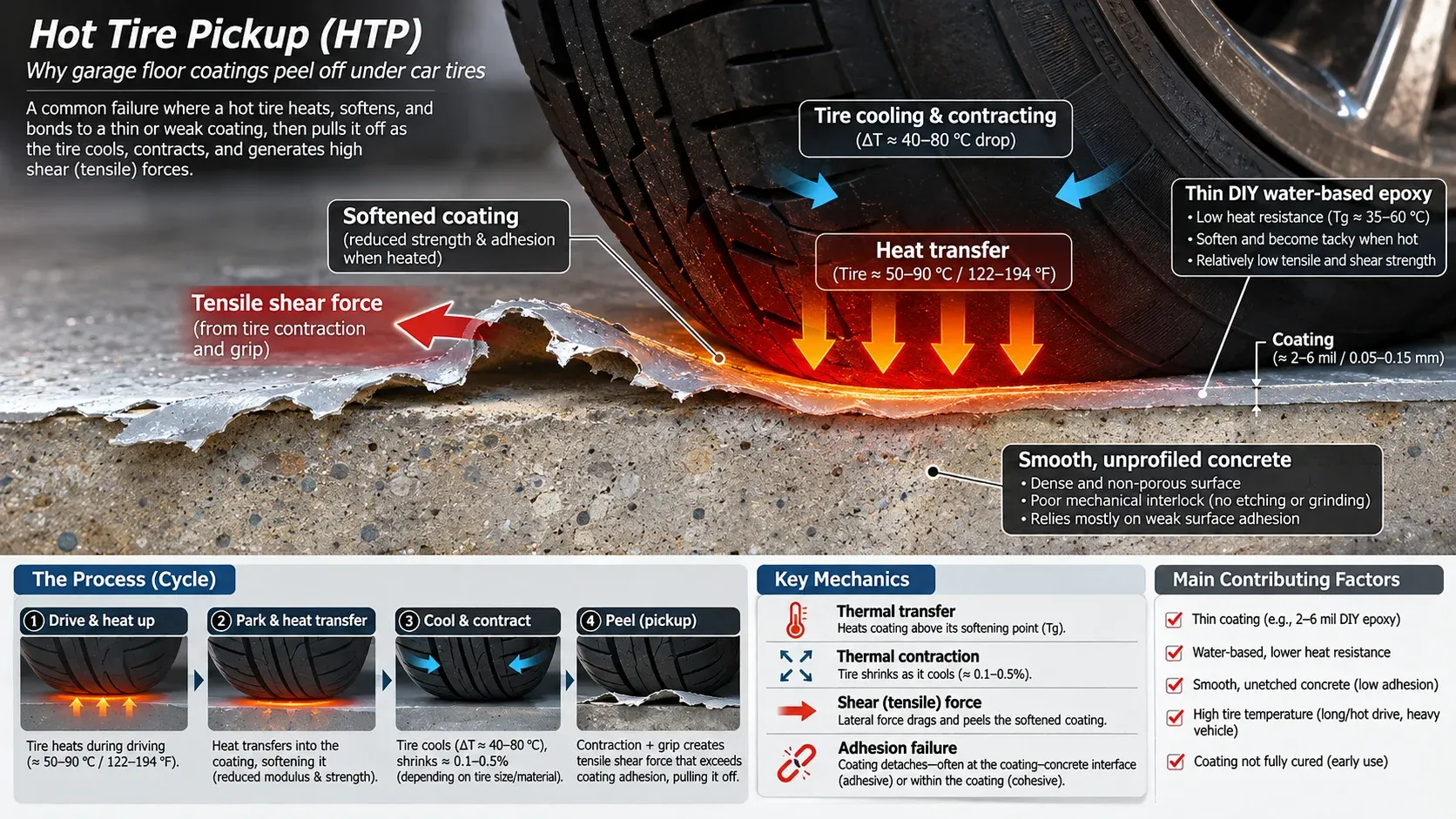
Technical cross section illustration detailing hot tire pickup mechanics on garage floor, car tire cooling down and contracting, thermal transfer softening thin DIY water-based epoxy, tensile shear force peeling coating off smooth unprofiled concrete substrate, clear labeled scientific callouts, engineering graphic style.
Epoxy Failure Severity Matrix
Examine your floor damage and pick the most cost-effective recovery route.
Coating peeled cleanly down to smooth grey concrete only where the four tires park
Peeled paint chips have thin flakes of white concrete stuck to their underside
Paint bubbles up across broad walking areas with damp white powder underneath
What to Do If Your Epoxy Floor Is Already Peeling
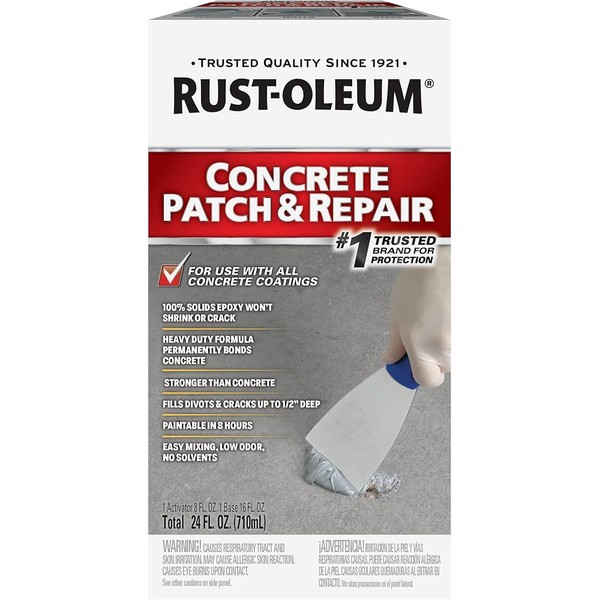
Rust-Oleum Concrete Patch and Repair Kit (Two-Part High-Strength Epoxy Gel)
Best For: Filling concrete divots and tire delamination craters before recoating
Est. Price: $24.98
"Never apply a new coating or modular tile over raw craters; this industrial patch bonds permanently so tires cannot tear the repair out."
- +Industrial epoxy chemistry cures harder than native 4,000 PSI concrete
- +Pre-measured two-part container eliminates mixing ratio mistakes
- +Can be ground flush with diamond tooling in eight hours
- -Working time is under 30 minutes in warm garage temperatures
- -Requires thorough surface wire-brushing or grinding for maximum grip
Once you grind off the failed latex coating, you must patch all expansion joints and spalls properly. Follow my step-by-step guide on how to fix cracks in a concrete garage floor before coating using commercial polyurea elastomeric fillers.
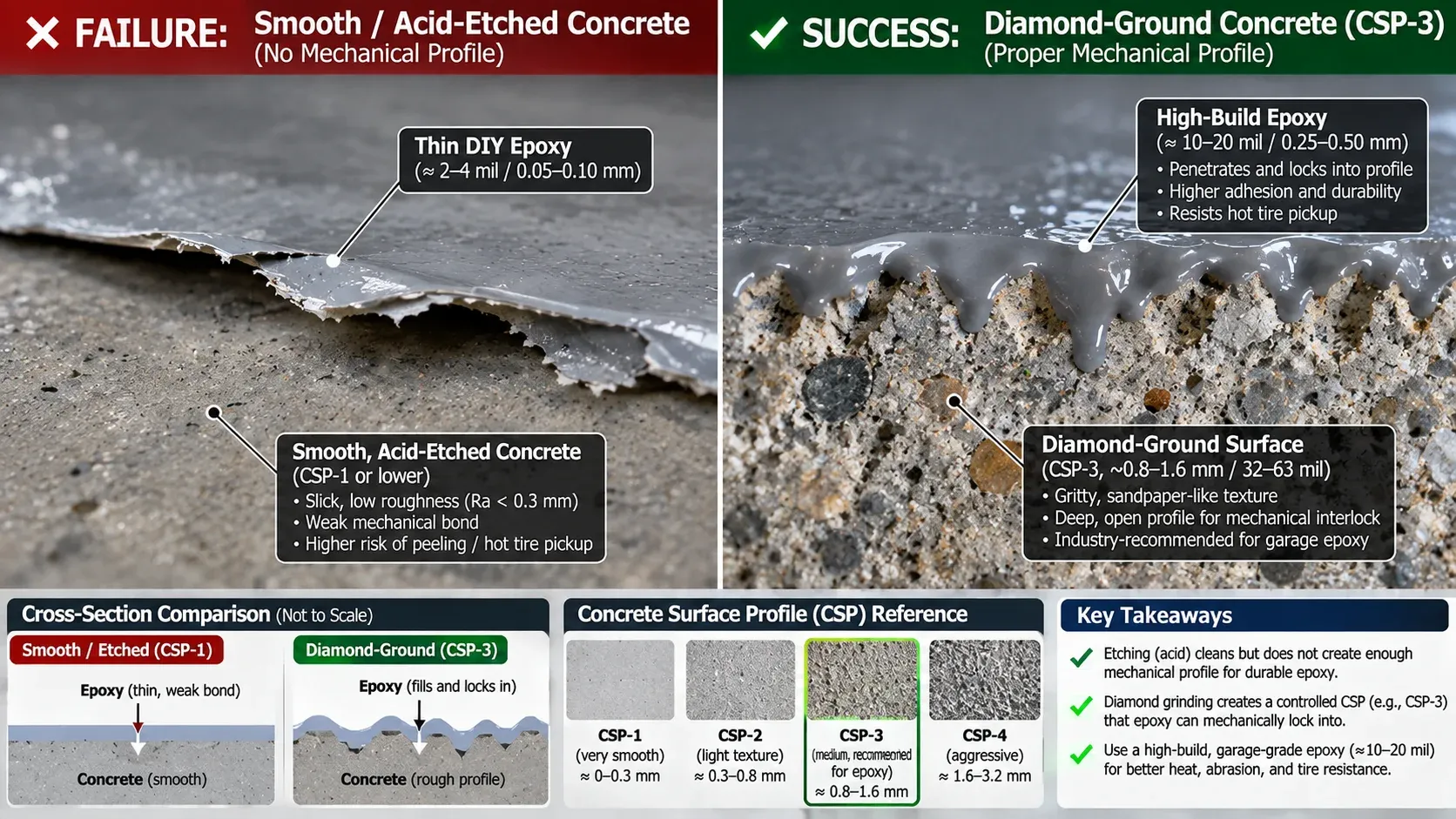
Two concrete floor surface profiles side by side, left side smooth acid-etched concrete with poor mechanical tooth CSP 1, right side diamond-ground concrete showing coarse sandpaper-like aggregate texture CSP 3 ready for industrial coating, workshop ruler in center for scale.
Never try to fix tire peeling by rolling fresh paint over the bald spots. The perimeter edges of the peeled patch have already suffered heat fatigue, meaning fresh paint will lift along those same borders within three months.
Patching also leaves visible, mismatched ridges across your parking bay that look worse than raw concrete.
If your slab also sweats during winter weather shifts, moisture pressure might be pushing up from below while tires pull from above. Review our guide on how to stop garage floor sweating in winter to run a 24-hour diagnostic test before deciding on a permanent floor strategy.
The Budget Workaround: Heavy-Duty Parking Pads
If you want a truly bulletproof permanent finish rather than temporary rubber mats, explore polyaspartic vs. epoxy clear topcoats to see why commercial contractors use 100% solids epoxy bases capped with UV-stable polyaspartic coats.
If the rest of your epoxy floor looks decent and peeling stays confined to your vehicle tire tracks, do not spend thousands re-grinding the slab. Install commercial parking pads directly over the vehicle bays.
A commercial parking mat isolates tire heat, catches salty winter slush, and shields the underlying concrete from plasticizer leaching.
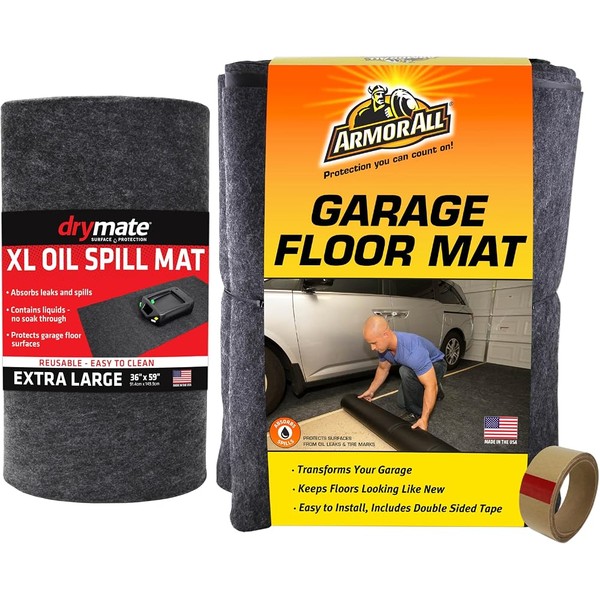
Armor All Heavy-Duty Charcoal Garage Floor Mat
Best For: Isolating tire heat and covering stripped epoxy paths without re-grinding
Est. Price: $169.99
"The most cost-effective workaround for peeled epoxy. It covers ugly bare patches and permanently stops hot tire damage."
- +Dense polyester fabric bonded to waterproof backing blocks 100% of tire heat
- +Absorbs and contains gallons of winter snow slush, engine oil, and radiator drips
- +Rolls out in five minutes with zero adhesive or subfloor prep required
- -Aggressive dry-steering with heavy pickup tires can wrinkle mat edges
- -Requires occasional hose-down or wet-vac cleaning to remove dried road salt
Lay the mat so your front and rear wheels stop squarely in the center of the fabric. The waterproof vinyl base stops hot tire chemicals from reaching whatever paint remains on the slab.
The Lifetime Fix: Floating Modular Ribbed Tiles
When paint flakes across large sections of your floor, stop throwing good money after bad coatings. Installing free-floating modular tiles eliminates coating failure permanently because tiles do not depend on chemical adhesion to concrete.
Vented polypropylene tiles snap together over your peeling epoxy without adhesives, grinding, or toxic fumes.
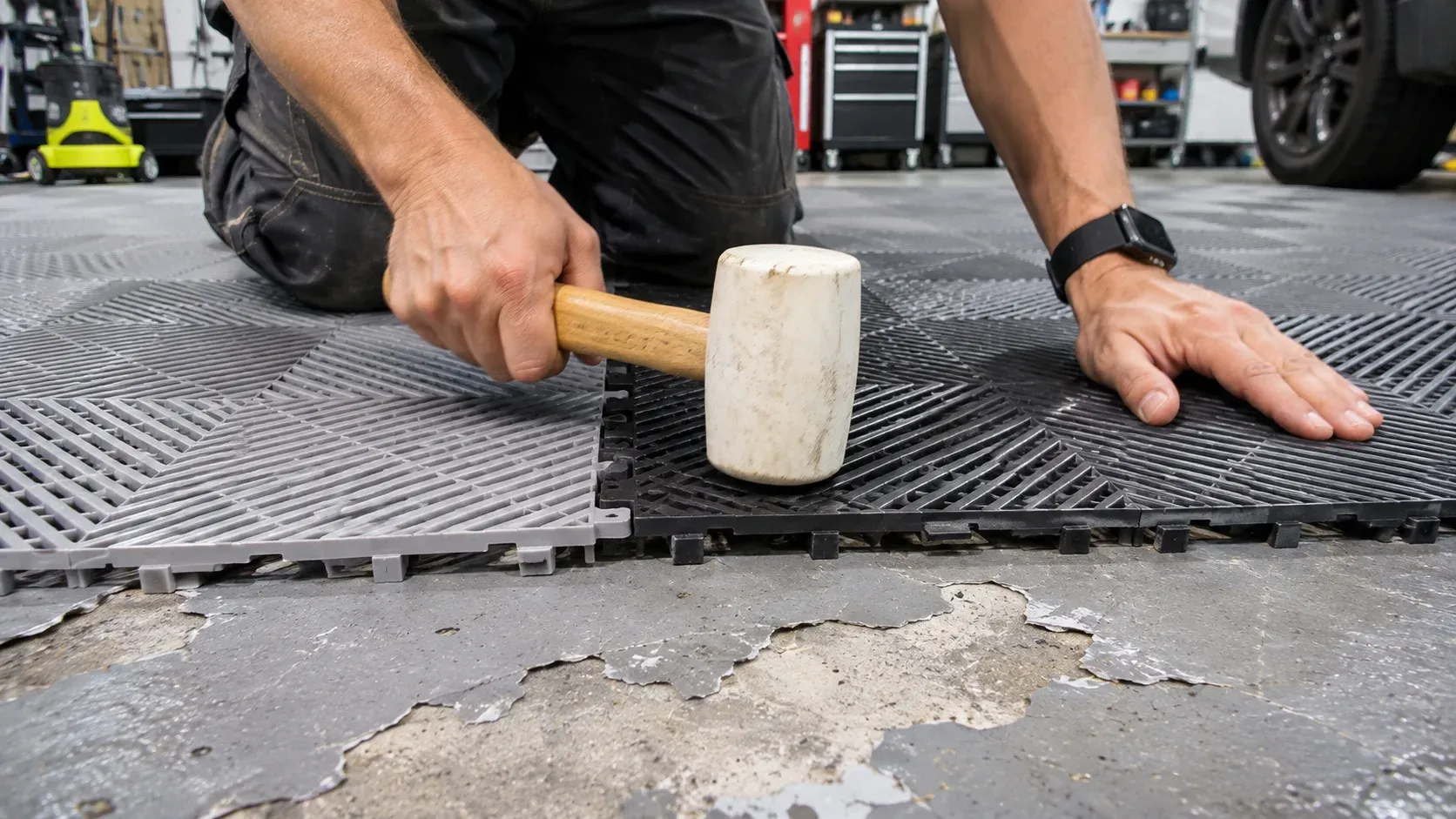
Hands of a DIY homeowner using a white rubber mallet to snap together gray and black Swisstrax Ribtrax ribbed modular garage tiles over an old damaged peeling epoxy floor, clean garage setting, natural sunlight pouring in from open garage door.
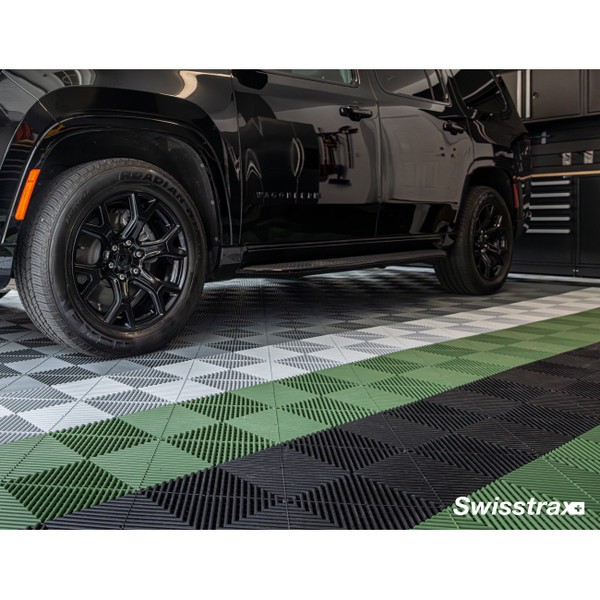
Swisstrax Ribtrax Pro Interlocking Modular Tiles
Best For: Transforming peeling, damaged concrete floors into a clean, permanent workspace
Est. Price: $3.95 / sq.ft
"The definitive solution for failed epoxy. You snap it together in one afternoon and never worry about peeling paint again."
- +Withstands direct tire heat up to 248°F with zero softening or sticking
- +Open-rib profile lets water, snow, and grit fall below walking surfaces
- +Supports 70,000 lbs of rollover weight without cracking or shifting
- -Higher initial material investment than a retail paint bucket
- -Fine metal shavings or dropped small nuts drop between ribs
Swisstrax tiles elevate your feet 1/2 inch above the peeling concrete slab. Hot tires park on heat-resistant polypropylene that will never pull up, while channels underneath allow damp concrete to breathe naturally.
Polyaspartic vs. 100% Solids Epoxy: What Actually Holds Up
If you insist on a seamless resin floor for your garage, skip retail paint aisles entirely. Commercial installers rely on two industrial formulations:
| Specification | Water-Based Retail Epoxy | 100% Solids Industrial Epoxy | Professional Polyaspartic |
|---|---|---|---|
| Dry Film Thickness | 2 to 3 mils (Tissue thin) | 10 to 16 mils (Heavy coat) | 10 to 14 mils (Dense shield) |
| Heat Resistance | Up to 120°F (Softens fast) | Up to 180°F (Moderate) | Up to 300°F (Immune to tires) |
| Cure Time to Drive | 3 to 5 days | 7 full days | 24 hours |
| Required Prep | Muriatic acid wash (CSP-1) | Diamond grinder (CSP-2) | Diamond grinder (CSP-2 to 3) |
A professional-grade coating system uses a 100% solids epoxy basecoat to penetrate mechanically ground concrete pores, followed by a polyaspartic clear topcoat. Polyaspartic chemistry resists heat up to 300°F and remains impervious to tire plasticizers.
3 Costly Mistakes That Guarantee Your Epoxy Will Fail
Avoid these three prep shortcuts when coating a home garage floor:
- Etching with muriatic acid instead of mechanical grinding: Acid cannot cut through hardened concrete sealer or machine-troweled laitance. If your water-drop test does not soak in within 10 seconds, acid etching will fail to create mechanical bite.
- Grinding over embedded motor oil stains: Diamond grinding wheels smear motor oil deeper into concrete pores rather than removing it. Always apply a poultice or citrus degreaser to pull deep oil stains before running diamond tooling across the slab.
- Parking on fresh epoxy after only 72 hours: Retail marketing claims you can drive on cured epoxy after three days. Full chemical cross-linking requires a minimum of seven full days at 70°F before hot radial tires should touch the surface.
The Bottom Line on Peeling Garage Floors
If your epoxy peeled strictly beneath your tire footprints, roll out a pair of heavy-duty vinyl parking mats this weekend. You will spend under $200, mask the ugly patches, and permanently prevent heat damage without renting heavy equipment.
If paint flakes across your entire garage floor, stop buying touch-up kits. Cover the mess with free-floating Swisstrax modular tiles, and you will never spend another Saturday scraping peeling paint off concrete.
Hank Miller
Hank is a master craftsman and DIY mechanic based in Ohio. He tests workshop equipment, garage floor coatings, and power tools under brutal, real-world workshop conditions, with zero paid brand sponsorships.