Diamond Stones vs Bench Grinder: How to Sharpen Chisels Razor-Sharp Without Burning the Steel

High-speed bench grinders ruin high-carbon chisel steel in three seconds flat. Here is how to achieve hair-shaving edges using continuous diamond plates and a leather strop.
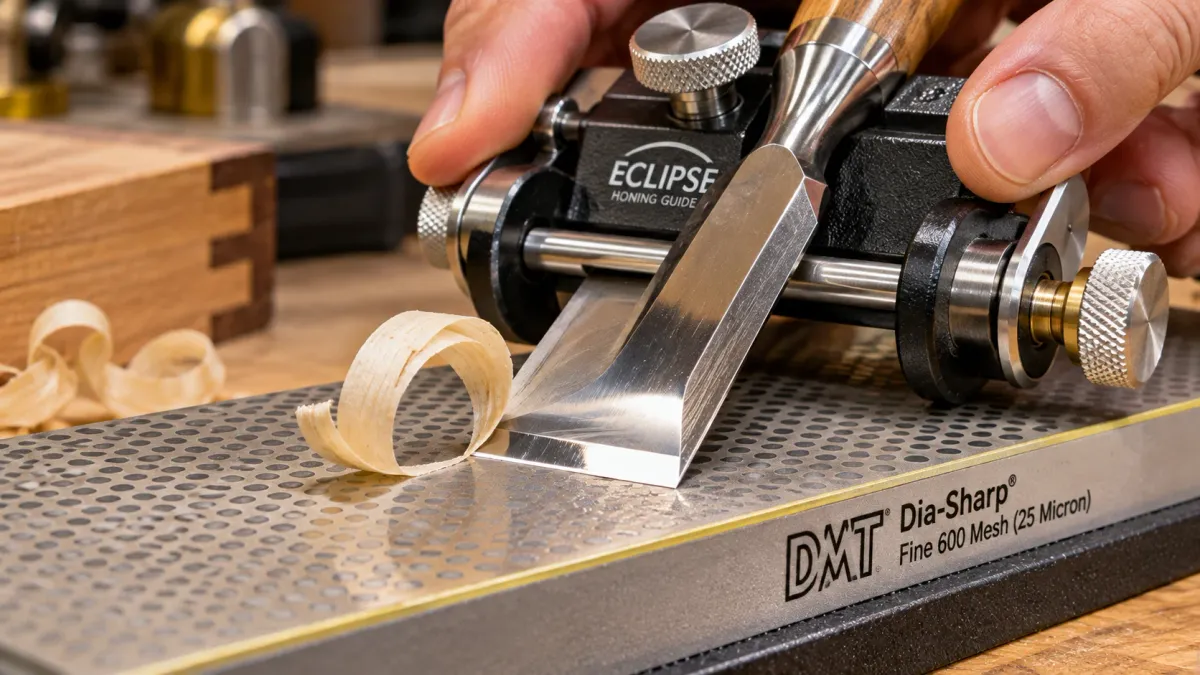
Table of Contents5 Sections
You need to clean out a crisp mortise or pare the shoulder of a tenon joint on a weekend woodworking project. Your favorite 1/2-inch chisel feels slightly dull, tearing the wood fibers rather than slicing them cleanly.
You walk over to your 3,450 RPM garage bench grinder, flick the power switch, and lightly press the chisel bevel against the spinning grey wheel. Three seconds later, a bright spark flares, and a vivid purple-blue spot spreads across the cutting tip.
You just ruined your chisel.
That blue color indicates that friction heat exceeded 500°F, destroying the factory temper of the tool steel. The microscopic crystalline structure collapsed from hard martensite into soft annealed iron. From this moment on, that cutting tip will fold over like a soda can tab whenever you tap it into hard maple or white oak.
To achieve hair-splitting sharpness on your woodworking chisels and hand plane irons without destroying their heat treatment, you must leave the high-speed grinder unplugged and switch to precision diamond plates.
The Metallurgy of “Bluing”: Why Heat Destroys Tool Steel
Under ASTM E18 standard test methods for Rockwell hardness, quality woodworking chisels are forged from high-carbon tool steel and hardened to an exact range of 60 to 62 HRC (such as O1, A2, or Japanese white paper steel) and heat-treated to an exact Rockwell hardness of 60 to 62 HRC.
At this specific hardness level, the steel holds an acute, razor-sharp edge while resisting premature chipping. However, this hardness is fragile when exposed to sudden, uncontrolled friction heat.
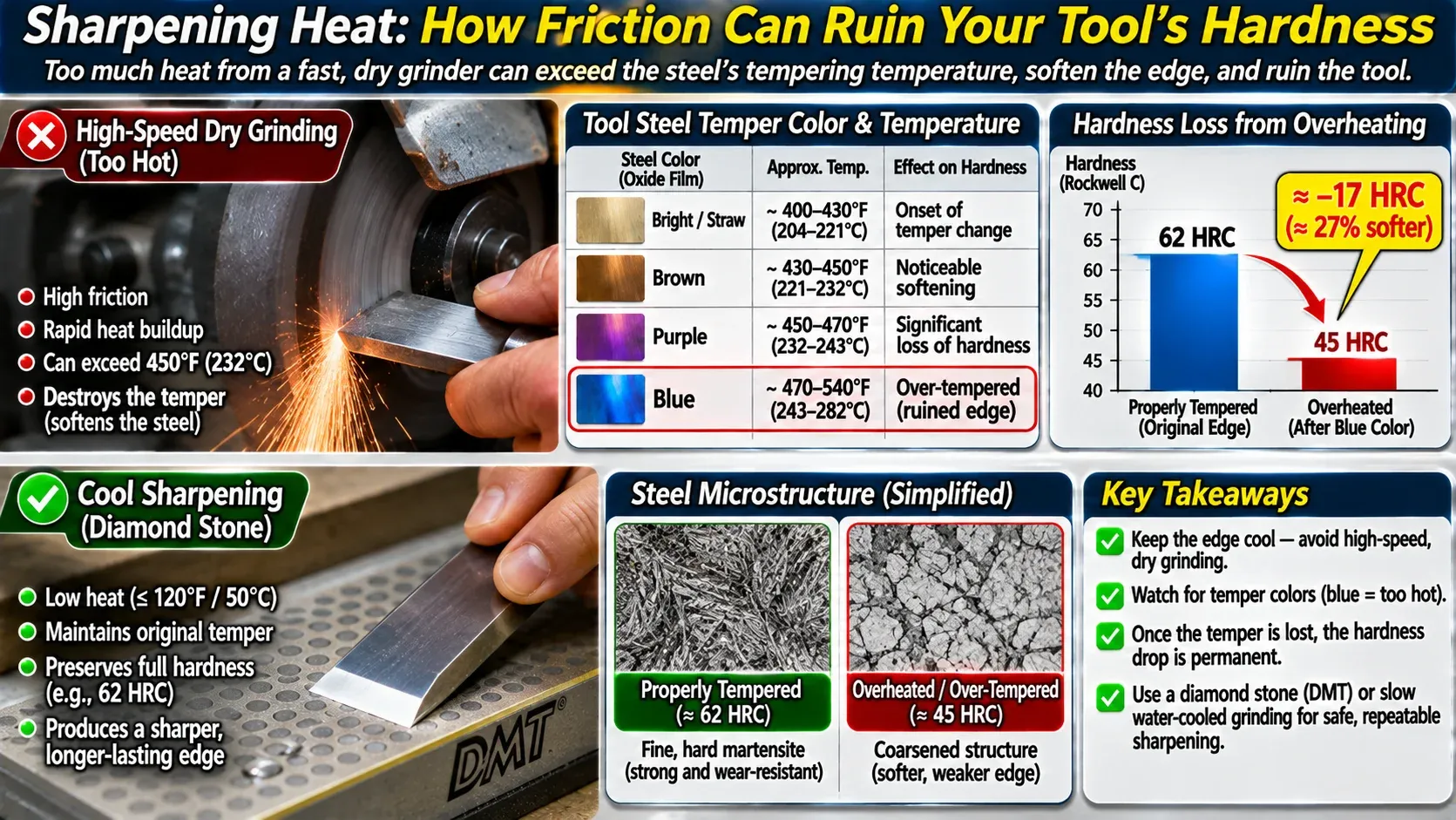
Metallurgical temperature color spectrum infographic for tool steel, showing high-speed dry bench grinder friction heating chisel tip beyond 450°F turning edge blue and dropping Rockwell hardness from 62 HRC to 45 HRC (ruined temper), contrasted with cool manual diamond stone sharpening, clean educational graphics.
Because the cutting tip of a chisel tapers down to a microscopic edge less than one micron thick, there is virtually zero metal mass behind the tip to absorb or dissipate heat. When you press that delicate wedge against a high-speed abrasive wheel, surface temperatures spike instantly.
Once steel turns blue, no amount of oil or water dipping can restore its temper. You must grind away the entire blued section of metal by hand until you reach undamaged steel deeper in the tool body.
Diamond Stones vs. Waterstones vs. Oilstones: The Unheated Garage Verdict
Woodworkers argue endlessly over sharpening media. However, inside an unheated residential garage where winter temperatures drop below freezing, practical constraints narrow your choices immediately.
Continuous-surface diamond plates are the undisputed champions for garage workshops. Unlike soft waterstones that hollow out in the center after three sharpening sessions, precision ground steel diamond plates remain dead flat for decades. You can store them on an open shelf in sub-zero winter temperatures without fearing cracked stones or frozen water baths.
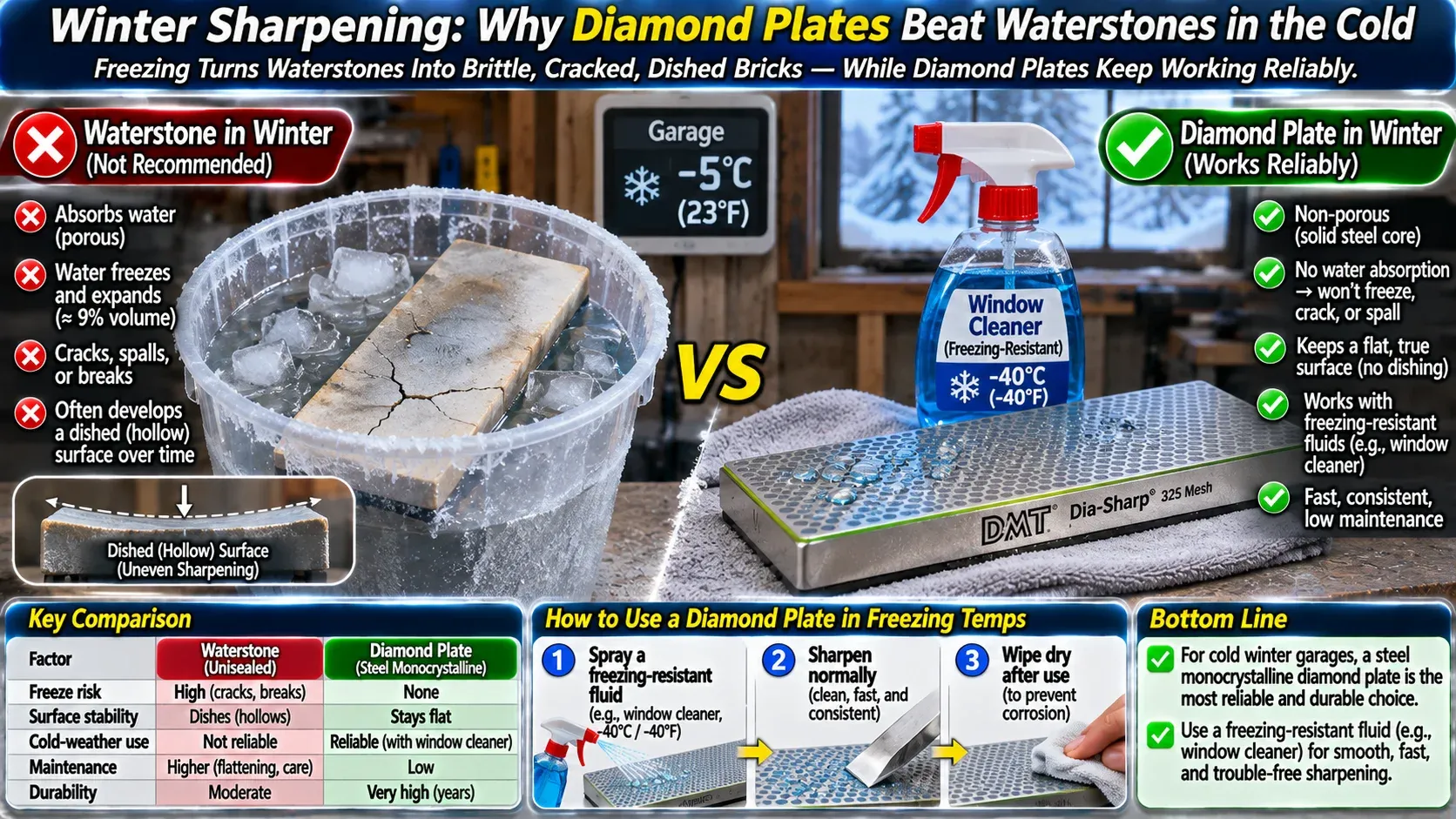
Comparative workshop infographic for cold winter garages, showing frozen cracked waterstone submerged in iced bucket with dished hollow surface vs solid steel monocrystalline diamond plate operating perfectly with freezing-resistant window cleaner fluid, clean technical comparison.
Sharpening Media Performance Comparison
High-Speed Bench Grinder (3,450 RPM)
Natural Arkansas Oilstones
Japanese Waterstones
Continuous Steel Diamond Plates
The Anatomy of Sharp: Flat Backs and Micro-Bevels
True sharpness is not an artistic mystery. It is a strictly geometric reality: sharpness is the clean, unmarred intersection of two polished, flat planes of steel.
If either plane is rough or rounded, the tool will never cut cleanly.
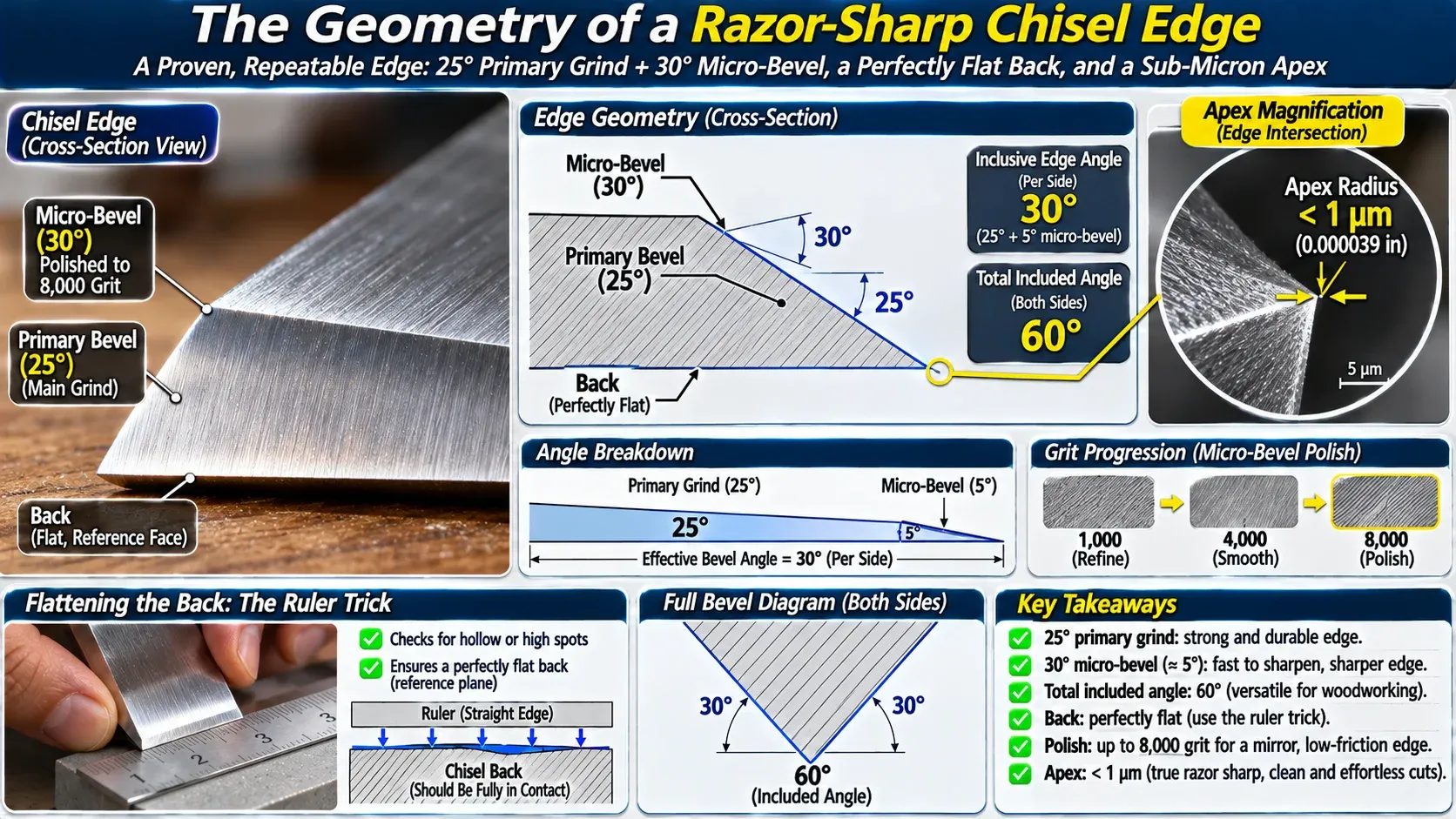
Precision geometric drafting diagram of a razor-sharp woodworking chisel edge, showing 25-degree primary grind bevel, 30-degree micro-bevel polished to 8,000 grit, perfectly flattened back using the ruler trick, magnified callout showing apex intersection under 1 micron, technical CAD blueprint.
1. The Chisel Back (Flatten Once in a Lifetime)
Ninety percent of dull chisel frustration stems from ignoring the back of the tool. The back forms one-half of your cutting edge. When you purchase a new or vintage chisel, you must spend twenty minutes polishing the back against your diamond plates until the first two inches near the tip are as flat and reflective as a mirror. You only perform this intensive flattening once in the lifetime of that tool.
2. The Primary Bevel vs. Micro-Bevel
Most bench chisels leave the factory ground to a 25-degree primary bevel. If you try to hone that entire 25-degree surface every time the chisel dulls, you must remove a massive amount of steel across a broad surface area, turning a quick touch-up into a thirty-minute chore.
Instead, introduce a 30-degree secondary micro-bevel.
By raising the honing angle five degrees, you only sharpen a tiny strip of steel roughly one millimeter wide right at the very cutting tip. You can polish that miniature micro-bevel in twenty seconds flat, removing minimal steel and returning to your workbench immediately.
Honing Guides: Eliminate Freehand Guesswork
Unless you spend forty hours a week at a woodworking bench, freehand sharpening on a flat stone causes your hands to rock slightly back and forth. That subtle rocking motion rounds the cutting edge into a dull, convex profile.
A simple, rigid honing guide holds the chisel firmly at your chosen angle throughout the sharpening stroke.
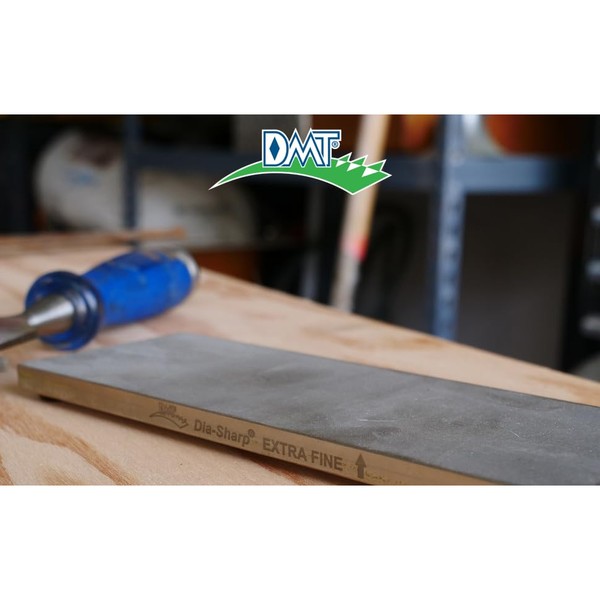
DMT 8-Inch Dia-Sharp Continuous Diamond Bench Stone Set
Best For: Woodworkers who want a lifetime flat sharpening platform that never hollows or cracks.
- +Precision-ground solid steel plate guaranteed flat within 0.0005 inches
- +Continuous monocrystalline diamond surface sharpens narrow mortise chisels smoothly
- +Coarse (325 mesh) and Extra-Fine (1200 mesh) plates handle both shaping and honing
- +Impervious to sub-zero garage temperatures; simply spritz with glass cleaner or soapy water
- -Requires a thirty-stroke break-in period on scrap steel to seat fresh diamond particles
- -Substantial initial investment compared to cheap silicon carbide stones
The DMT Dia-Sharp continuous diamond plates eliminate the frustration of polka-dot diamond patterns, which can snag the narrow tips of 1/8-inch and 1/4-inch mortise chisels. They cut the hardest cryogenically treated A2 steel with light hand pressure.
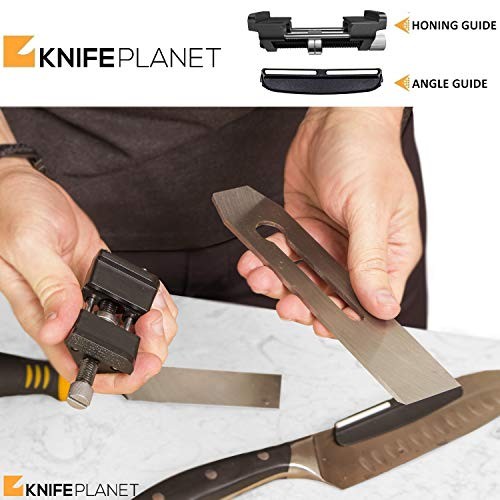
ATLIN Honing Guide for Woodworking Chisels and Plane Blades
Best For: Accurate, repeatable micro-bevel angles without spending fifty dollars on boutique guides.
- +Classic side-clamping jaw design grips standard chisels from 1/8" to 1-7/8" securely
- +Hardened steel center roller glides smoothly across diamond bench plates
- +Cast-in angle gauge steps make setting exact 25-degree and 30-degree bevels foolproof
- +Durable all-metal construction resists rust and workshop wear
- -Narrow center roller requires steady downward finger pressure to prevent tilting
- -Side jaws require careful alignment on heavily tapered Japanese mortise chisels

Leather Honing Strop with Green Chromium Oxide Buffing Compound
Best For: The mandatory final polishing step that elevates sharp tools into surgical instruments.
- +Vegetable-tanned thick cowhide mounted on a flat, rigid solid beech wood base
- +Includes ultra-fine 0.5-micron chromium oxide polishing bar for mirror honing
- +Removes microscopic wire burrs instantly without rounding the cutting apex
- +Produces effortless, hair-shaving sharp edges in ten seconds
- -Stropping requires strictly trailing strokes; pushing forward cuts the leather
- -Compound must be applied lightly; heavy buildup reduces stropping effectiveness
The 5-Minute Routine for Surgical Sharpness
Follow this five-minute routine whenever a chisel begins pulling or tearing end-grain wood fibers:
The 5-Minute Surgical Sharpening Sequence
Restore hair-shaving sharpness when cutting edge begins tearing end-grain fibers.
Clamp in Honing Guide
30 secClamp chisel in honing guide with tip projecting to establish precise 30° secondary bevel angle.
Diamond Plate Honing
1 minApply 12 smooth, consistent pull-strokes across 1200-grit Extra-Fine diamond plate using light downward finger pressure.
Snap the Micro-Burr
30 secRemove chisel from guide. Lay blade back perfectly FLAT on fine stone; pull 3 times across to cleanly snap wire burr.
Bevel Strop Polishing
2 minsDraw secondary bevel backward across green chromium-oxide loaded leather strop 15 times at matching 30° angle.
Flat Back Mirror Finish
1 minDraw flat back across leather strop 5 times with uniform pressure to remove residual microscopic burr.
The chisel shaves arm hair cleanly and pares end-grain white pine like cold butter without tearout.
If you do not feel a microscopic wire burr along the flat back after Step 2, you have not sharpened completely to the cutting apex. Return the tool to your fine diamond stone and make four more strokes until that raised burr appears uniformly across the entire width of the blade.
Keep your stones clean, protect your tool steel from high-speed grinder heat, and set up a dedicated sharpening corner next to your main workstation. If you need a solid foundation for your hand tool work, build our wobble-free garage workbench. When clamping delicate carved parts or tenons during hand paring, equip your station with non-marring jaw inserts using our guide on bench vises: forged steel vs. cast iron, and protect your sharpened edges from workshop humidity using how to keep tools from rusting in a toolbox.
With flat diamond stones, a rigid guide, and a loaded leather strop, you will never struggle with dull chisels again.

Hank Miller
Hank is a master craftsman and DIY mechanic based in Ohio. He tests workshop equipment, garage floor coatings, and power tools under brutal, real-world workshop conditions, with zero paid brand sponsorships.