Cooling a Hot Garage in Summer: Why Swamp Coolers Ruin Tools (And the Exhaust Fan Blueprint)

Evaporative swamp coolers spike indoor humidity to 85 percent, causing flash rust on cast iron. Learn how shutter exhaust fans and intake louvers clear heat soak.
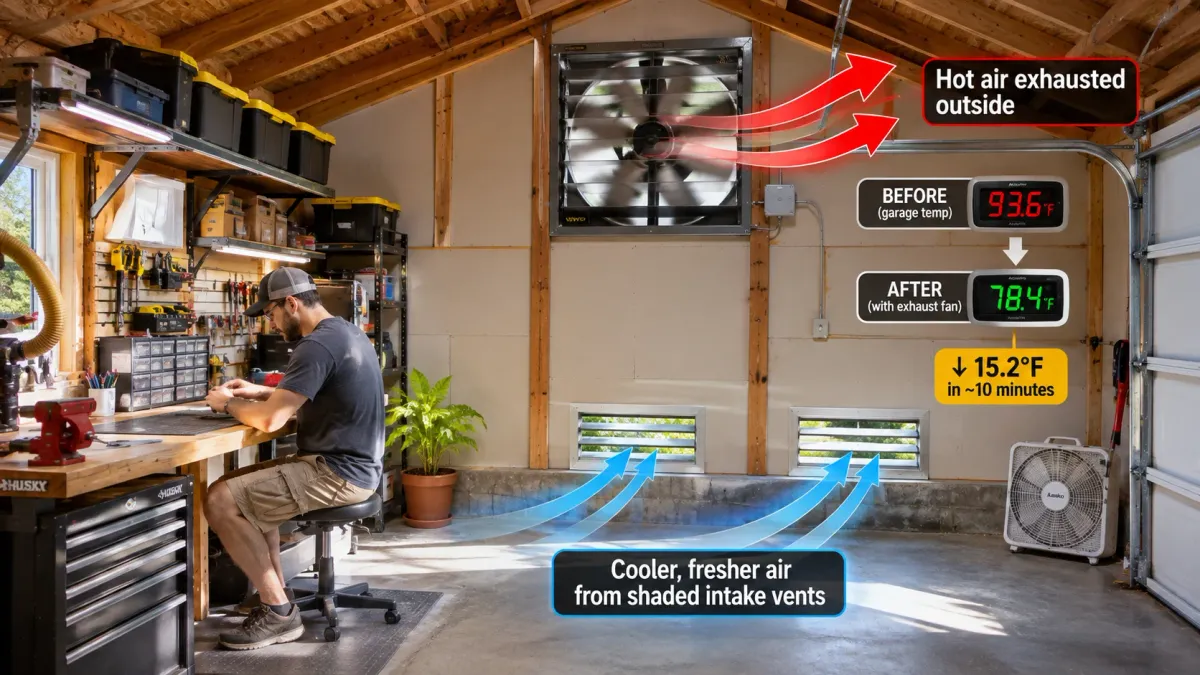
Table of Contents5 Sections
You open the interior walk-through door into your garage at 4:30 PM on a sweltering July afternoon, and an oppressive wave of 105-degree stagnant heat hits you squarely in the chest. Your vehicle engine sits ticking in the center bay, radiating intense heat like an industrial furnace, while paint fumes, gasoline vapors, and tire odors hang suspended in the suffocating air.
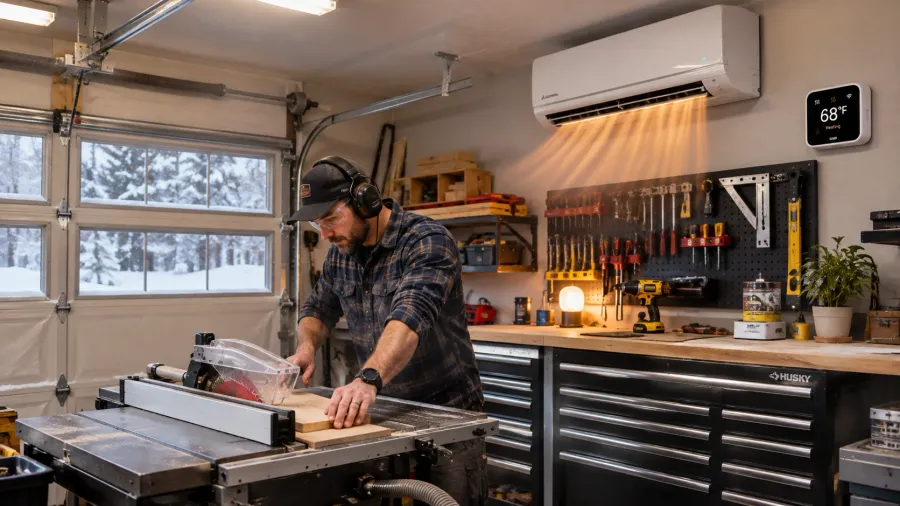
Homeowners respond by buying portable evaporative swamp coolers or setting up large box fans on the floor. Within three weeks, their box fan is merely circulating hot air across their face, while the swamp cooler has dumped gallons of moisture into the room, causing precision cast-iron table saw tops, drill press chucks, and hand chisels to break out in destructive orange rust.
I diagnosed workshop ventilation dynamics and designed airflow layouts across Midwestern machine shops for decades. In this guide, I explain why evaporative cooling destroys metal tools, break down the two physical heat sources that turn your garage into an oven, and show you how to install a thermostatically controlled shutter exhaust system that sweeps heat away using cross-ventilation physics.
The Evaporative Cooler Disaster: The Rust Factory
I see folks buy swamp coolers thinking they found a cheap shortcut. In Ohio humidity, pumping gallons of atomized water into your shop turns every precision tool into an orange mess. Check my guide on how to keep tools from rusting in a toolbox before you even consider adding moisture to your garage air.
Walk through home improvement superstores during summer, and you will see portable evaporative swamp coolers marketed as budget air conditioning alternatives for garages. They roll on caster wheels, run on standard household current, and cost under two hundred dollars.
An evaporative cooler works by pumping liquid water across a cellulose cooling pad while a fan draws air through the wet media. In extremely arid desert climates like Arizona, where outdoor ambient relative humidity sits below 15 percent, water evaporation drops air temperature noticeably.
In the Midwest, East Coast, South, or coastal regions, outdoor summer humidity already sits at 60 to 75 percent. Adding a swamp cooler inside an enclosed garage pumps gallons of water vapor into stagnant air, spiking indoor relative humidity above 85 percent.
That moisture condenses across bare metal machinery surfaces. Bare cast-iron tool beds (such as table saw tables, jointer fences, and lathe beds) lack protective paint skins, triggering electrochemical flash rusting that pits precision-ground metal within forty-eight hours.
The Two Sources of Extreme Garage Heat
According to U.S. Department of Energy (DOE) building envelope guidelines, uninsulated roof decking can easily radiate attic temperatures exceeding 140 degrees into an enclosed workspace.
To cool an enclosed garage effectively without spending three thousand dollars on a mini-split air conditioning system, you must target the two physical heat generators driving the temperature spike:
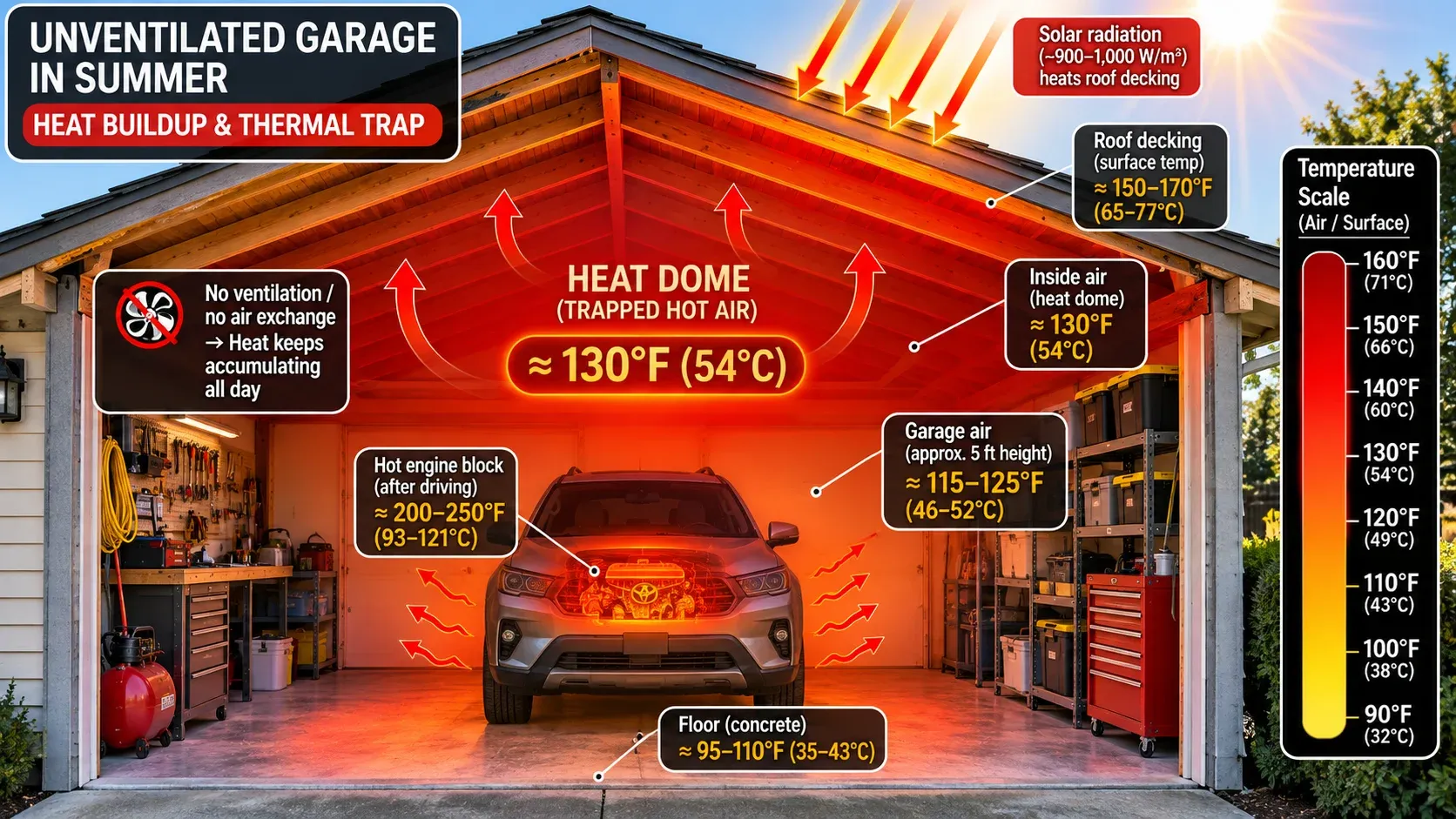
Thermal architectural cross section diagram of an unventilated garage in summer, showing solar radiation through roof decking creating a 130°F heat dome trapped under ceiling, hot car engine block radiating thermal energy, no air exchange arrows, red-hot thermal gradient scale.
Source 1: Radiant Attic Heat Transfer
Throughout the day, direct sunlight heats asphalt roof shingles up to 150 degrees Fahrenheit. That heat conducts into uninsulated attic rafters, turning the ceiling joists above your garage into a massive radiant ceiling panel that bakes your workshop from above all afternoon.
Source 2: Vehicle Engine Heat Soak
When you park your daily driver inside the garage after an afternoon commute, your vehicle carries massive thermal mass. The four-cylinder or V8 engine block, exhaust manifolds, catalytic converters, and transmission fluid operate between 200 and 600 degrees Fahrenheit.
Once you close the overhead door, that five-hundred-pound block of hot metal functions exactly like a 25,000-BTU space heater running on full blast for three continuous hours. The heat cannot escape, trapping dense thermal energy beneath the ceiling.
Workshop Exhaust Sizing Matrix: Calculating Required Air Changes (CFM)
Determine the fan size and airflow volume needed to purge summer heat soak from your garage.
Single-car garage stall (12 x 20 x 8 feet, roughly 1,920 cubic feet)
Standard two-car garage workshop (20 x 20 x 9 feet, roughly 3,600 cubic feet)
Three-car garage or heavy metal fabrication bay (over 5,000 cubic feet)
The Cross-Ventilation Blueprint: Exhaust Fan + Intake Louver
A ceiling or wall exhaust fan cannot blow air out of a building unless replacement air enters from another opening. Operating a powerful exhaust fan inside a completely sealed garage creates a static vacuum that starves the fan blades, reducing airflow by 70 percent and overheating the motor windings.
To achieve maximum cooling efficiency, you must execute a cross-ventilation flow path based on fluid dynamics:
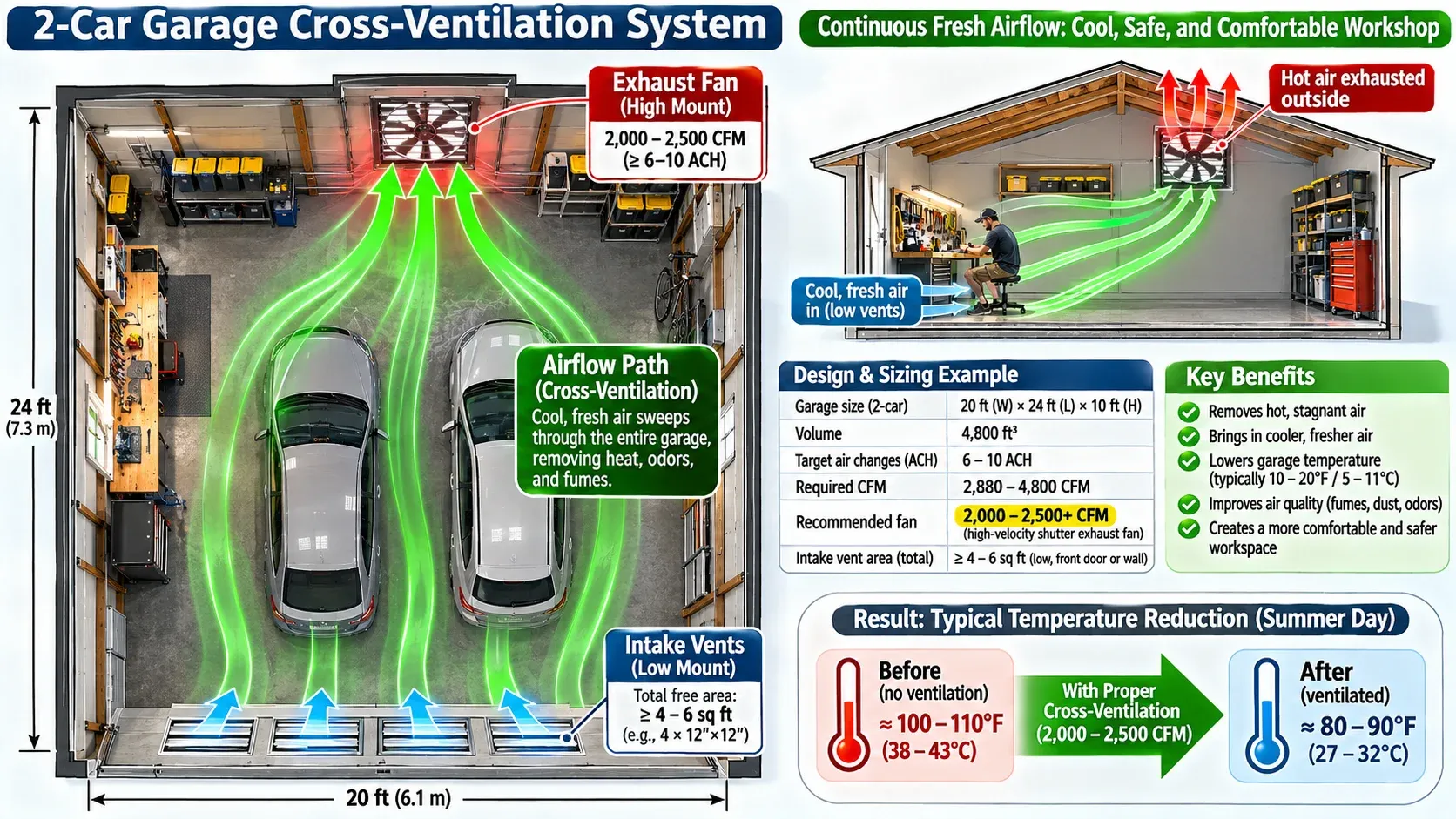
Aerodynamic floor plan diagram of a 2-car garage showing cross-ventilation airflow paths, high-mounted exhaust fan on rear gable pulling hot stagnant air out, cool intake air entering through low-level vents on front garage door, green laminar airflow lines cooling workspace.
First, install your shutter exhaust fan as high as possible on the gable wall that faces away from prevailing winds. Because hot air naturally rises toward the ceiling, high mounting ensures the fan pulls the hottest superheated air directly off the ceiling deck.
Second, equip the fan with gravity-operated aluminum exterior shutters. When the fan powers on, airflow pushes the lightweight louvers open; when the fan shuts down, gravity drops the shutters tight, preventing insects, rodents, and freezing winter drafts from entering your shop.
Third, establish an intake air opening on the opposite side of the garage at floor level (such as a cracked window on the shaded north wall, or an automatic intake louver). As the exhaust fan ejects hot ceiling air outdoors, negative pressure pulls cool, shaded outdoor air across your concrete floor, creating a continuous sweeping breeze that flushes engine heat outdoors in under fifteen minutes.
Automation: The Thermostat Controller
The primary reason exhaust fans fail to keep garages cool is human operation: homeowners forget to turn the fan on until the garage is already a blistering 105 degrees, or they forget to turn the fan off before going to bed.
Wire your exhaust fan through a dedicated line-voltage mechanical or digital cooling thermostat mounted at eye level. Set the thermostat dial to 85 degrees Fahrenheit.
When afternoon sunshine and parked vehicle heat push the ambient garage temperature past 85 degrees, the thermostat automatically engages the fan, evacuating hot air before it can saturate structural framing. Once nighttime temperatures drop below 85 degrees, the thermostat shuts the fan down automatically, conserving electrical power while keeping your workshop fresh and comfortable.
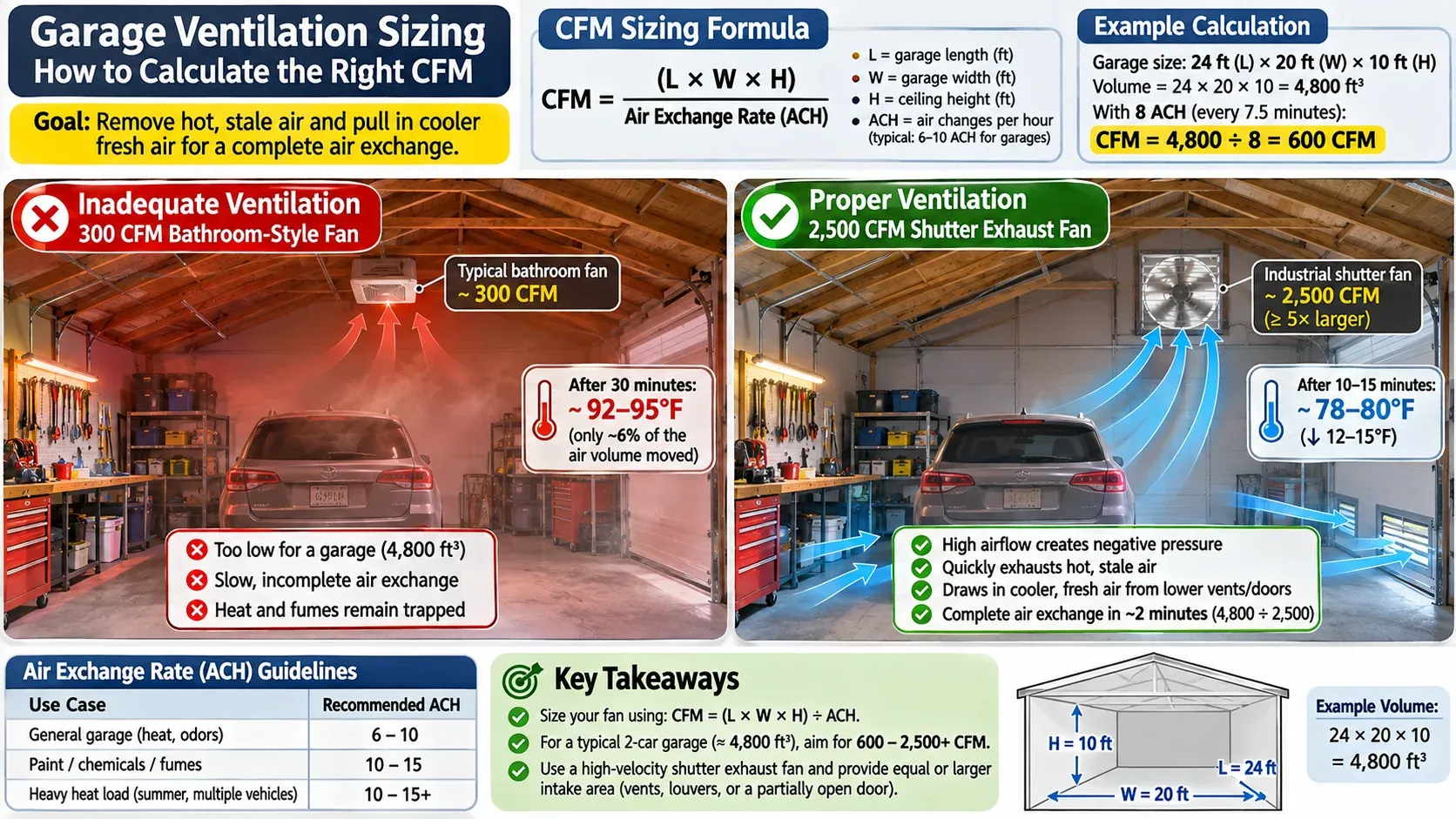
Clean engineering infographic demonstrating garage ventilation CFM sizing formula: length x width x ceiling height divided by air exchange rate, diagram comparing inadequate 300 CFM bathroom-style fan vs industrial 2,500 CFM shutter exhaust fan creating negative pressure draft.
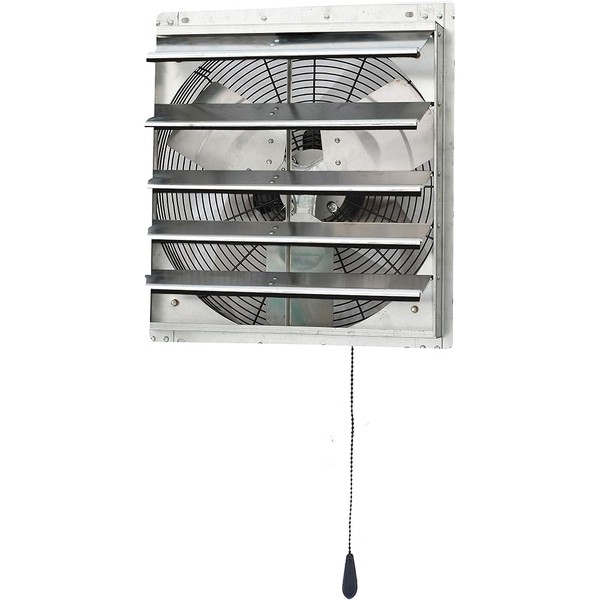
iLiving 18-Inch Wall-Mounted Shutter Exhaust Fan with Thermostat
Best For: Two-car garage workshops requiring automatic heat relief
Est. Price: $160 - $190
"The definitive, heavy-duty wall ventilation fan that automatically purges trapped engine heat without driving up your electric bill."
- +Moves up to 1,736 CFM of air, easily cycling a two-car garage 15 times per hour
- +Pre-wired with adjustable cooling thermostat and standard grounded power cord
- +Corrosion-resistant aluminum exterior shutters close tight against pests
- -Requires cutting a 19x19-inch square rough opening through exterior wall
- -High-speed operation generates audible wind noise during peak cycles
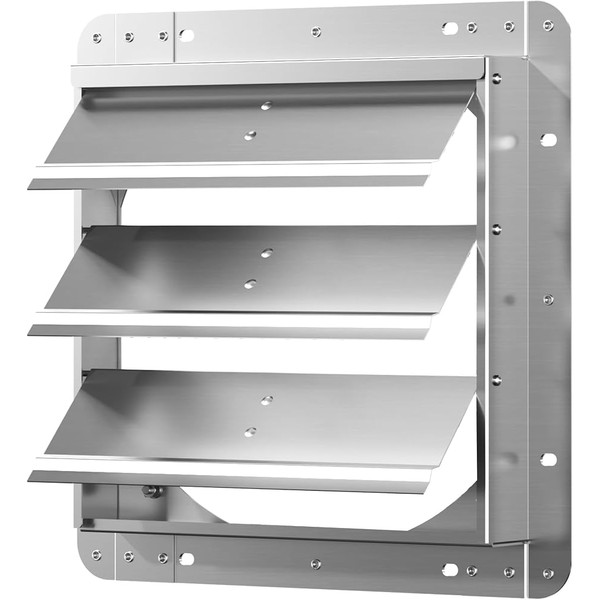
TPI Corporation Heavy-Duty Aluminum Intake Louver (18-Inch)
Best For: Providing low-level replacement airflow across garage floors
Est. Price: $75 - $95
"An essential passive ventilation component that guarantees smooth, high-velocity intake airflow across your shop floor."
- +Gravity-operated aluminum louvers open automatically under negative pressure
- +Includes rear bird and insect mesh screen to keep out pests
- +Heavy extruded aluminum frame resists weathering and rust
- -Requires dedicated low-wall opening opposite your exhaust fan
- -May require seasonal interior insulation cover in freezing northern climates
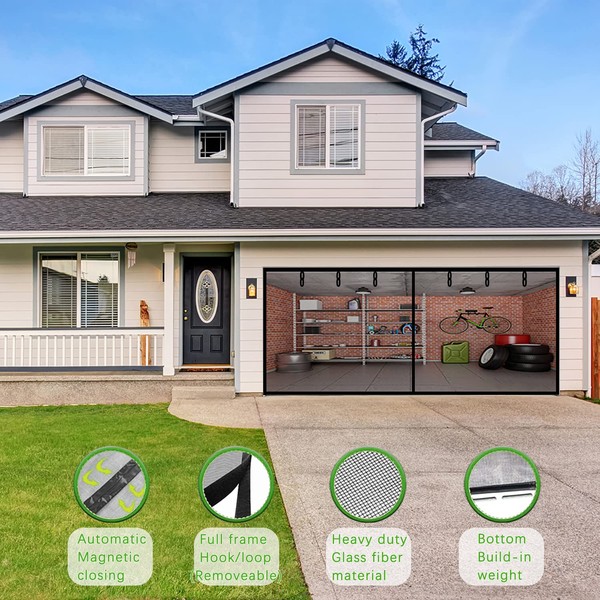
Magnetic Garage Door Screen for Two-Car Openings (16x7 ft)
Best For: Maximum cross-ventilation on mild summer evenings
Est. Price: $45 - $55
"A brilliant summer accessory that lets you open your overhead door completely for maximum cooling breeze without inviting insects inside."
- +Allows massive fresh-air intake through the entire main overhead opening
- +High-density fiberglass mesh keeps mosquitoes and gnats completely out
- +Heavy center magnetic seam seals automatically after walking through
- -Requires perimeter hook-and-loop tape installation along door frame jambs
- -Must be rolled up before closing the main overhead door
Coordinating Workshop Lighting and Electrical Loads
Installing an industrial wall-mounted exhaust fan requires planning your electrical infrastructure and overhead ceiling layouts.
Power your exhaust fan and heavy ventilation equipment safely without overloading household branch circuits by reviewing our wiring guide on wiring a serious garage workshop subpanel.
Ensure your overhead fan placement does not cast harsh strobe shadows across your workbenches by checking our fixture placement layout in the two-car garage lighting blueprint.
Hank Miller
Hank is a master craftsman and DIY mechanic based in Ohio. He tests workshop equipment, garage floor coatings, and power tools under brutal, real-world workshop conditions, with zero paid brand sponsorships.