Best Budget Welding Tables for Home Garages: DIY Solid Plate vs Modular Fixture Tables

Thin metal and wood-topped benches warp under weld heat and create silent fire hazards. Here is how to choose between thick steel plates and modular fixture tables.
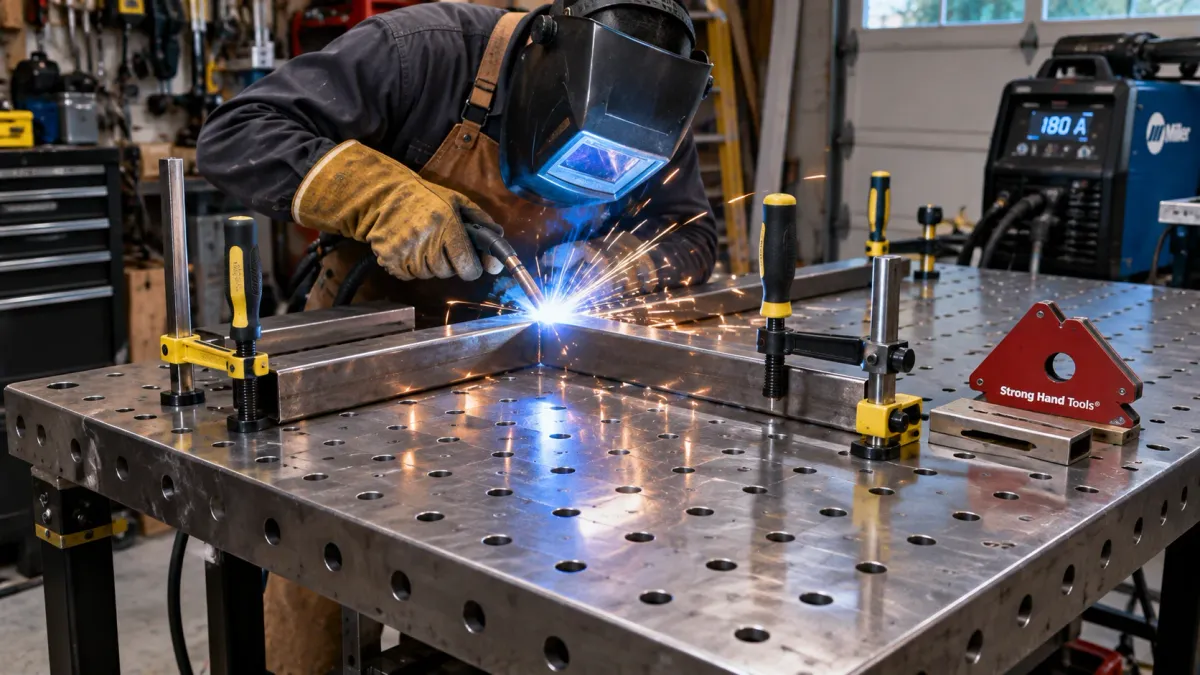
Table of Contents6 Sections
- 01.The Physics of Heat Shrinkage: Why Thin Table Tops Warp
- 02.The Fire Trap: Why Wood Components Have Zero Place on a Welding Bench
- 03.Solid Steel Plate vs. Modular 16mm Fixture Tables
- 04.Mobility in Small Garages: Heavy-Duty Leveling Casters
- 05.Grounding: The Dedicated Copper Ground Lug
- 06.Recommended Tables and Hardware for Home Garages
You spend an entire Saturday carefully cutting and beveling four lengths of square steel tubing to build a custom utility trailer gate. You clamp the pieces down onto a workbench topped with thin sheet metal, grab your MIG torch, and lay down solid, penetrating corner fillet welds.
You let the steel cool, unclamp the frame, and place it down on your flat garage floor.
One corner sits an inch off the concrete, rocking back and forth like a three-legged stool. The frame twisted out of square because your table surface bowed upward under weld heat.
Even worse, you catch the scent of smoldering wood. A red-hot slag bead slipped through a gap in your sheet metal top and embedded itself into the dry two-by-four timber framing beneath. You spend the next twenty minutes frantically dumping water into smoking cracks to prevent a midnight structural fire.
If you weld in a home garage, you need a true, heat-resistant fabrication surface. Here is how to choose between a heavy solid steel plate table and a modern modular CNC fixture table without breaking the bank.
The Physics of Heat Shrinkage: Why Thin Table Tops Warp
Welding introduces intense thermal energy. A standard GMAW (MIG) arc generates temperatures exceeding 2,500°F directly inside the molten weld puddle.
As molten steel cools from liquid to solid, it contracts dramatically. Welding engineers call this transverse and longitudinal shrinkage stress. That contraction generates thousands of pounds of mechanical tension pulling across the joint.
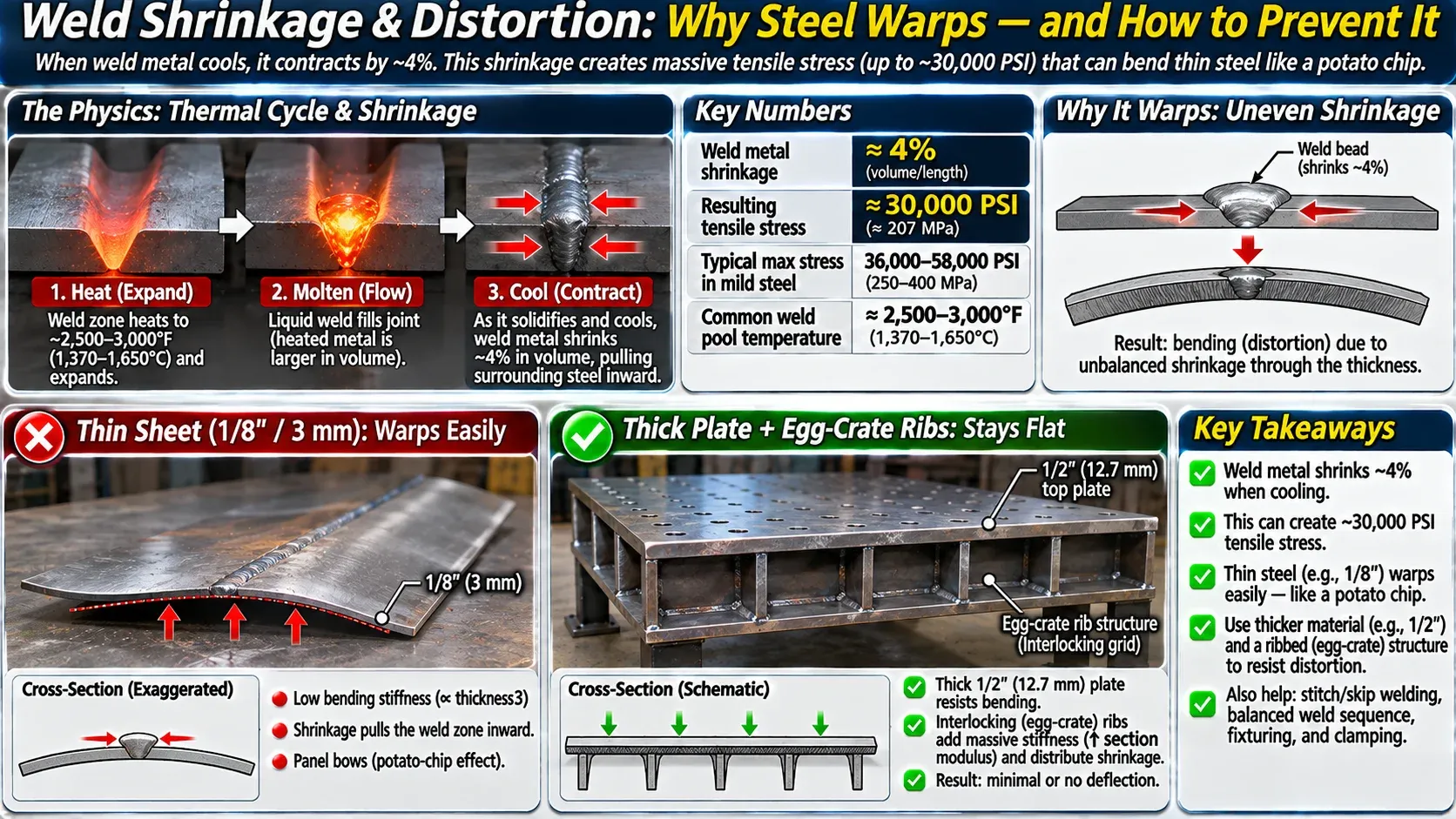
Thermal physics engineering infographic explaining weld shrinkage distortion, molten weld puddle contracting 4% during cooling exerting 30,000 PSI tensile stress warping thin 1/8-inch sheet steel like a potato chip, contrasted with rigid 1/2-inch plate with interlocking egg-crate ribs resisting deflection, clean technical visual.
If you clamp tubing to a thin sheet metal bench (anything under 1/4 inch thick), the table lacks the structural stiffness to resist those shrinkage forces. The top flexes upward, permanently warping both your table and your project.
A thick steel tabletop (3/8-inch or 1/2-inch plate) provides two critical engineering functions:
- Massive Heat Sink: Heavy steel plate absorbs heat rapidly away from your weld zone, minimizing local distortion in delicate thin-wall tubing.
- Mechanical Resistance: The sheer cross-sectional stiffness of 3/8-inch solid steel resists multi-axis shrinkage stresses, forcing the cooling weld metal to yield rather than pulling the table out of plane.
The Fire Trap: Why Wood Components Have Zero Place on a Welding Bench
Many DIY channels suggest tacking a piece of 16-gauge sheet metal over a standard wooden workbench to save money.
In an active garage shop, that setup is a dangerous fire hazard.
The American Welding Society (AWS) Safety in Welding standards state that all welding tables and work surfaces must be constructed entirely of non-combustible materials to prevent smoldering fires. Wood covered by sheet metal forms a natural oven. Trapped slag smolders silently for hours, feeding on dry timber fibers without emitting visible smoke until open flames break out long after you shut off shop lights.
A dependable garage welding bench must feature 100% all-metal steel construction. Frame your legs, cross-stretchers, and shelves using structural square steel tubing, heavy angle iron, or welded steel channel.
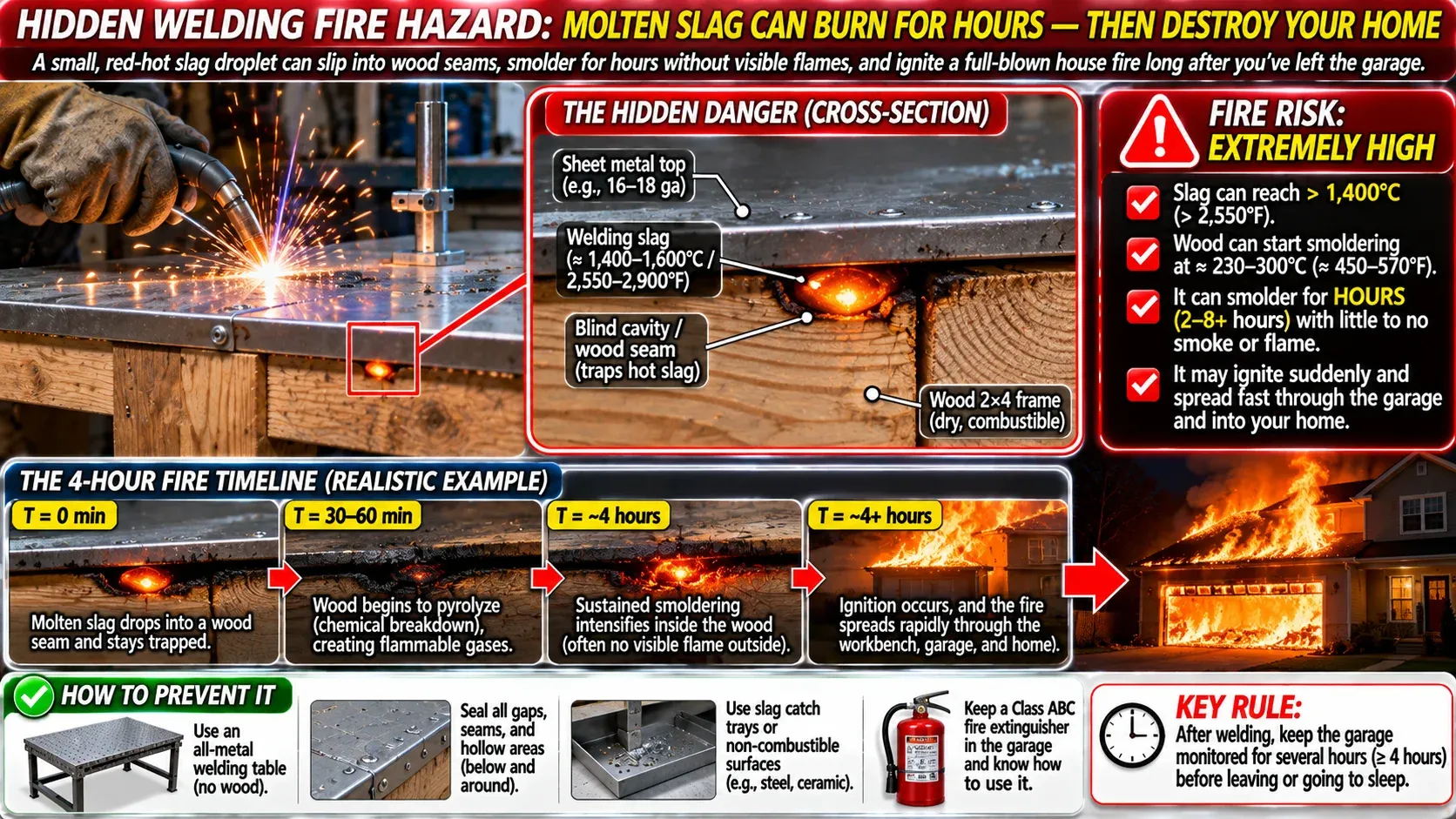
Severe fire safety hazard infographic for garage workshops, cross section of a wooden 2x4 workbench topped with sheet metal, showing molten welding slag droplets trapped in blind wood seams smoldering unnoticed for 4 hours before erupting into house fire at night, bold red emergency warning overlays.
Welding Table Top Comparison
Wood Frame with Thin Sheet Metal
DIY Solid Steel Plate (3/8" - 1/2")
Modular 16mm CNC Fixture Table
Solid Steel Plate vs. Modular 16mm Fixture Tables
When fabricating a permanent welding station, two design philosophies dominate: traditional solid steel plate and modular CNC fixture tables.
1. Solid Steel Plate (3/8-Inch to 1/2-Inch Thick)
Solid plate tables are traditional workshop bruisers. A 3x4-foot plate of 1/2-inch hot-rolled A36 steel weighs roughly 245 pounds on its own.
- Strengths: Virtually indestructible. You can strike frozen suspension pins, bend heavy flat bar with a sledgehammer, and tack ground clamps directly to the slab face without denting the surface.
- Weaknesses: Clamping is restricted to the outer perimeter edges. If you need to secure a diagonal brace in the dead center of a 4x4-foot table, your C-clamps cannot reach it.
2. Modular 16mm CNC Fixture Tables (The Modern Solution)
Modular tables (such as Certi-Flat or BuildPro kits) use precision laser-cut steel plates perforated with a grid of 16mm holes spaced exactly two inches on center. Beneath the surface, an intricate lattice of interlocking perpendicular steel ribs prevents sagging and maintains flatness within 0.005 inches.
- Strengths: Rapid clamping speed. You insert quick-acting drop-in fixture clamps, squaring stops, and V-blocks anywhere across the entire table surface. You can square up complex multi-piece frames in two minutes.
- Weaknesses: Because modular tops feature CNC ribs rather than solid two-inch thickness, you cannot use them as an anvil for heavy sledgehammer work.
Mobility in Small Garages: Heavy-Duty Leveling Casters
Most home fabricators share garage space with family cars. A permanent 500-pound welding table stuck in the center bay ruins daily parking.
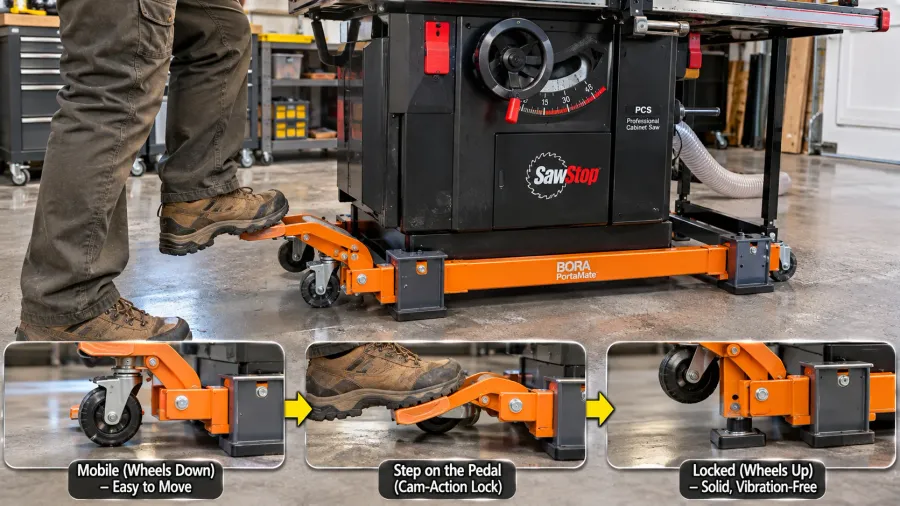
Equip your welding table legs with retractable ratcheting leveling casters (such as GD-60F casters).
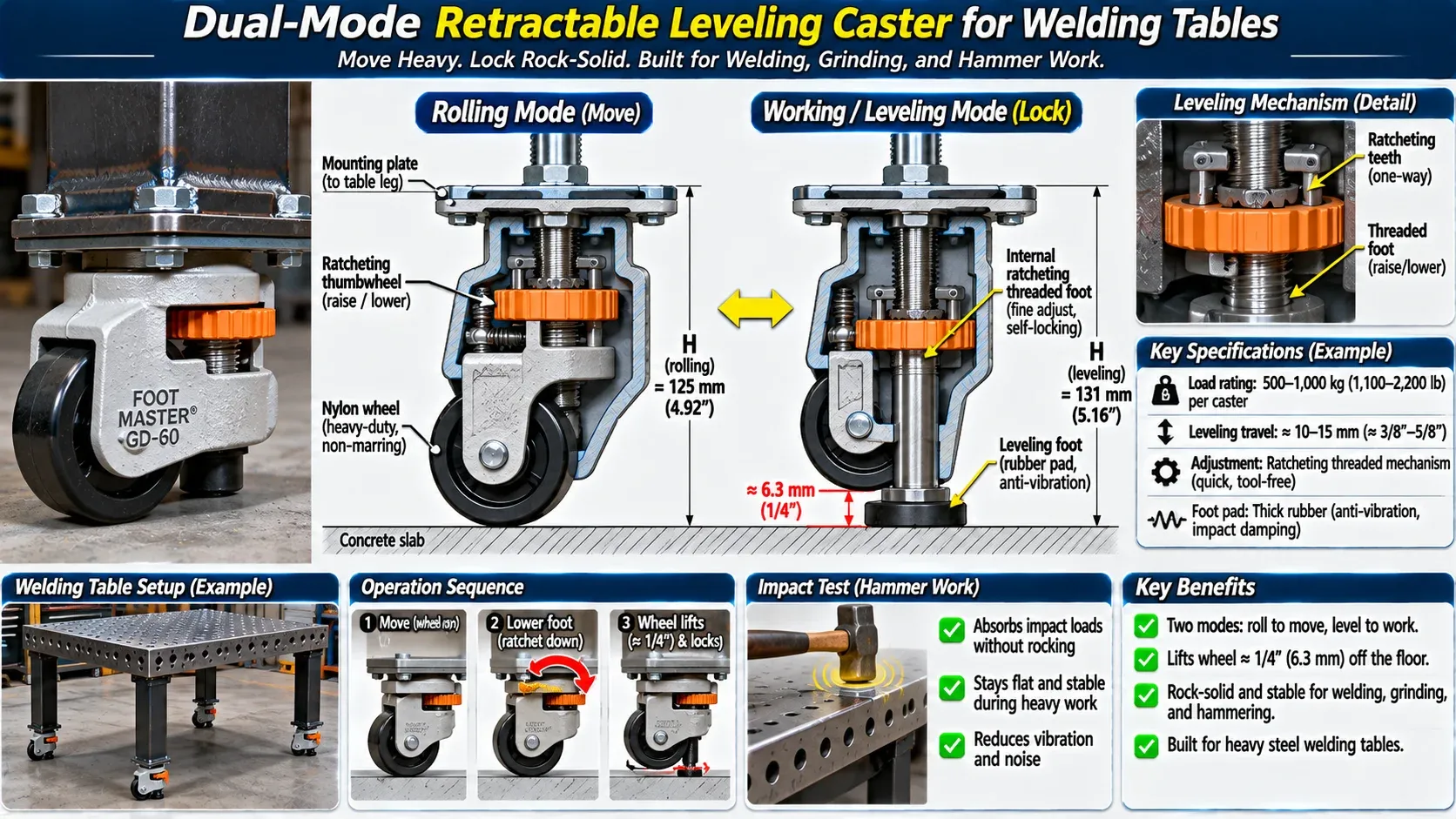
Technical mechanical engineering drawing of a dual-mode retractable leveling caster for a heavy steel welding table, showing internal ratcheting threaded foot mechanism extending down to elevate nylon wheel 1/4 inch off concrete slab, absorbing hammer impacts without rocking, clean CAD style.
These specialized units combine a heavy nylon or polyurethane roller with a built-in, threaded anti-vibration rubber foot. When you need to relocate the table, ratchet the foot up so the wheel contacts the floor. Once the table reaches its workstation, ratchet the rubber feet down to lift the wheels completely off the concrete. The table rests firmly on four anchored shock-absorbing pads with zero rolling slack.
Grounding: The Dedicated Copper Ground Lug
Never clamp your welder ground cable onto a painted leg stretcher or loose table lip. A poor ground connection creates micro-arcing between the table and workpiece, leaving arc burns across your finished project and destabilizing your welding arc.
Weld a dedicated 1/2-inch copper or brass threaded grounding stud onto the underside of your table frame. Bolt your welder work clamp permanently to this lug. This transforms the entire steel tabletop into a clean, unified electrical ground, ensuring crisp high-frequency starts and smooth, spatter-free beads.
Recommended Tables and Hardware for Home Garages
Whether you prefer building a kit or buying a ready-to-weld station, these options deliver dependable performance.
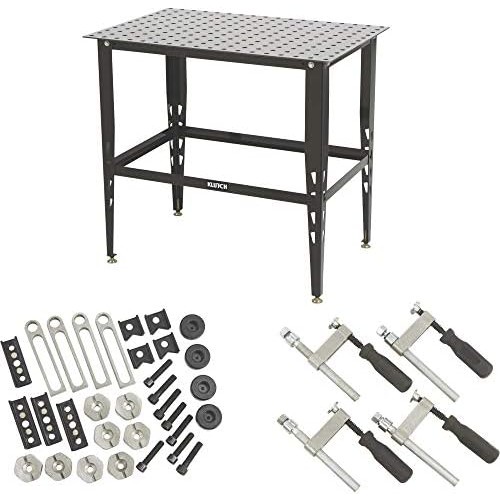
Klutch Steel Mobile Welding Workstation with Tool Kit
Best For: Hobbyist welders who need an affordable, mobile fixture table for weekend garage fabrication.
- +Heavy-gauge steel tabletop features 16mm fixture holes for versatile clamp placement
- +Sturdy 600-pound load capacity easily supports automotive suspension and frame work
- +Retractable pull handle and heavy-duty wheels allow easy movement across garage slabs
- +Pre-machined surface slots accommodate standard welding clamps and squaring fences
- -Assembly requires careful squaring to ensure tabletop halves align perfectly
- -Top plate thickness is 1/8 inch; avoid heavy sledgehammer impacts
The Klutch Mobile Table is an outstanding entry point for residential garages. Its perforated top lets you position clamps anywhere across the work surface, while the folding handle lets you tuck it against the wall when parking cars.
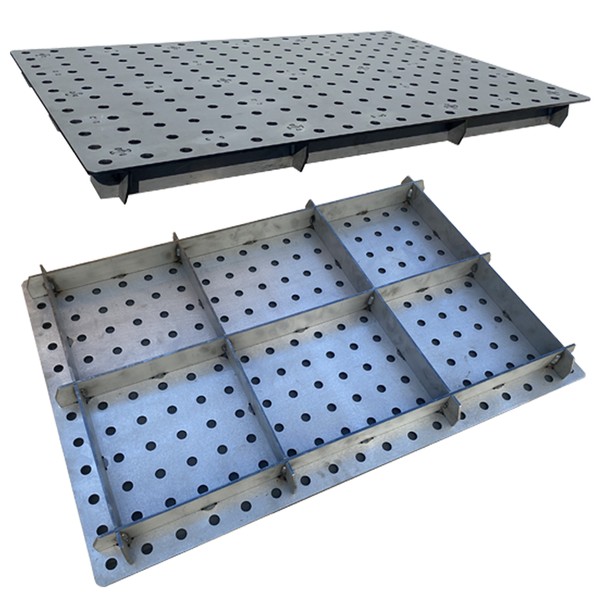
Certi-Flat 3x3 Fab-Block Modular Welding Table Top Kit
Best For: Serious DIY fabricators who demand commercial-grade table flatness for high-precision projects.
- +Patented tab-and-slot interlocking rib design guarantees flatness within 0.005 inches
- +Tough 3/16-inch hot-rolled steel construction handles intense production welding heat
- +Standardized 16mm CNC laser-cut holes on a 2x2 inch grid accept industry-standard tooling
- +Weld-it-yourself design saves hundreds of dollars in factory assembly freight fees
- -Requires careful DIY assembly and precision stitch-welding of underlying lattice ribs
- -Leg kit and casters must be purchased or fabricated separately
If you want absolute precision, Certi-Flat kits are legendary among fabricators. You slot the laser-cut rib matrix together like a puzzle, clamp it flat, and stitch-weld the ribs underneath to create a lightweight, rigid torsion box that never twists.
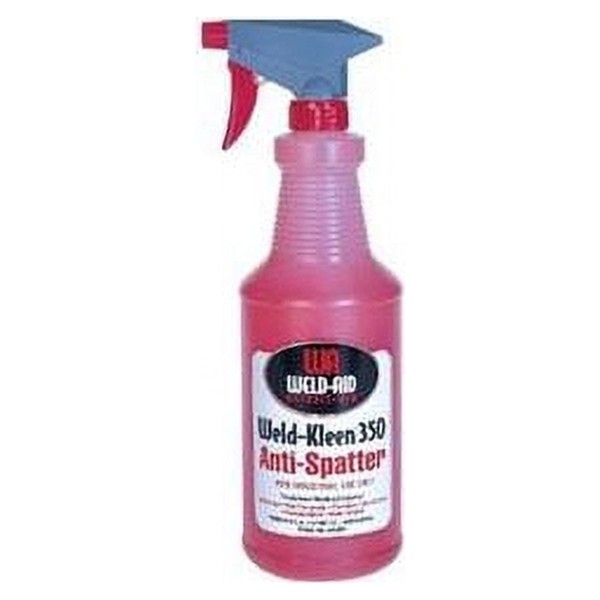
CRC Weld-Kleen 350 Anti-Spatter Spray (Water-Based)
Best For: Keeping precision steel plate and fixture tables clean, smooth, and free of welded spatter.
- +Prevents molten spatter BBs from adhering to your precision tabletop and clamps
- +Water-based non-toxic formula contains zero harmful solvents or paint-contaminating silicones
- +Wipes off easily with a rag; preserves high electrical conductivity across steel tops
- -Must be allowed to dry completely before striking your arc to avoid porosity
- -Requires reapplication after heavy grinding sessions
Before striking your first arc on a new steel table, mist the surface with an anti-spatter spray. Spatter beads will wipe off with a shop rag instead of welding themselves to your flat surface.
If your garage workshop needs dedicated high-voltage power to run a capable MIG or TIG machine, review our guide on 120V versus 240V welders for home garages and our instructions for wiring a 240V garage subpanel. To securely clamp round and irregular workpieces on your steel table, bolt down a rugged vise using our guide on bench vises: forged steel vs. cast iron, and roll your table smoothly across rough slabs with our guide to heavy-duty mobile bases and casters.
Invest in all-steel construction, guarantee true tabletop flatness, and lock your work down firmly. Your welds will lay flatter, your joints will stay square, and your garage will remain safe.
Hank Miller
Hank is a master craftsman and DIY mechanic based in Ohio. He tests workshop equipment, garage floor coatings, and power tools under brutal, real-world workshop conditions, with zero paid brand sponsorships.