Best Heavy-Duty Mobile Bases for Table Saws: Stop Wobble & Rolling Disasters on Rough Garage Floors

Small caster wheels get trapped in garage floor expansion cracks, tipping top-heavy machinery. Here is how to choose a wobble-free mobile base for heavy cast iron equipment.
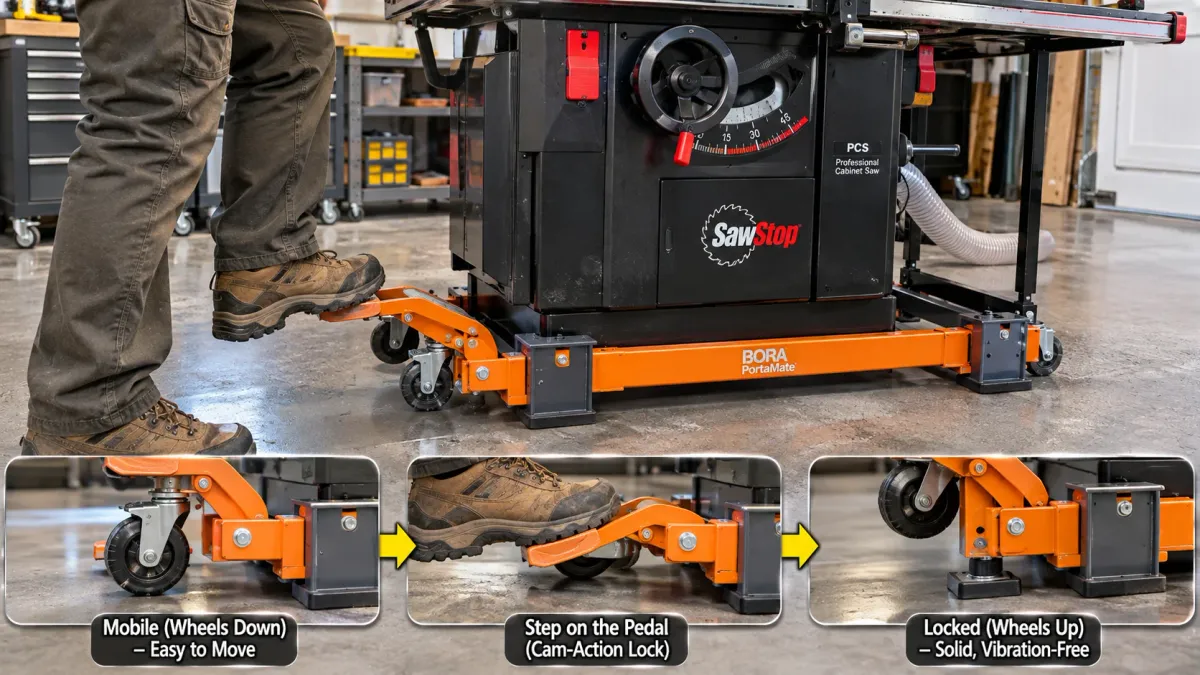
Table of Contents6 Sections
- 01.The Physics of Machine Tipping: Center of Gravity and Control Joints
- 02.Low-Profile Drop-Corner Design: Why Machine Height Matters
- 03.Wheel Materials: Polyurethane vs. Hard Plastic
- 04.Ground Contact: Rigid Footpads vs. Locking Swivel Casters
- 05.Three Tested Mobile Bases for Garage Machinery
- 06.Safe Rolling Routine: How to Move 400-Pound Tools
It is 6:00 PM on a Sunday in your two-car garage. You finish cutting cabinet face frames, and you need to push your 400-pound cast-iron table saw against the back wall so your spouse can park inside.
You grab the table saw rip fence, lean your weight into it, and roll the machine across the floor. Halfway across the room, you hear a loud clunk.
The front left two-inch plastic wheel drops straight into an unsealed concrete expansion joint. The wheel jams solid. The 400-pound machine stops dead, but the heavy cast-iron table and three-horsepower motor up top keep moving forward under momentum. The entire machine tips toward you at a twenty-degree angle. You throw your chest against the table edge and dig your boot heels into the slab, barely saving yourself from being pinned under shattered iron.
If you operate stationary woodworking or metalworking machinery in a shared garage, you must roll heavy equipment without risking life, limb, or expensive iron castings.
Here is how to choose and configure a rock-solid mobile base that glides over uneven concrete joints and locks completely rigid during delicate cuts.
The Physics of Machine Tipping: Center of Gravity and Control Joints
Stationary machinery presents a unique mechanical hazard: an inverted pendulum. OSHA Machine Guarding Standard 1910.212 on machinery stability mandates that stationary machinery must be secured against tipping or movement during cutting operations. A three-horsepower cabinet saw or eight-inch jointer carries sixty to seventy percent of its total mass concentrated near the top of the cabinet.
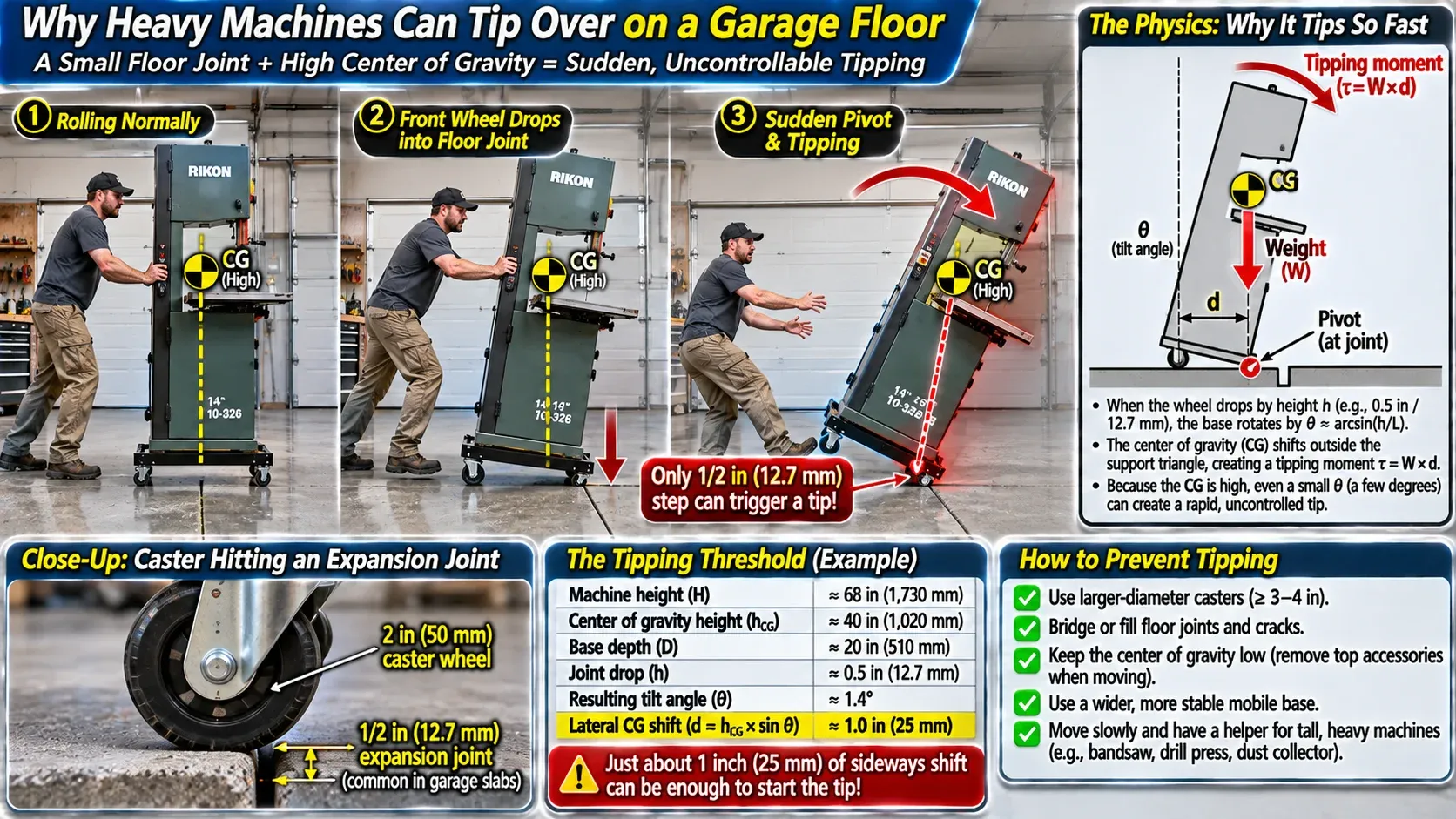
Technical physics safety infographic showing machinery tipping dynamics on concrete floors, tall bandsaw with high center of gravity being wheeled across garage slab, small 2-inch caster wheel dropping into 1/2-inch floor expansion joint creating sudden angular tipping momentum, red danger vector lines.
When you roll a top-heavy machine, any sudden stop at floor level creates an intense rotational tipping moment. The height of the machine multiplies the forward momentum, turning the locked caster into a fulcrum.
Standard residential garage slabs feature tooled control joints or saw-cut expansion joints spaced every eight to ten feet. These joints measure 1/2 to 3/4 inch in width and depth. When a small 2-1/2 inch caster wheel hits a 3/4-inch gap, the curvature of the wheel cannot climb the square concrete shoulder. The wheel wedges tightly into the gap, arresting forward motion instantly and pitching the heavy cast-iron top forward.
To roll safely across cracked or jointed garage floors, your mobile base must utilize wheels with a minimum diameter of 3-1/2 to 5 inches. Larger wheels span the joint opening, rolling smoothly over the gap without dropping into the bottom of the seam.
Low-Profile Drop-Corner Design: Why Machine Height Matters
A common mistake among home woodworkers is building a rolling cart by bolting casters underneath a sheet of 3/4-inch plywood.
When you mount casters directly under a flat base, you raise the entire machine three to four inches off the floor. That extra elevation introduces two serious hazards:
- Compromised Center of Gravity: Raising a 400-pound cabinet saw four inches higher narrows its critical tipping angle from eighteen degrees down to twelve degrees, making it dramatically easier to overturn on sloped slabs.
- Ergonomic Fatigue and Kickback Risk: Standard machine tables sit at 34 to 36 inches above the floor, matching human hip height. Raising the table to 39 inches forces you to push heavy sheet goods with your arms elevated, reducing downward control and increasing the danger of dangerous kickback.
Professional mobile bases solve this using drop-corner steel brackets. The heavy structural steel corner brackets cradle the machine feet just 1/2 inch to 3/4 inch above the concrete slab. This keeps the center of gravity low and preserves the factory working height of your tools.
Wheel Materials: Polyurethane vs. Hard Plastic
Avoid mobile bases that use hard black polypropylene or nylon casters. Hard plastic wheels slide sideways on fine wood sawdust like bald tires on ice. When you roll a machine over metal shavings, hard plastic embeds the debris into the wheel tread, creating flat spots that rumble forever.
Choose heavy-duty cast-iron or stamped-steel wheel hubs clad in thick, non-marring polyurethane tread.
Polyurethane provides several distinct advantages:
- Elastic Shock Absorption: The material compresses slightly over concrete ridges, swallowing expansion joints without jarring precision cast-iron alignments.
- Traction on Dusty Slabs: Polyurethane maintains positive frictional grip on dust-coated concrete and epoxy floors, preventing runaway machines on sloped garage floors.
- Floor Protection: Unlike hard plastic or bare cast iron, polyurethane will never crack epoxy coatings or leave black rubber scuff marks on finished slabs.
Mobile Base Architecture Comparison
Flat Plywood with Swivel Casters
Universal Bolt-Together Kit
Industrial Drop-Corner Base (Bora PM-3500)
All-Terrain 5-Inch Base (Rockler)
Ground Contact: Rigid Footpads vs. Locking Swivel Casters
Many hobbyists assume that buying casters with foot-operated wheel locks will keep a table saw stable during operation.
That assumption is false. A standard wheel brake merely locks the rotation of the wheel axle. It does not lock the internal 360-degree ball bearing swivel race inside the caster horn. Even with the wheel brake engaged, the swivel mechanism retains 1 to 2 millimeters of lateral play. When you push a heavy sixty-pound sheet of 3/4-inch birch plywood across the saw blade, that tiny caster play allows the entire saw to rock, creating binding, burned cuts, and uneven kerfs.
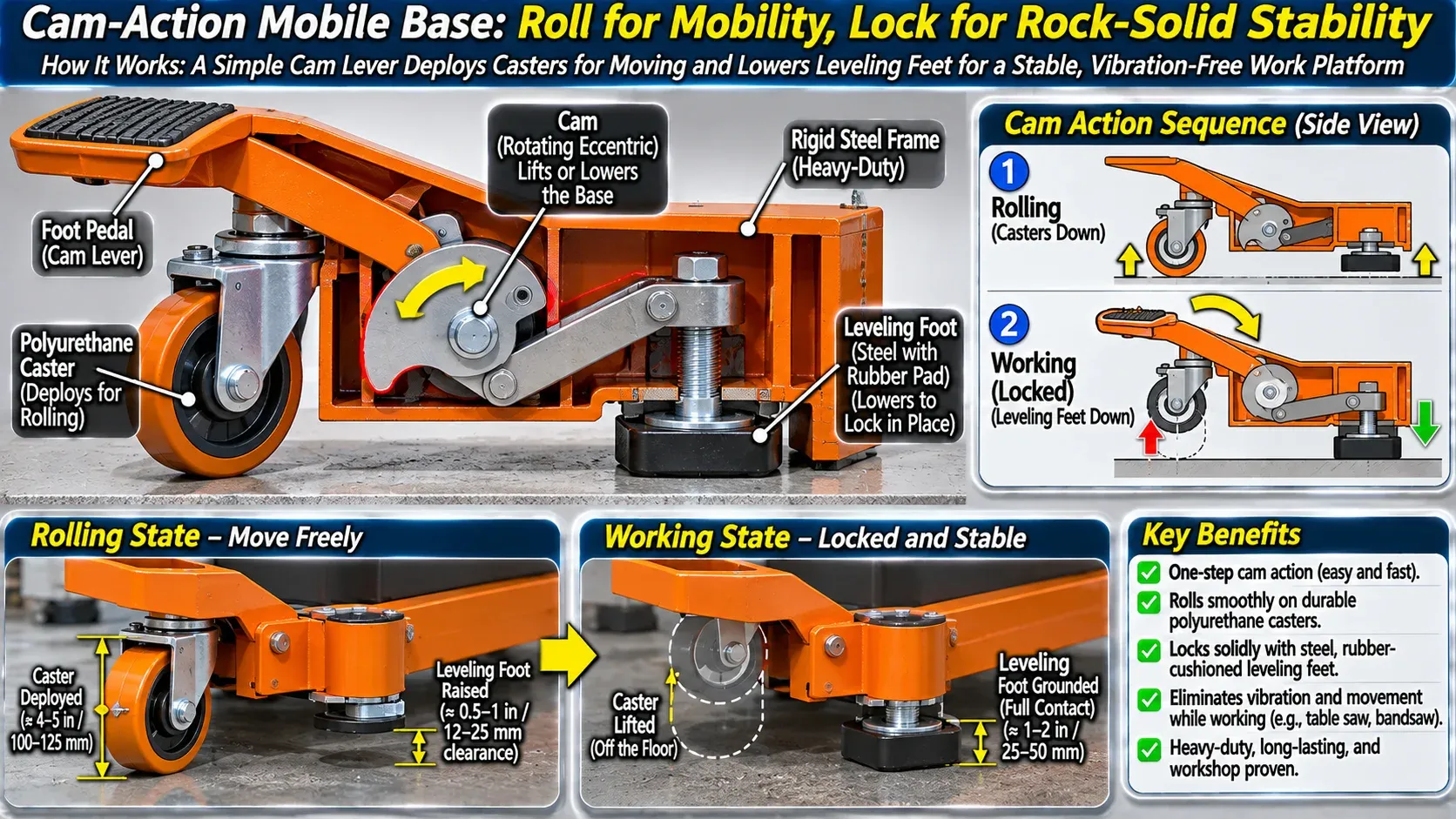
Mechanical CAD cutaway diagram of a heavy-duty cam-action mobile base mechanism, two-position operational schematic showing rolling state with polyurethane casters deployed vs working locked state with heavy rubber-cushioned steel leveling feet grounded solidly on slab, clear kinematic arrows.
True precision requires a cam-action drop-down footpad mechanism.
When you flip the foot levers down, the base transfers one hundred percent of the machine mass onto heavy rubber or solid steel leveling feet anchored directly against the concrete floor. The casters lift completely off the ground, eliminating all bearing slack and vibration.
Three Tested Mobile Bases for Garage Machinery
I have pushed heavy equipment over cracked Midwestern concrete for decades. These three bases provide dependable support for heavy shop equipment.
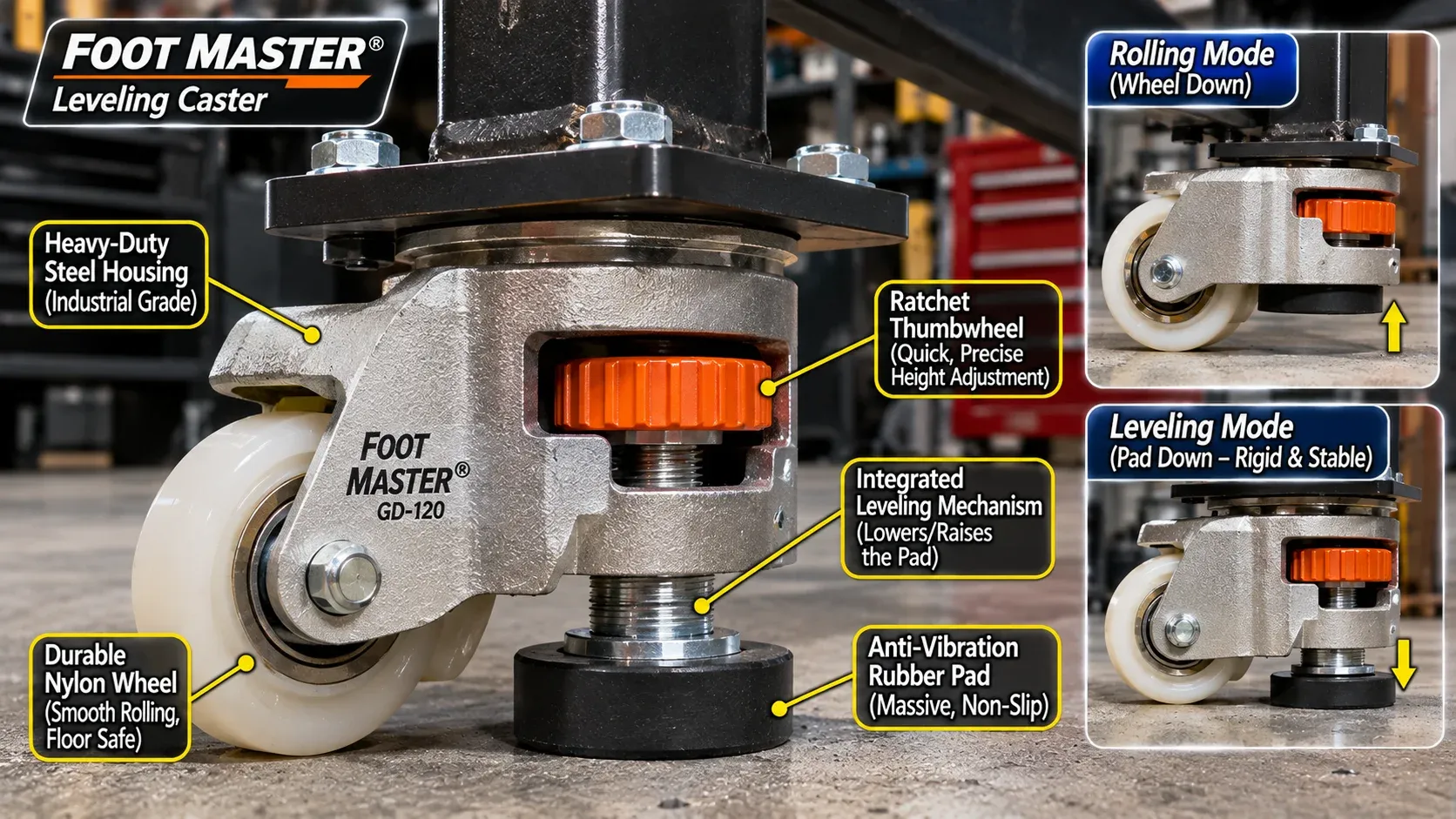
Macro detail photography of a heavy-duty industrial Foot Master leveling caster mounted on a metal fabrication table leg, showing durable nylon roller wheel and integrated orange ratchet thumbwheel extending a massive anti-vibration rubber leveling pad to the concrete floor, high industrial quality.
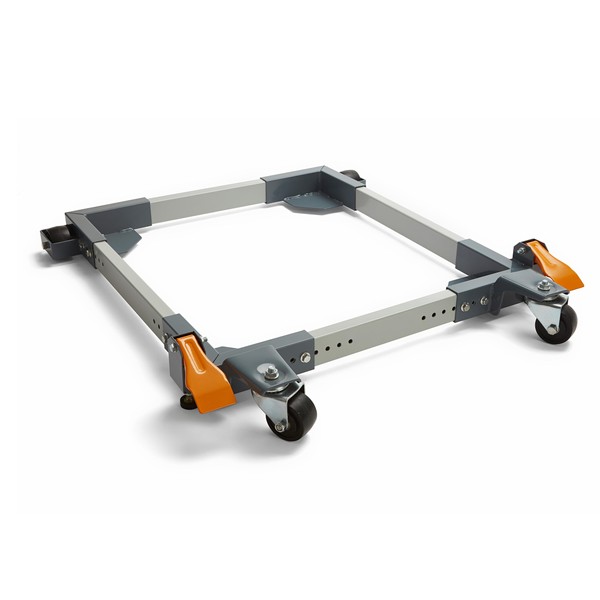
Bora Portamate PM-3500 Industrial Heavy-Duty Mobile Base
Best For: Heavy stationary cabinet table saws, heavy shapers, and cast-iron band saws.
- +Massive 1,500-pound load rating handles cabinet saws and 8-inch jointers with ease
- +Low-profile drop corners keep machine working surface within 1/2 inch of factory spec
- +Heavy-duty three-inch non-marring ball bearing polyurethane wheels navigate joints
- +Solid foot-operated steel cams drop leveling pads directly onto concrete instantly
- -Requires careful square assembly and bolt torquing during initial setup
- -Extension rails for long 52-inch fence tables sold separately
The Bora PM-3500 represents the gold standard for heavy stationary equipment. Its welded drop corners withstand heavy cabinet saw weights without sagging, and the cam-action foot levers engage smoothly without binding your boots.
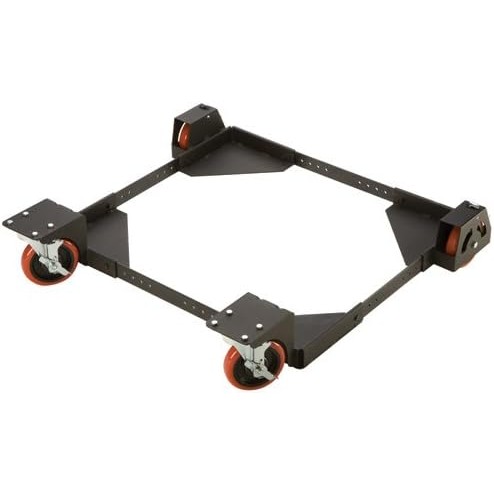
Rockler Heavy-Duty All-Terrain Mobile Base
Best For: Garages with severely cracked slabs, deep control joints, or steep entrance ramps.
- +Massive 5-inch diameter polyurethane wheels roll over rough expansion joints and cords
- +Extra ground clearance prevents bottoming out on sloped garage door thresholds
- +Rigid tubular steel stretchers resist frame racking under heavy 800-pound loads
- +Large rubberized footpads lock machine solid with zero lateral wobble
- -Higher initial cost compared to universal light-duty mobile bases
- -Increases machine footprint slightly due to outward-canted wheel brackets
If your garage slab resembles a topographic map with deep frost heaves and broken concrete ridges, the Rockler All-Terrain base is the answer. Its five-inch wheels roll across gaps that stop smaller casters cold.
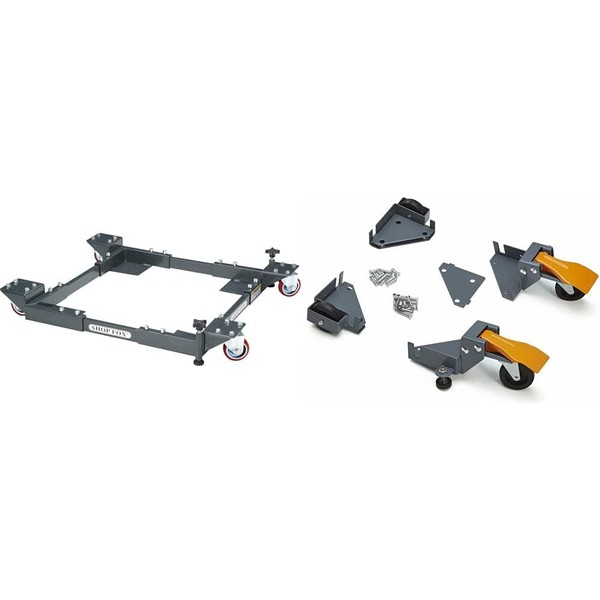
Shop Fox D2057A Heavy-Duty Adjustable Mobile Base
Best For: Mid-weight workshop tools like drill presses, scroll saws, and benchtop planer stands.
- +Solid 700-pound load rating handles contractor saws, drill presses, and small planers
- +Adjustable frame dimensions adapt from 19x20 inches up to 29x29 inches
- +Dual foot-actuated levers drop front rubber feet firmly onto concrete
- -Hard plastic wheels can struggle across wide, square-edged control joints
- -Requires flat floor surfaces to achieve uniform four-corner contact
Safe Rolling Routine: How to Move 400-Pound Tools
Follow these basic safety rules whenever moving heavy tools across your garage:
- Lower All Attachments First: Lower your saw blade completely below the table insert. Lock the rip fence securely in place over the table center to prevent it from sliding off and crashing to the floor.
- Push Low on the Machine Body: Never push a rolling tool by grabbing the overhead dust shroud or the outer edge of an extension wing. Place both hands low on the main structural machine cabinet, pushing through the center of mass.
- Keep Your Travel Path Swept Clean: Wood offcuts, power cords, and dropped bolts act like wheel chocks. Take thirty seconds to sweep your rolling path before moving heavy machinery.
If your table saw top suffered surface rust from sitting on cold garage concrete, read our proven restoration guide on restoring cast iron table saw tops. To keep air lines and dust collector hoses connected without tripping over ductwork, coordinate your drops with our small-shop guide on woodworking dust collection physics, and align your outfeed tables with our wobble-free garage workbench blueprint. Pair that pristine cast-iron top with a heavy-duty drop-corner mobile base, and your small garage will transform from a cramped storage unit into a fully flexible, professional workspace.
Hank Miller
Hank is a master craftsman and DIY mechanic based in Ohio. He tests workshop equipment, garage floor coatings, and power tools under brutal, real-world workshop conditions, with zero paid brand sponsorships.