How to Restore a Rusted Cast Iron Table Saw Top (Without Ruining Its Precision Flatness)

Aggressive sanders ruin the 0.002-inch precision flatness of cast iron tables, while silicone sprays ruin wood finishes. Learn the razor-scrape and two-tier wax protocol.
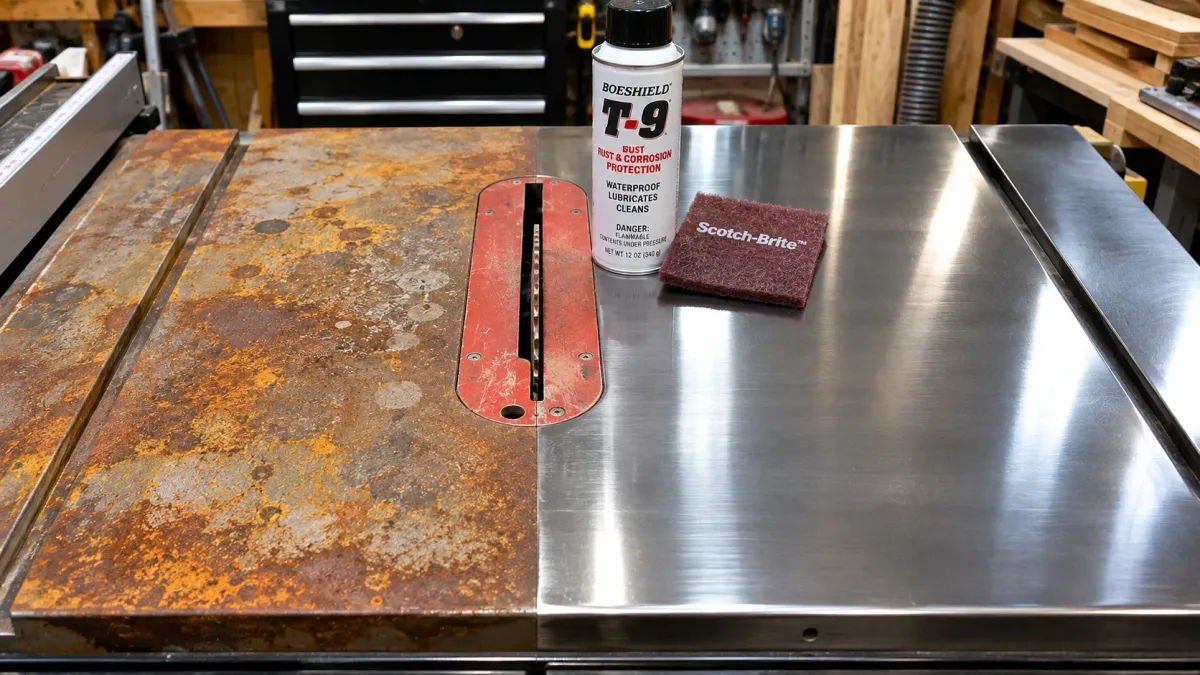
Table of Contents6 Sections
You pull the canvas tarp off your cabinet table saw after three weeks of wet spring weather, and your heart sinks. The precision-ground, mirror-smooth cast iron surface that cost you fifteen hundred dollars is covered in an ugly mottled rash of reddish-brown rust, complete with an orange handprint where you leaned against the bare metal while wearing sweaty gloves.
Desperate to get back to woodworking, homeowners grab a random orbital sander, slap on a sheet of 120-grit sandpaper, and grind away at the table. Ten minutes later, the orange rust is gone, but the high-speed sander has dished out the metal around the miter gauge slots, destroying the tabletop’s 0.002-inch factory tolerance and guaranteeing that every board you cut will be out of square.
I aligned industrial milling machinery and rebuilt vintage cast-iron shop equipment for decades. In this guide, I explain why mechanical sanders and vinegar ruin cast iron, show you why silicone lubricants destroy your furniture finishes, and provide the proven four-step restoration method that removes rust completely while preserving factory-ground precision flatness.
The 2 Deadly Mistakes That Ruin Cast Iron Forever
When you lap tool surfaces or clean cast iron machinery beds, treat them with the same precision you use on your bench edges. Read my guide on how to sharpen woodworking chisels with diamond stones to see why true flatness matters for all shop reference surfaces.
Before touching your table saw top with any tool or chemical, you must avoid two widespread maintenance blunders that cause irreversible workshop damage:
Mistake 1: The Power Orbital Sander Sin
Meehanite gray cast iron is a relatively soft, porous ferrous metal alloyed with graphite flakes. Standard aluminum-oxide or silicon-carbide sandpaper abrasive is significantly harder than cast iron.
When you run an orbital sander across a flat table, the spinning disc cuts faster at the edges of the miter slots and throat plate openings. In less than two minutes, the sander hollows out low spots measuring three to five thousandths of an inch deep.
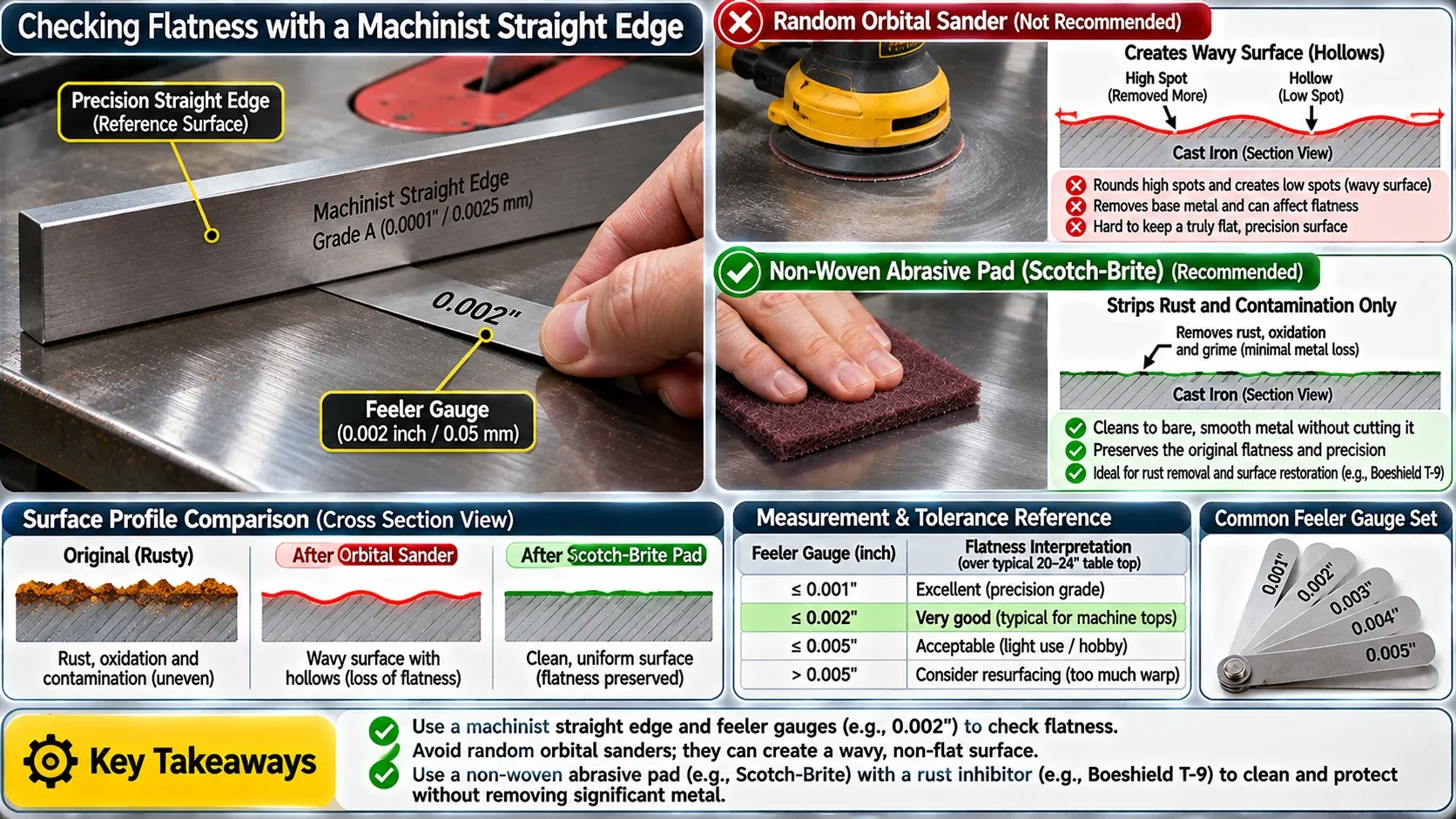
Technical engineering diagram showing machinist straight edge and 0.
Once that flat surface plane is distorted, your workpiece rocks across the dips as you feed lumber past the blade. Your miter gauge binds in its slot, your rip cuts develop uneven tapers, and your boards burn against the rear blade teeth.
Mistake 2: The Silicone Spray Curse
When cleaning metal, homeowners frequently reach for general-purpose silicone spray lubricants to make wood slide smoothly across the table.
Never use any chemical containing silicone inside a woodworking shop. Silicone molecules transfer from the metal table onto the bottom of your raw lumber.
Once silicone penetrates wood pores, it cannot be sanded away or dissolved with mineral spirits. Months later, when you apply polyurethane, lacquer, or wood stain to your finished tabletop, the silicone repels the liquid finish, creating hundreds of tiny circular crater defects known as fisheyes that require stripping the furniture down to bare wood.
Cast Iron Corrosion Severity Scale: Matching Rust to Restoration Method
Identify the depth of oxidation on your table saw top to select the safest restoration procedure.
Light pale-orange dust with zero surface flaking or textural roughness (Flash Rust)
Crusty, dark-brown rough patches that catch a fingernail (Flaking Rust)
Black cratered pockmarks and missing metal divots (Deep Pitting)
Step 1: Mechanical De-Scaling with a Razor Blade
The fastest and safest way to remove 80 percent of heavy, crusty rust scale without scratching bare iron is manual razor scraping.
Take a fresh, brand-new single-edge carbon steel razor blade. Hold the blade firmly in both hands at a very shallow 15-to-20-degree angle relative to the tabletop surface.
Slide the blade forward across the rusted cast iron using moderate downward pressure. Because the hardened steel blade is held at a low shearing angle, it glides across the flat cast-iron plane without cutting in, cleanly shearing off the raised oxide scale and dried tree sap blobs like an ice scraper on a vehicle windshield.
Wipe the dry, pulverized orange rust powder off the tabletop with a dry shop vacuum brush. You will be astonished at how much heavy rust peels away in ten minutes without using a single drop of liquid chemical.
Step 2: The Evapo-Rust Paper Towel Soak
Evaluated under ASTM G1 standard practice for preparing, cleaning, and evaluating corrosion test specimens, selective chelating agents bond exclusively with iron oxide, leaving the underlying virgin gray iron casting completely unetched.
Never pour household white vinegar onto a cast-iron tool table. Vinegar contains acetic acid, which aggressively attacks both iron oxide and the underlying crystalline iron matrix, leaving deep acid-etched micropores that permanently ruin the smooth glide of the table.
Instead, use a non-toxic selective chelation rust remover like Evapo-Rust. Chelation chemistry bonds specifically to iron oxide molecules, dissolving rust completely while leaving bare elemental iron completely untouched.
To apply liquid Evapo-Rust to a flat horizontal table without running off:
- Cover the entire cast-iron tabletop with a single layer of standard kitchen paper towels.
- Pour liquid Evapo-Rust generously over the paper towels until the paper is completely saturated and clings flat against the metal.
- Stretch standard plastic food wrap across the wet paper towels to prevent the liquid from evaporating.
- Allow the chemical to soak undisturbed for forty-five minutes to an hour while the chelation agents dissolve the remaining dark oxidation.
Step 3: Scotch-Brite Buffing and Mineral Spirits
Peel off the plastic wrap and lift away the black-stained paper towels, tossing them into the trash. The cast iron will look dark gray with loose, liquefied rust sludge resting on the surface.
Spray the table with a generous mist of odorless mineral spirits to act as a floating lubricant. Take a 3M Scotch-Brite 7448 Ultra-Fine gray hand pad (equivalent to 00-grade steel wool, but made of synthetic fibers that will not shed steel shards into your saw motor) and buff the surface using circular hand motions.
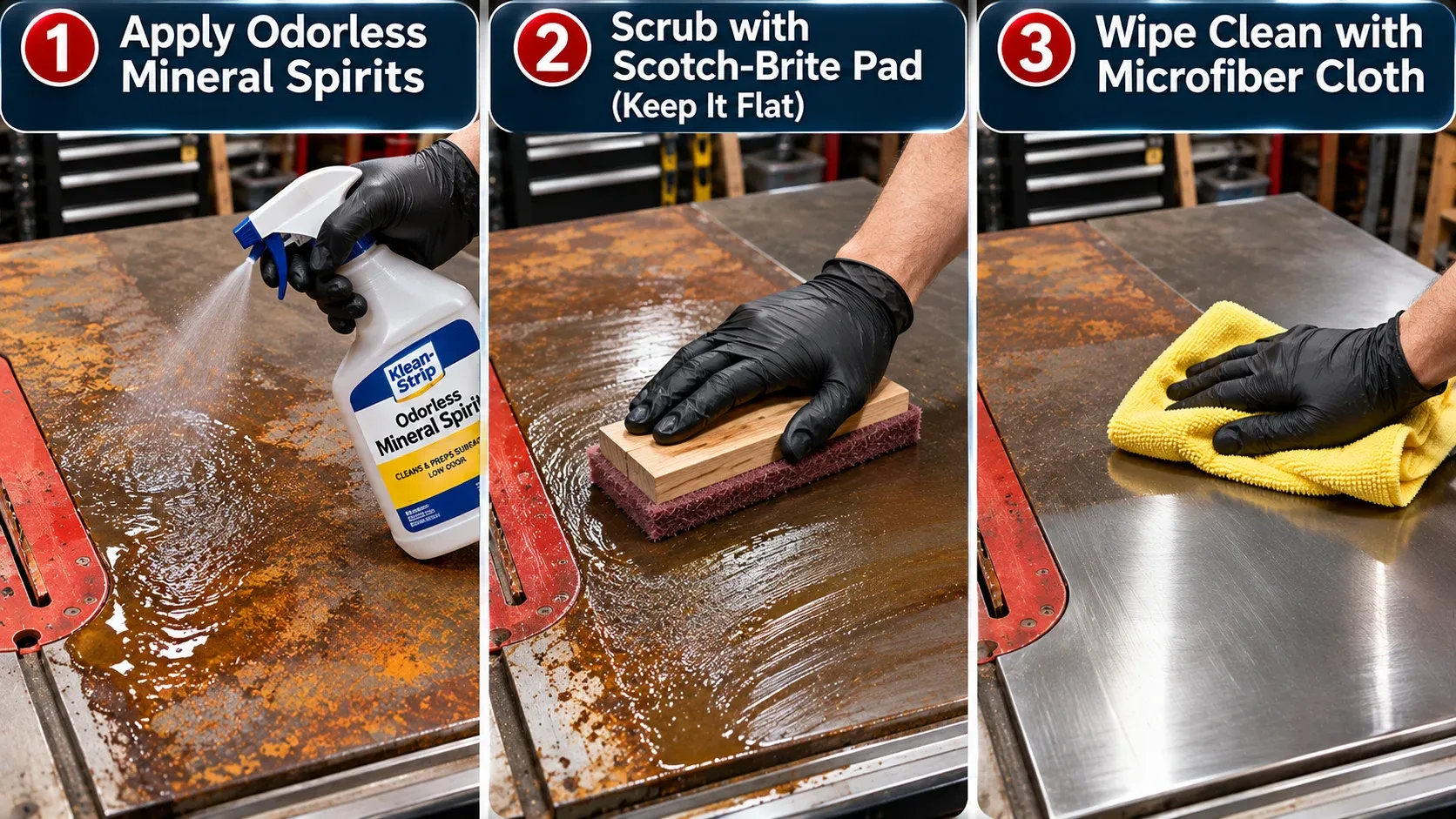
Three-panel step-by-step restoration photo series: panel 1 spraying odorless mineral spirits onto rusted cast iron, panel 2 scrubbing with maroon Scotch-Brite pad wrapped around a wooden flat block, panel 3 wiping clean with microfiber cloth revealing gleaming bare metal, crisp workshop photography.
The mineral spirits and non-abrasive synthetic pad lift remaining micro-particles out of the surface grain. Wipe the table completely dry with clean cotton shop rags; the cast iron will emerge with its original machined gray luster intact.
Step 4: The 2-Layer Shield (Boeshield T-9 and Paste Wax)
Bare, freshly cleaned cast iron is chemically active and will develop microscopic flash rust within twelve hours if exposed to humid air. You must seal the open pores immediately with a dedicated two-tier protective system:
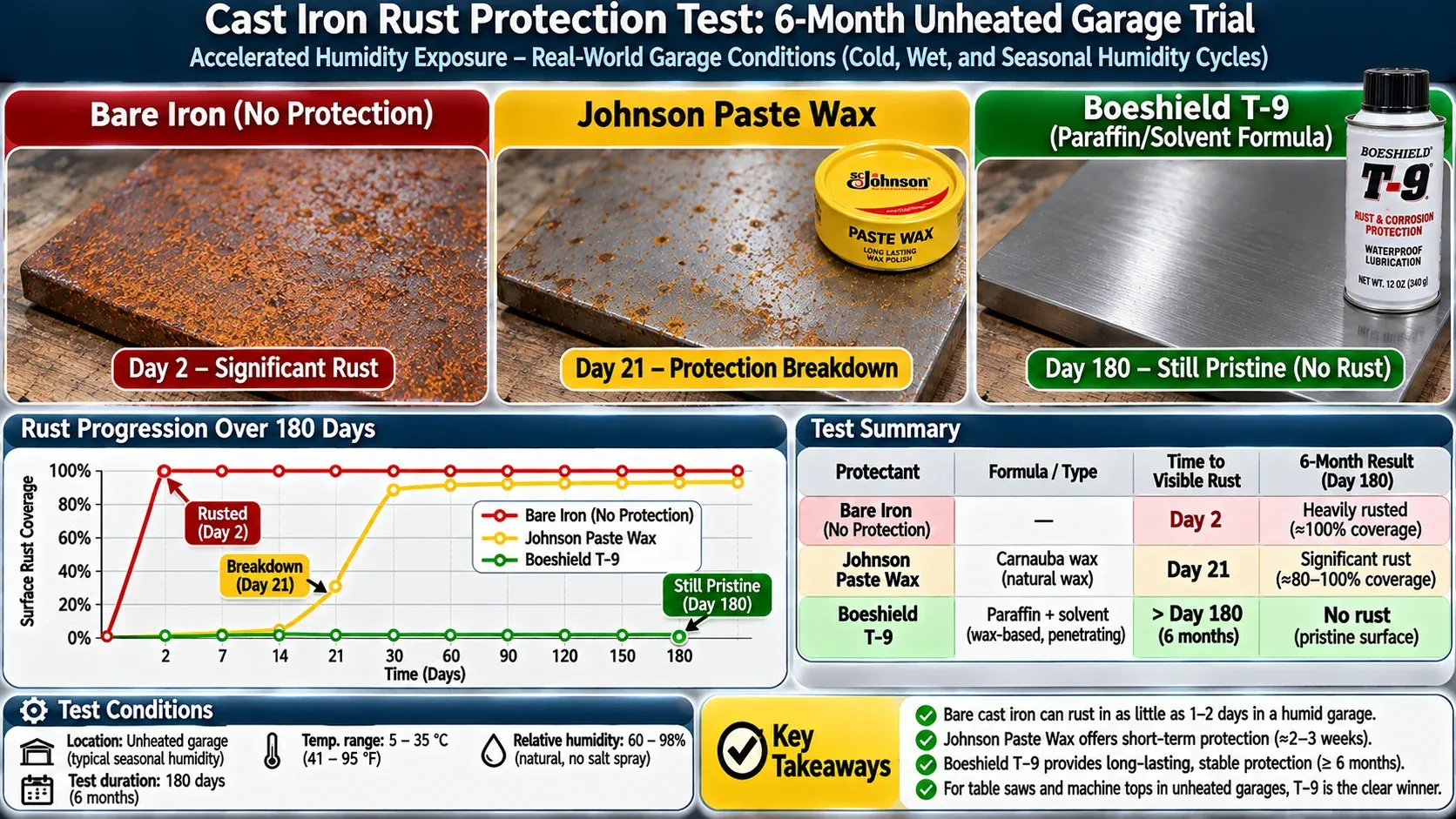
Accelerated humidity testing infographic chart comparing cast iron rust protectants over 6 months in an unheated garage, comparing unprotected bare iron (rusted day 2) vs Johnson Paste Wax (breakdown day 21) vs Boeshield T-9 paraffin/solvent formula (pristine day 180), clean scientific layout.
Layer 1: Deep Pore Sealing with Boeshield T-9
Spray a light, even mist of Boeshield T-9 across the bare metal. Developed by Boeing Aviation, T-9 contains a paraffin wax base suspended in a high-penetration solvent carrier.
Allow the T-9 to soak into the microscopic cast-iron pores for thirty minutes, then wipe the excess film off with a clean rag. The solvent evaporates, leaving a non-tacky, waterproof wax barrier locked deep inside the metal grain.
Layer 2: Frictionless Glide with Minwax Paste Wax
Once the T-9 cures, apply a thin coat of Minwax Paste Finishing Wax (or Johnson’s Paste Wax, provided it is verified 100 percent silicone-free) using a small cotton cloth.
Allow the wax to haze over for ten minutes, then buff the surface vigorously with a clean microfiber towel. The hard carnauba wax skin fills micro-abrasions, seals out moisture from sweaty palms, and reduces surface friction so dramatically that a forty-pound sheet of oak plywood glides across your table saw with the push of a single finger.
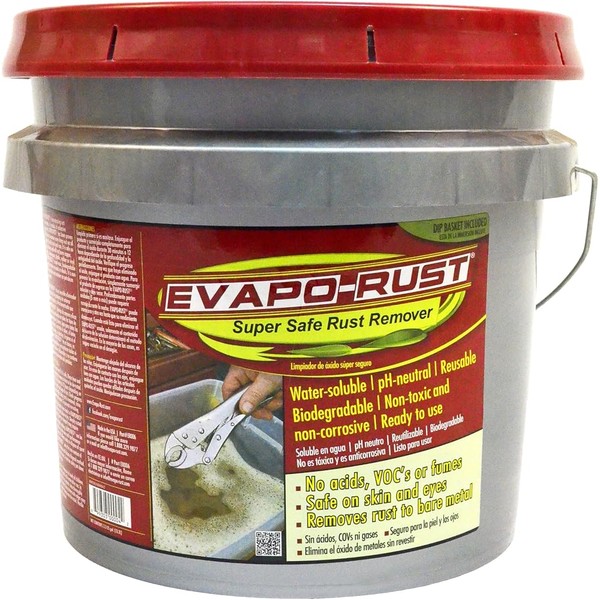
Evapo-Rust Original Super Safe Rust Remover (1-Gallon)
Best For: Dissolving rust without acid etching or metal loss
Est. Price: $22 - $28
"The safest, most effective chemical rust remover in existence, preserving precision machining while melting away deep rust."
- +Non-toxic, biodegradable chelation formula leaves bare metal unharmed
- +Contains zero volatile acids; safe on skin and produces zero toxic fumes
- +Completely eliminates rust scale down to bare gray bare metal pores
- -Requires continuous surface wetting using the paper-towel soak technique
- -Must be wiped clean and neutralized with mineral spirits after treatment
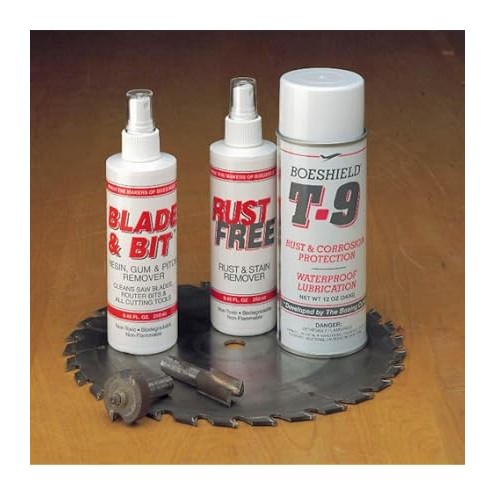
Boeshield T-9 Rust & Corrosion Protection Spray (12 oz)
Best For: Base-layer moisture barrier for bare cast-iron machinery
Est. Price: $19 - $24
"The industry standard primary anti-corrosion barrier for woodworking machinery, engineered by Boeing to stop rust dead."
- +Dries to a clean paraffin-based dry wax film that will not attract dust
- +Penetrates microscopic cast-iron pores to lock out ambient humidity
- +100 percent silicone-free; completely safe for fine woodworking finishes
- -Requires 30 minutes of drying time before buffing top wax coat
- -Aerosol spray can requires gentle trigger control to avoid overspray
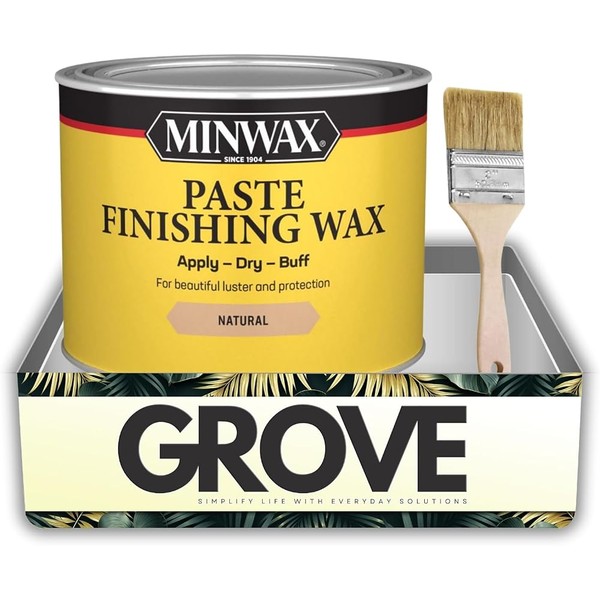
Minwax Paste Finishing Wax (Silicone-Free Regular)
Best For: Top-layer glide and hand-sweat protection on machinery beds
Est. Price: $14 - $18
"The classic, dependable machine wax that delivers a slick, glass-like top glide while protecting cast iron from sweat and moisture."
- +Hard carnauba and paraffin wax polish makes heavy lumber glide effortlessly
- +Zero silicone content guarantees no fisheye paint defects on finished wood
- +One single can provides years of routine workshop maintenance applications
- -Must be applied thin; heavy buildup takes longer to buff clear
- -Requires re-buffing every three to six months in heavily used shops
Preserving Your Restored Machinery
Once you restore the factory-smooth shine and precision flatness of your table saw top, safeguard the rest of your workshop tools against moisture attacks.
Keep hand tools, calipers, and socket sets from rusting inside your tool chest drawers by deploying the vapor protocols in our guide on how to keep tools from rusting in a toolbox.
Ensure your workshop maintains stable relative humidity throughout humid summer months by installing high-efficiency cross-ventilation from our guide on cooling a hot garage in summer.
Hank Miller
Hank is a master craftsman and DIY mechanic based in Ohio. He tests workshop equipment, garage floor coatings, and power tools under brutal, real-world workshop conditions, with zero paid brand sponsorships.