Why Your Garage Concrete Never Stops Dusting (And the $80 Permanent Chemical Fix)

Sweeping chalky concrete only grinds more weak laitance into airborne dust. Learn how penetrating lithium silicate densifiers petrify free lime into permanent granite.
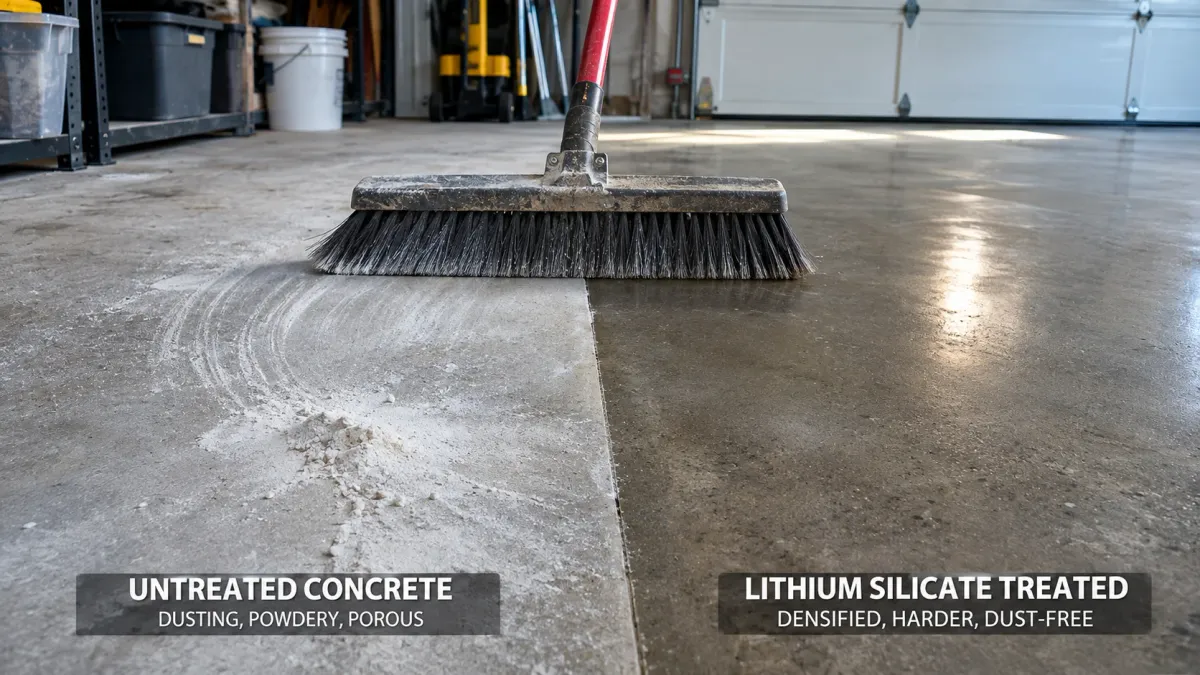
Table of Contents5 Sections
- 01.The Chemistry of “Laitance”: Why Your Concrete Is Shedding Skin
- 02.The Film-Forming Trap: Why Acrylic and Epoxy Paint Peel Off
- 03.The Permanent Cure: How Lithium Silicate Turns Lime into Granite
- 04.The 3-Step DIY Application: Pump Sprayer and Microfiber Mop
- 05.Preparing Your Slab for Long-Term Protection
You walk into your garage in a clean pair of dark socks to grab a socket set, step back inside your home, and look down in disbelief. Your socks show a pale gray coating of fine chalk, and every step across your hardwood floor leaves a powdery white footprint that you struggle to wipe away.
Homeowners respond by grabbing a push broom and sweeping the concrete slab vigorously every Saturday morning. Two hours later, a fresh layer of pale powder coats vehicle windshields, settled workbench tools, and storage bins, because sweeping dry concrete abrades weak surface minerals and kicks fine silica dust straight into the air you breathe.
I spent years inspecting industrial facility slabs and maintaining equipment bays in central Ohio. In this guide, I explain the construction chemistry behind concrete dusting, why painting over powdery concrete guarantees peeling paint within six months, and how an eighty-dollar application of penetrating lithium silicate permanently petrifies your slab into solid stone.
Hank's Bottom Line on Concrete Dusting
- Concrete dusting is caused by excess bleed water during installation, leaving a soft, chalky calcium hydroxide layer (laitance).
- Sweeping with a dry broom accelerates abrasion and sends hazardous respirable crystalline silica dust into your workshop air.
- Penetrating lithium silicate chemical densifiers react with free lime inside the pores, forming permanent calcium silicate hydrate (C-S-H) rock crystals.
- Application takes 2 hours with a garden pump sprayer and flat microfiber mop, with zero grinding, zero rinsing, zero peeling.
The Chemistry of “Laitance”: Why Your Concrete Is Shedding Skin
The American Concrete Institute (ACI 302.1R Guide for Concrete Floor and Slab Construction) identifies excessive bleed water during late troweling as the primary culprit for weak, friable surface laitance on unsealed garage slabs.
Concrete is not simply dried rock; it is a rigid crystalline matrix formed by an exothermic reaction between Portland cement, aggregate, and water. When finishing crews pour a residential garage slab on a tight schedule, finishing workers often spray excess water onto the surface to make hand-troweling faster and easier.
Adding water to the top of curing concrete destroys the water-to-cement ratio at the surface. Water floats to the top, carrying light particles of unhydrated cement, fine sand, and calcium hydroxide (unbound free lime) to form a porous, chalky surface layer called laitance.
Laitance possesses almost zero structural compressive strength. Every time you roll car tires across the floor, walk across the bay in work boots, or drag a rolling stool, you crush those microscopic chalk crystals into sub-micron dust particles that float indefinitely through your garage air.
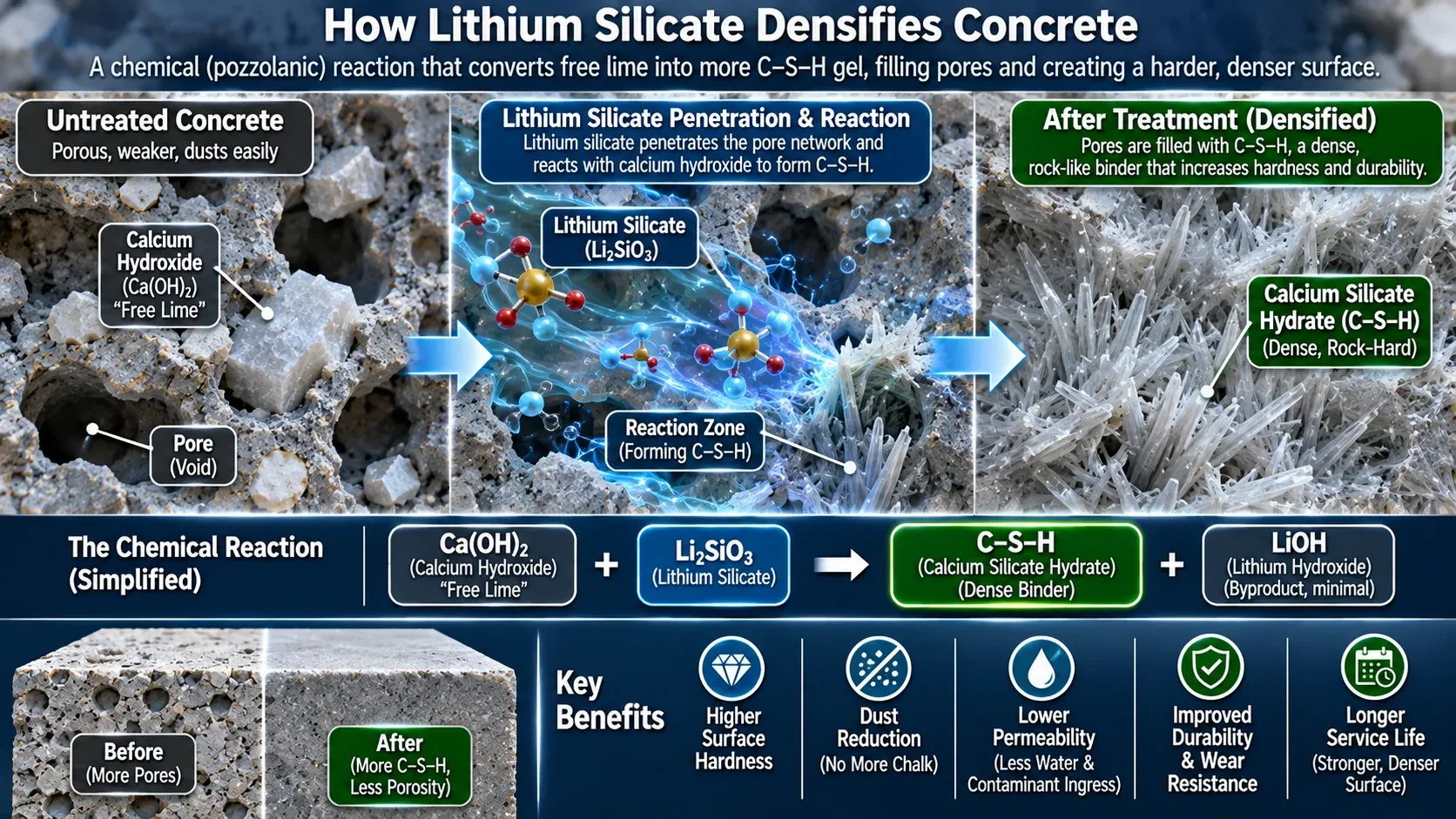
Chemical reaction engineering diagram on concrete microstructure, showing free calcium hydroxide (lime) pores being converted into dense rock-hard calcium silicate hydrate (C-S-H) crystalline needles by penetrating lithium silicate molecules, microscopic 3D molecular render aesthetic.
Concrete Surface Integrity Diagnostic: Chalking vs. Structural Spalling
Differentiate between superficial surface laitance and deep freeze-thaw aggregate damage.
Rubbing a coin across the slab creates a pale white powder; concrete underneath feels hard and solid
Pockmarks, exposed gravel aggregate, and flaking concrete chunks 1/4 inch deep
The Film-Forming Trap: Why Acrylic and Epoxy Paint Peel Off
When homeowners get tired of breathing concrete dust, their instinct is to purchase a five-gallon bucket of floor paint or budget garage floor epoxy from the local paint store. They roll two thick coats across the concrete, admire the glossy shine, and assume the dusting problem has been solved.
Film-forming coatings require a solid mechanical profile to achieve adhesion. When you roll paint over powdery laitance, the resin sticks to the microscopic dust crystals sitting on the surface, rather than anchoring into solid concrete aggregate.
Within three to six months, vehicular traffic stresses the paint. Hot summer tires soften the resin, foot traffic fractures the bond, and the paint lifts off the floor in large, unsightly sheets, exposing the exact same chalky mess underneath.
The Permanent Cure: How Lithium Silicate Turns Lime into Granite
Before applying a lithium silicate hardener, clean all loose debris and fill any deep fractures. Check my tutorial on how to fix cracks in a concrete garage floor before coating to ensure your repairs bond solidly with the hardened concrete substrate.
Permanent dustproofing requires chemical transformation rather than superficial paint films. You must introduce a penetrating chemical densifier that reacts with the weak minerals inside the slab.
When you spray a penetrating lithium silicate densifier onto raw concrete, the lithium ions carry silicate molecules deep into the microscopic capillary pores of the concrete. Once inside, the silicate reacts with soft calcium hydroxide (the free lime causing your dust) to synthesize Calcium Silicate Hydrate (C-S-H).
C-S-H represents the exact crystalline binder that gives hardened Portland cement its immense strength. The chemical reaction grows microscopic crystals inside every void, hardening the top quarter-inch of your slab and locking dust-causing lime into a permanent granite-like matrix.
Because lithium silicate penetrates the pores and chemically converts the concrete itself, there is no surface film to crack, peel, blister, or wear off under hot tires.
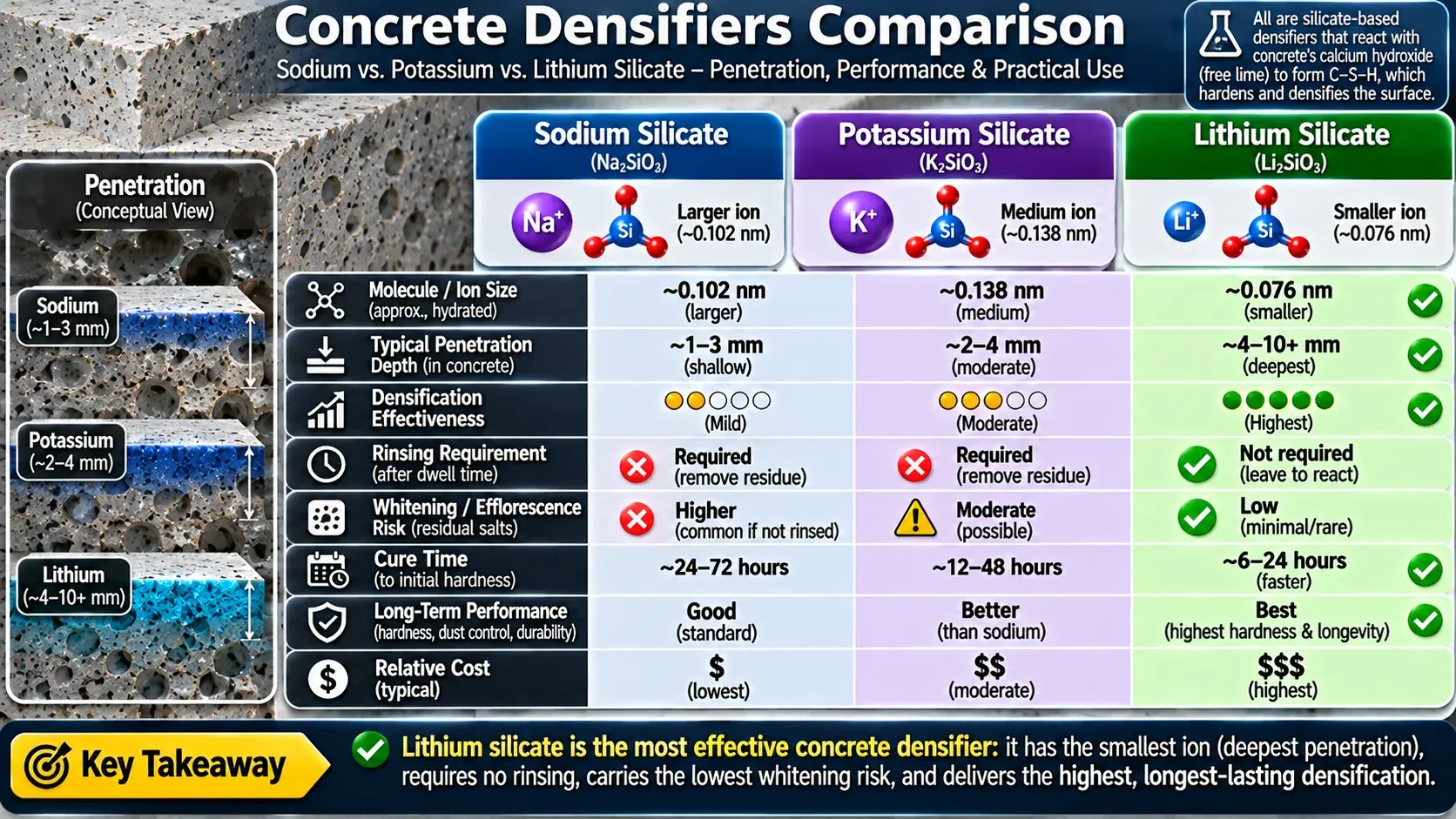
Comparative technical infographic table comparing Sodium vs Potassium vs Lithium concrete densifiers, metrics including molecule size penetration depth, rinsing requirements, and whitening risk, clean modern comparison layout with green checkmarks on lithium column.
Concrete Densifier Comparison: Traditional Sodium vs. Modern Lithium
Comparing chemical penetration depth, application complexity, and salt residue risks.
Traditional Sodium Silicate (Water Glass)
Rough agricultural barn slabs and coarse broom finishes
- Very low initial material purchase cost
- Leaves white crusty efflorescence that requires heavy scrubbing and neutralization
Modern Lithium Silicate (Penetrating)
Residential garage slabs, workshop floors, and smooth troweled bays
- One-step spray and wipe application with zero rinsing required
- Slightly higher initial upfront cost per container
The 3-Step DIY Application: Pump Sprayer and Microfiber Mop
Applying a lithium silicate densifier requires no heavy machinery, rental diamond grinders, or commercial floor scrubbers. You can treat a standard two-car garage slab in roughly two hours using basic household supplies.
The 3-Step DIY Lithium Densifier Application
Low-pressure sprayer and microfiber mop technique for permanent slab crystallization.
HEPA Vacuuming & Oil Spot De-greasing
45 minsRun fine-dust vacuum across entire bay to clear pore openings. Pull out embedded oil stains with clay poultice paste so silicate can penetrate bare concrete.
Garden Sprayer Flood Coat
30 minsPour lithium silicate into pump sprayer with brass fan tip. Spray continuously from back corner forward, keeping slab visibly wet for 20 minutes.
Microfiber Flat Mop Distribution & Cure
15 minsUse a wide commercial microfiber flat pad to push excess puddles evenly across the slab. Allow 24 hours of cure time before parking vehicles.
Slab surface hardened into water-resistant crystalline stone with zero chalking or white footprints forever.
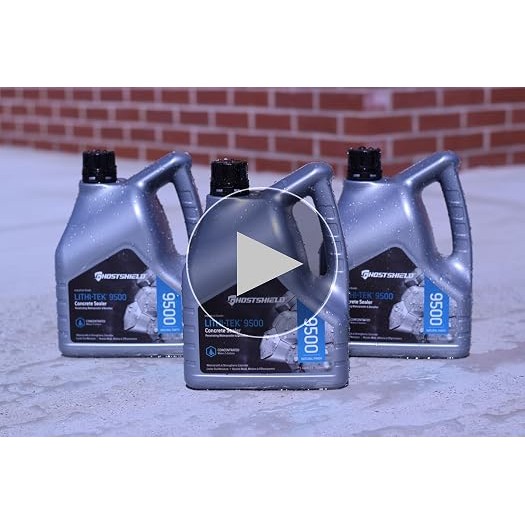
Ghostshield Lithi-Tek 4500 Concrete Densifier
Best For: Permanent dustproofing of smooth troweled slabs
Est. Price: $65 - $75
"The most effective, foolproof chemical hardener for stopping dusting on residential garage slabs without surface films."
- +Deeply penetrating lithium chemistry petrifies free lime into C-S-H crystals
- +Zero VOC formula produces no hazardous chemical fumes during application
- +One single gallon covers up to 500 square feet of residential slab
- -Does not alter appearance or provide a wet-look shine
- -Requires slab to be thoroughly dry and oil-free prior to spraying
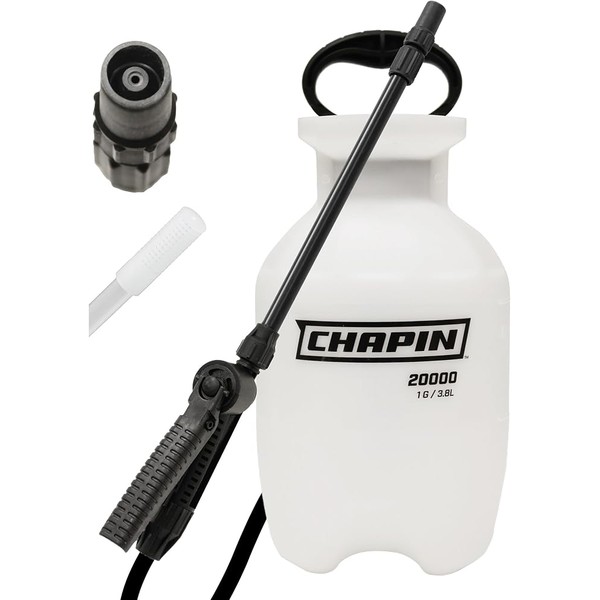
Chapin 20000 1-Gallon Lawn and Garden Pump Sprayer
Best For: Evenly applying liquid densifiers and sealers
Est. Price: $14 - $18
"A durable, inexpensive pump sprayer that applies liquid densifiers smoothly without spitting or clogging."
- +Adjustable cone-to-fan spray nozzle provides uniform chemical mist
- +Translucent poly tank allows continuous fluid level monitoring
- +Ergonomic pump handle pressurizes the chamber with minimal strokes
- -Plastic wand requires thorough warm-water flushing after chemical use
- -One-gallon capacity requires occasional refilling on two-car bays
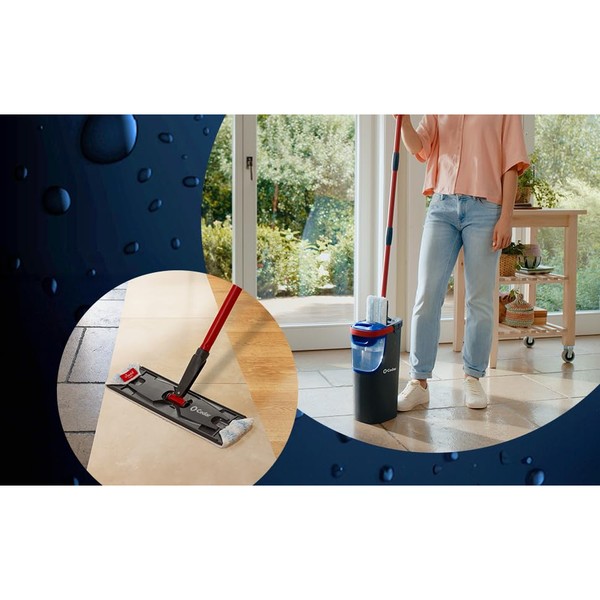
O-Cedar Commercial 18-Inch Microfiber Flat Mop
Best For: Distributing liquid sealers without puddling
Est. Price: $22 - $28
"The ideal tool for breaking surface tension and distributing penetrating liquid densifiers evenly across your slab."
- +18-inch wide mop head covers large floor surfaces quickly
- +Dense microfiber pad holds chemical without dripping or shedding lint
- +Machine-washable pad cleans up easily with warm water
- -Aluminum telescoping handle must be locked securely to prevent slipping
- -Requires gentle pushing pressure to avoid skipping over rough texture
Preparing Your Slab for Long-Term Protection
Before spraying a chemical densifier across your garage, ensure your slab is free of stubborn contaminants that block chemical penetration.
If your vehicle has leaked transmission fluid or motor oil, treat those deep saturated stains first with our step-by-step poultice guide on how to pull deep oil stains out of concrete.
If you also struggle with wet, slippery concrete floors on warm winter afternoons, review our diagnostic walkthrough on how to stop garage floor sweating in winter to resolve slab condensation before treating your surface.
Hank Miller
Hank is a master craftsman and DIY mechanic based in Ohio. He tests workshop equipment, garage floor coatings, and power tools under brutal, real-world workshop conditions, with zero paid brand sponsorships.